-1.jpg?width=48&height=48&name=55f40cc2763590699ea313bb5c9f08b5%20(chosen)-1.jpg)
Every revenue leader knows what it feels like when a deal starts to go cold.
The demo went great. The champion is excited. The proposal goes out - and then, silence. Somewhere between “proposal sent” and “deal signed,” the deal faded and visibility vanished.
It has nothing to do with price or product. It comes down to the process.
Over the last five years, SaaS buying cycles have exploded in complexity. Gartner reports the average B2B purchase now involves 11 stakeholders - each with their own tools, timelines, and requirements.
The result? More activity, less alignment.
Today’s sales paradox is clear: the very tools built for visibility have created fragmentation. CRMs capture internal motion, but not buyer reality. Email and Slack keep teams busy, but not connected. Forecasts are based on opinions, not engagement.
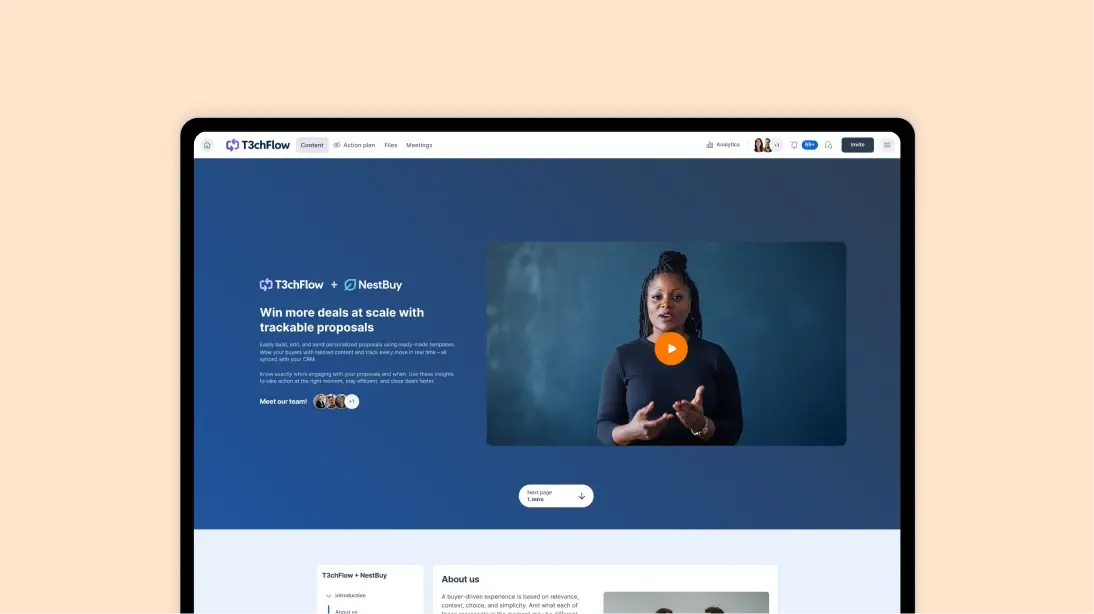
Digital Sales Rooms (DSRs) solve this. They bridge the gap and create a shared workspace where buyers and sellers finally operate from the same source of truth.
Skip the theory. Start a free trial and run your next deal through it.
The hidden cost of selling in the dark
SaaS companies spend millions on pipeline generation and still lose predictability downstream. The problem? Deal flow.
Once proposals leave the CRM, they usually vanish into inboxes. Your sales team can’t see who’s reviewing, when legal steps in, or whether procurement has even looked at it.
That lack of visibility has a measurable cost. According to Forrester, B2B sellers spend just 23% of their time in direct engagement with buyers - the rest is lost to admin work and internal coordination.
It’s common for a single enterprise deal to pass through 10 file versions, 4 internal approvals, and 3 buyer-side departments. Each delay leads to more uncertainty. And each handoff increases risk.
The modern buying process hasn’t become harder. It's just become invisible.
A Digital Sales Room restores that visibility. It’s where every stakeholder - seller, buyer, legal, finance - works from the same version of truth.
Instead of chasing files, everyone collaborates in one shared workspace that tracks who’s viewed what, when, and for how long. The rep regains control, the buyer regains clarity, and leadership regains confidence that what’s in the pipeline is real.
McKinsey found that top-performing B2B organizations are 35% more likely to use shared digital workspaces during late-stage sales - and those teams close deals 2x faster on average.
The Digital Sales Room benefits
One of the benefits of the Digital Sales Room is that it creates a live workspace around the deal itself. Every proposal, contract, and security document lives under one secure link, with full engagement tracking.
Sales teams can see every stakeholder involved, how long they’ve spent on each section, and where attention spikes or dips. Instead of guessing who’s engaged, they can prioritize based on data. Follow-ups become targeted, not hopeful.
Buyers no longer need to dig through threads or chase down outdated contracts. One of the main buyer experience benefits is that the workspace feels like an extension of the product - organized, branded, and built for collaboration.
Legal and procurement can comment directly in the DSR and champions can share internally without losing control of the narrative.
It’s win-win, and the difference becomes clear when you compare the traditional sales workflow with a Digital Sales Room–driven process.
|
Stage |
Traditional Workflow |
With Digital Sales Room |
|
Proposal Review |
Multiple PDFs, version confusion, long feedback loops |
One live workspace, shared comments, instant updates |
|
Stakeholder Alignment |
Separate email threads and late involvement |
All reviewers collaborate in real time |
|
Forecasting |
Based on rep sentiment |
Based on verified buyer engagement data |
|
Contract Execution |
Sequential approvals and delays |
Parallel review and e-signature flow |
|
Visibility |
Limited to internal CRM updates |
Full transparency across both sides of the deal |
With a DSR, deals move faster, forecasts get sharper, and every stakeholder stays aligned around a single shared source of truth. It’s not just theory, either.
Further reading: 5 best digital sales room software in 2026
How SalesScreen built predictable deal velocity with GetAccept
SalesScreen, a Norwegian sales performance software company, turned to GetAccept to bring structure and speed to their enterprise deal cycles.
Before using GetAccept, their sales organization faced a familiar challenge: deals slowed down after the proposal stage. Their CRM tracked activities, but once proposals were sent, visibility dropped. This led to delays that stretched deal cycles beyond forecasted timelines.
By implementing GetAccept’s Digital Sales Room, SalesScreen gave every stakeholder - from sales and customer success to legal - a single shared environment for collaboration.
Buyers accessed all relevant documents in one branded workspace, commented directly inside proposals, and signed contracts without leaving the platform.
The result is a more predictable, transparent sales motion - one where both parties clearly understand the current situation, the desired outcome, and exactly how SalesScreen will help them get there.
Within just one quarter of using GetAccept, SalesScreen saw:
- 100% increase in win rate: SalesScreen exceeded its annual OKR, doubling win rates from 13% to 26%, with the biggest gains in enterprise deals.
- 2× revenue growth: The team doubled quarterly revenue from Q2 to Q3 after switching from their previous provider to GetAccept.
- Smarter forecasting: Real-time buyer engagement data replaced guesswork, turning forecast meetings from assumption-driven to data-driven.
- Faster deal cycles: Proposal-to-close times shortened across complex enterprise opportunities.

With GetAccept, SalesScreen turned buyer engagement data into a competitive advantage, one measurable step at a time.
And they’re not alone. Across industries, revenue teams adopting Digital Sales Rooms are seeing the same transformation - faster cycles, stronger alignment, and far greater forecasting accuracy.
What's the measurable impact of a Digital Sales Room?
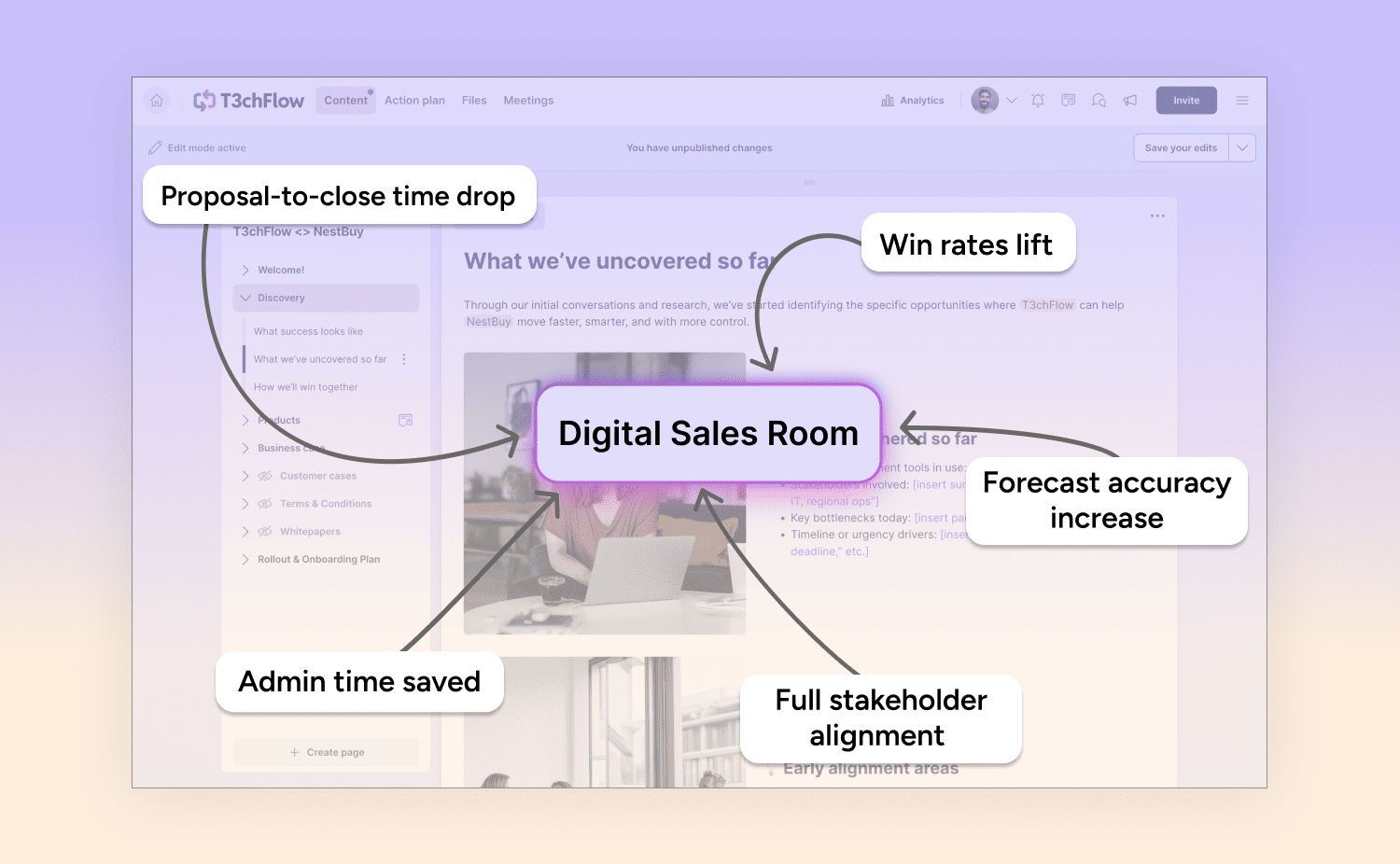
Across GetAccept’s customer base, the results tell a consistent ROI story. When revenue teams run deals through Digital Sales Rooms, measurable performance improvements follow:
|
Metric |
Typical SaaS Baseline |
With GetAccept Digital Sales Rooms |
|
Proposal-to-Close Time |
14–18 days average |
Reduced by up to 50 % |
|
Win Rate |
20–30 % (avg SaaS) |
Improved by 10–60 % (deal-type dependent) |
|
Forecast Accuracy |
60–65 % |
Increased to 80–85 % |
|
Admin Time per Proposal |
~1 hour |
Saved 45–55 minutes per proposal |
|
Stakeholder Alignment |
Often fragmented |
Unified, transparent collaboration |
The takeaway: DSRs don’t just make deals measurable. Every number represents fewer handoffs, cleaner collaboration, and a more predictable revenue engine.
Sales pipeline predictability you can scale
Every CRO and VP of Sales eventually faces the same problem: the pipeline looks full, but the number that matters (closed won) feels unpredictable.
CRMs weren’t built to fix that. They record what your team inputs, not what your buyer does.
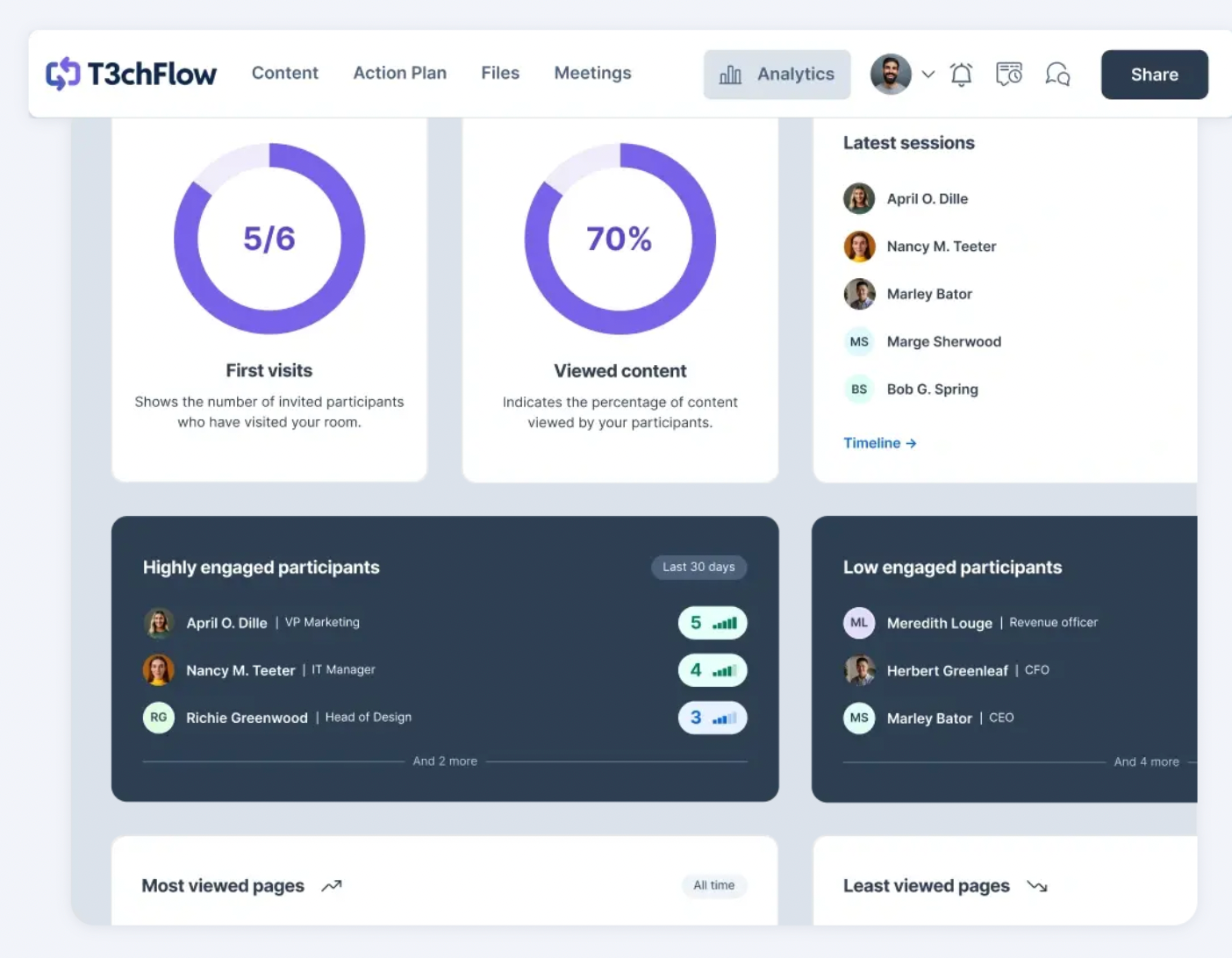
A Digital Sales Room closes that loop. It captures buyer-side behavior in real time and syncs it to the pipeline, transforming how leadership sees deal health.
When a rep says, “It’s going well,” a DSR shows whether that’s true. When engagement drops, the system surfaces it before the deal slips. When new stakeholders join, the data updates automatically.
That shift changes more than forecasting - it changes culture.
How?
- Reps stop relying on instinct and start relying on insight
- Managers coach based on real buyer behavior
- Leaders forecast with confidence backed by proof.
And for buyers, the experience improves too. A transparent, well-managed deal process shows reliability. It builds trust and it removes friction.
In a market where 75% of B2B buyers prefer self-guided, asynchronous purchasing, that confidence is the difference between interest and commitment.
When you can see what buyers are doing, you can help them move forward faster.
AI and the rise of intelligent deal rooms
GetAccept’s AI digital sales room capabilities turn engagement data into proactive guidance. With it, reps receive automatic summaries of buyer activity, suggested follow-up timing, and even recommended content based on where attention spikes.
You don't need to ask “What’s happening in this deal?”; GetAccept tells you.
We’re talking pattern recognition across hundreds of deals where you can identify what good looks like, detect at-risk accounts, and scale winning behavior.
Don’t worry, AI isn’t here to replace the rep. It’s to empower them. Combined with a DSR, it creates the kind of predictability every revenue organization needs to scale.
Where do Digital Sales Rooms fit in your revenue stack?
DSRs aren’t meant to replace your CRM, proposal software, or e-signature tools. They connect them into a unified system of action for your internal sales ops and the buyer’s decision process:
- CRM: Tracks pipeline stages and seller activity.
- Digital Sales Room: Captures real buyer engagement, comments, and collaboration.
- E-signature and contract tools: Finalize execution and compliance.
Together, these layers create a seamless, traceable workflow from first proposal to final signature - eliminating handoffs, strengthening compliance, and giving leadership a single source of truth across every deal.
As buyers take greater control of the purchasing process, transparency becomes a competitive advantage. Revenue teams that can see what’s happening, respond in real time, and guide stakeholders with clarity will close faster and forecast with greater confidence.
Digital Sales Rooms enable that visibility - bringing collaboration, accountability, and measurable progress into one shared space.
-1.jpg)