
If you're searching for Qwilr alternatives, you're probably hitting one of these walls:
- You're spending days, not minutes, building each proposal - and there's no AI doing the heavy lifting, so you're still manually drafting in ChatGPT or Claude and copying the output back in.
- Your CRM shows a proposal was sent, but nothing useful after that - engagement data doesn't flow back in a way you can actually report on or act on.
- You have no idea when a deal's gone quiet and guessing whether to follow up.
We evaluated tools across three core dimensions - speed to create and send, depth of AI capabilities, and quality of CRM integration - to help you choose the right candidate.
Try GetAccept free for 14 days
Qwilr alternatives at a glance
| Tool | Primary focus | Pricing |
| GetAccept | Automated Digital Sales Rooms building, CRM-synced selling, AI-drafted follow-up and proposals with built-in e-sign | Public pricing; starts at $25/user/month |
| PandaDoc | Strong document automation with CRM-connected workflows | Free plan; paid from $19/user/month |
| Better Proposals | Fast, affordable proposals with built-in e-signatures and payments | Starts at $13/user/month |
| Proposify | Proposal and contract management with CRM-connected workflows | $19/user/month |
| Dealhub.io | CPQ, CLM, and quote-to-revenue automation | Not publicly listed |
Why trust us?
We built GetAccept 10 years ago to solve a problem we saw playing out in B2B sales teams every day: proposals go out, and then nothing. No visibility into who read what, no way to engage the buying committee, no clear path from "proposal sent" to "deal closed."
That context shapes how we evaluate tools. We're looking at whether a platform helps reps spend less time on admin and more time closing. The research in this article draws from vendor documentation, public pricing pages, and verified user reviews on G2. Where review data wasn't available, we say so directly rather than filling the gap with assumptions.
What is Qwilr?
Qwilr is a proposal software platform that lets sales teams create web-based, interactive documents instead of static PDFs.
The platform's core appeal is design quality. Proposals built in Qwilr look modern and branded, with interactive pricing tables, embedded videos, and accept/decline buttons built in. It integrates with CRMs including HubSpot and Salesforce, and offers basic engagement tracking so reps know when a proposal has been opened.
Qwilr's plans start at $35 per user per month billed annually, with Growth at $55 and Scale at $75. AI, conditional content and Salesforce integration sit on the Scale plan.
Why teams consider Qwilr alternatives?
Teams consider Qwilr alternatives mainly over slow proposal builds, CRM data that doesn't flow back, and no visibility into stalled deals.
1. Building each proposal still takes too long.
Qwilr has no native AI to speak of - you're still drafting content elsewhere (ChatGPT, Claude) and pasting it in. What should take minutes after a call takes days.
2. Engagement data doesn't make it back to your CRM in a useful way.
You can pull deal data into a proposal, but what happens after - who opened it, what they did - doesn't flow back into your CRM in a way you can actually report on or act on.
3. You're often guessing why a deal's gone quiet.
Qwilr's engagement tracking shows when a proposal has been opened. It does not show which stakeholders are engaged or when a deal starts to go cold, so follow-up timing becomes a guess.
A proposal sent is not the same as a deal moving. Without a clear signal that a room's gone cold, follow-up becomes a "just checking in" email instead of a well-timed nudge.
A proposal sent is not the same as a deal moving. Without a clear signal that a room's gone cold, follow-up becomes a "just checking in" email instead of a well-timed nudge.
A proposal sent is not the same as a deal moving. Without a clear signal that a room's gone cold, follow-up becomes a "just checking in" email instead of a well-timed nudge.
We evaluated tools across three dimensions — speed to create and send, depth of AI, and quality of CRM integration — to give you a clear picture of what's actually available in 2026.
1. GetAccept – the best Qwilr alternative for B2B sales teams
Best for: B2B sales teams that want to create and send professional proposals faster, track buyer engagement, and manage everything through to signature without leaving their CRM.
GetAccept is a Digital Sales Room platform that helps sales teams create, personalize, and send professional proposals in minutes.
GetAccept makes it easy to produce polished, on-brand proposals. Reps can work from reusable templates, automatically populate content and pricing from their CRM, and add personal touches like video to make each proposal more engaging.
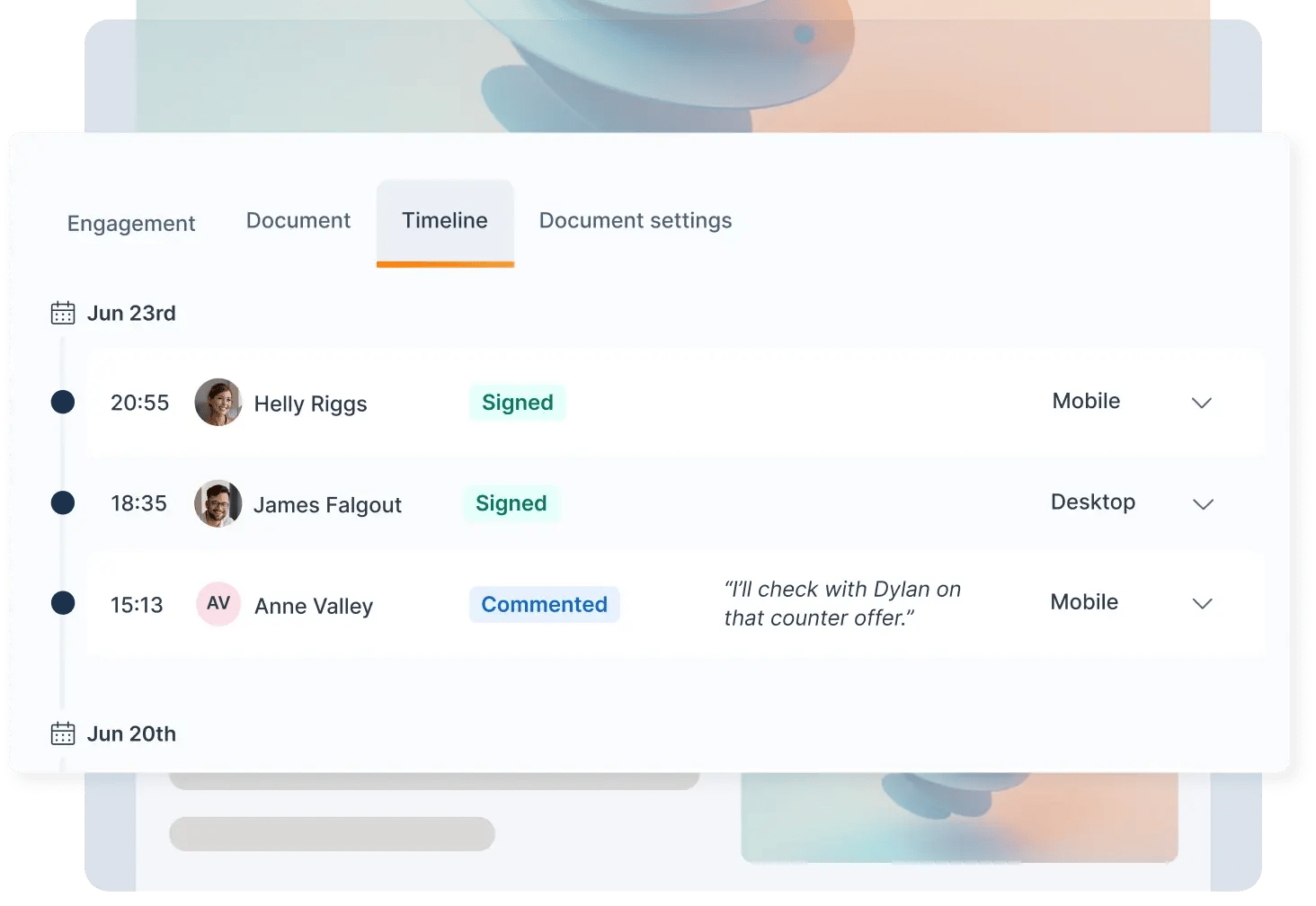
Once a proposal is sent, GetAccept shows who's opened it, what they're reading, and when they're engaging, so reps can follow up at the right moment. Buyers can ask questions, collaborate, and sign electronically, all in one place. And when a deal involves multiple stakeholders or a longer buying process, GetAccept's Digital Sales Rooms give everyone a shared space for content, conversations, and next steps.
For reps, that means less time preparing proposals and chasing responses. For managers, it means better visibility into buyer activity and deal progress, with engagement insights connected to the CRM.
Use cases
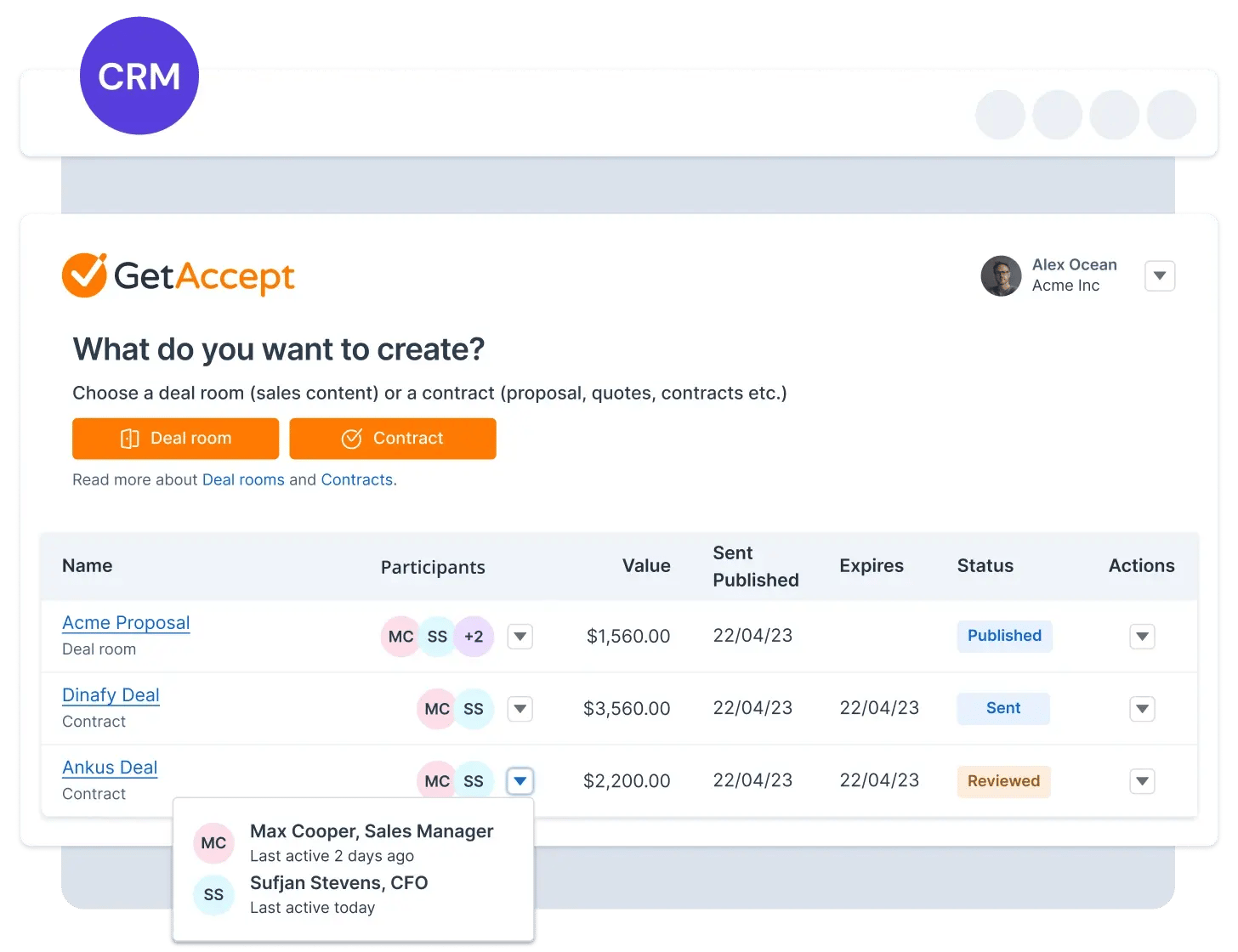
- Creating personalized Digital Sales Rooms in minutes for every deal, with proposals, demos, pricing, and contracts in one place
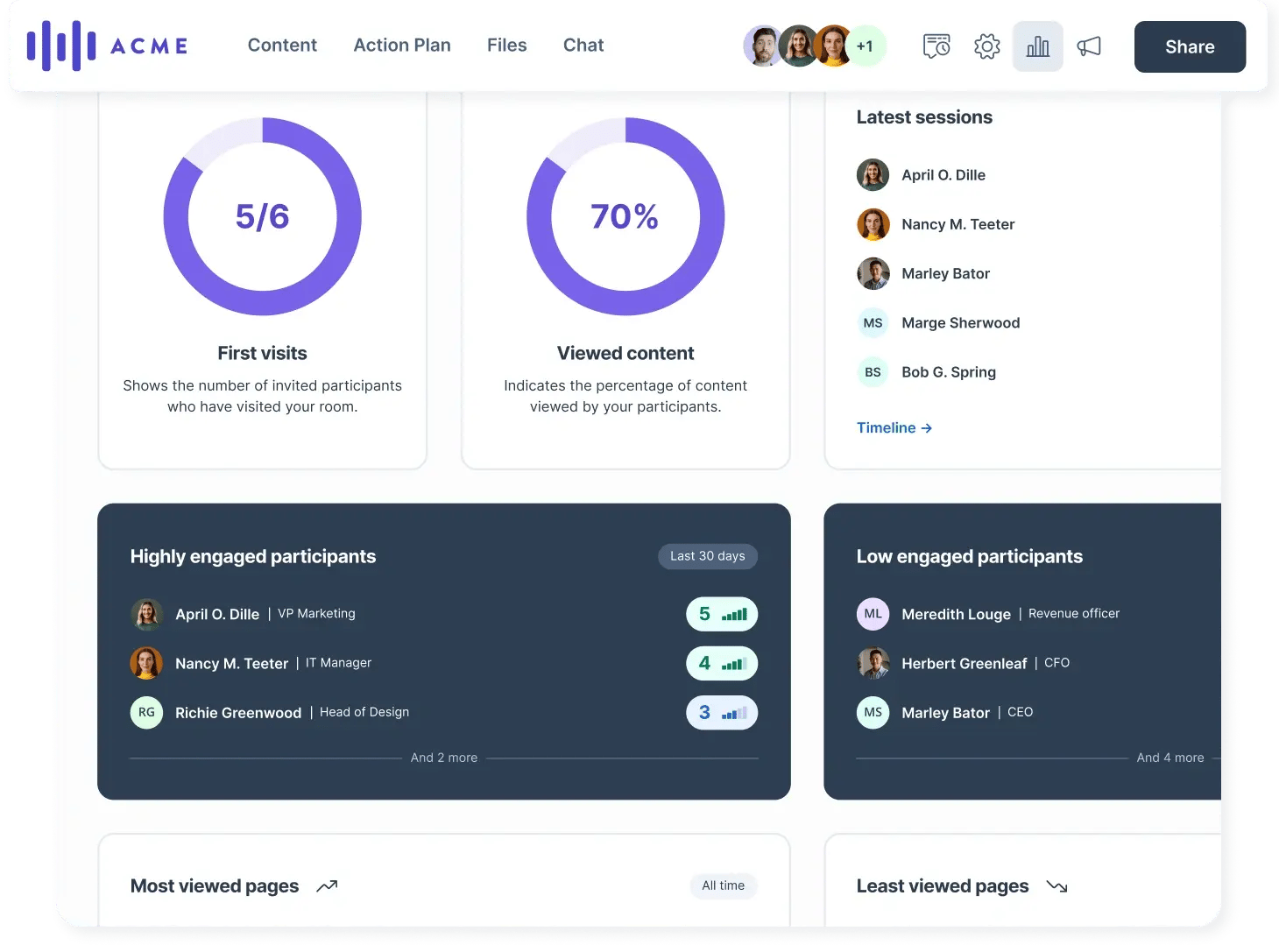
- Tracking stakeholder-level engagement to know who's involved in the decision and what they care about
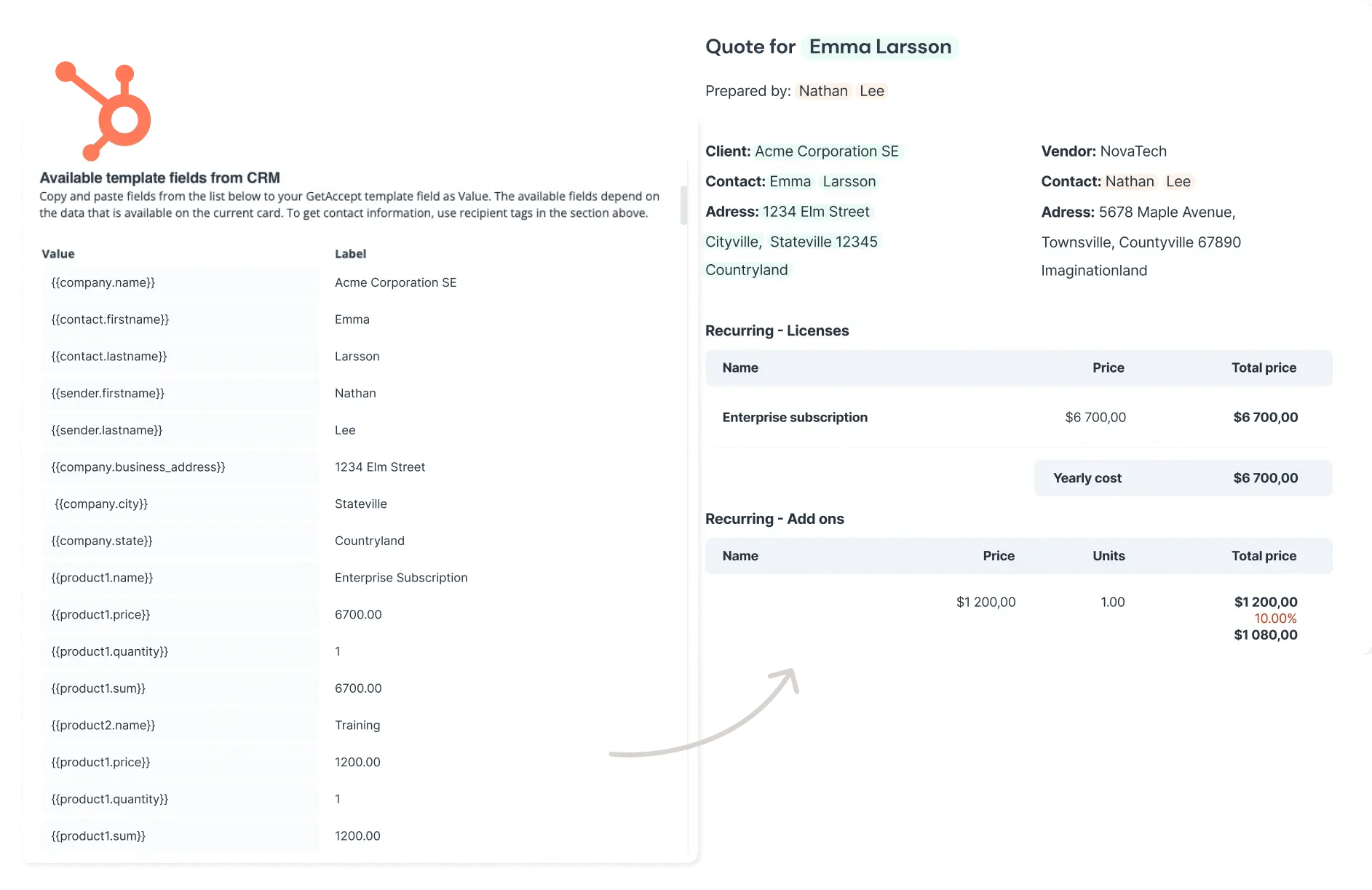
- Generating fast AI-powered proposals that pull context from CRM data, meeting transcripts, and deal history
- Giving sales managers real buyer engagement data to coach reps and forecast accurately
Key features
- Digital Sales Rooms that consolidate proposals, demos, case studies, pricing, security docs, contracts, and Mutual Action Plans into a single buyer-facing link
- Stakeholder-level engagement tracking showing which person viewed which content, how long they spent on each section, and when they're most active
- Contextual AI that draws on CRM data, meeting transcripts (Gong/Glyphic), room content, knowledge bases, and uploaded files to generate truly personalized proposals - not just generic drafts
- Built-in e-signatures with signing order, role transfer, and automatic sync to Salesforce and HubSpot
- Native, bidirectional CRM integrations with Salesforce, HubSpot, Dynamics, Pipedrive, and SuperOffice - buyer engagement logs automatically, no manual data entry
- Mutual Action Plans with milestones, ownership, and CRM sync to keep deals moving forward on both sides
- Pricing tables and CPQ rules that sync automatically with CRM data for accurate, fast quoting
What GetAccept offers over Qwilr
- Deal-level AI, not document-level AI: GetAccept's AI understands the current state of the whole deal, not just the content in a single proposal. It pulls from CRM records, call transcripts, and room activity to create personalized experiences at scale. Qwilr's AI is focused on content generation within documents.
- Real signal when a deal goes quiet, not just "opened": GetAccept shows you what happens after you hit send - who's engaged, what they're spending time on, and when a room goes cold. Instead of guessing why a prospect stopped responding, you follow up based on actual behavior.
- End-to-end deal management in one platform: From the first discovery deck to the signed contract, everything lives in GetAccept. Qwilr is built around the proposal document; it doesn't cover the full deal lifecycle.
- CRM integration deep enough to trust the data in it: Buyer engagement, contracts, and activity sync automatically to HubSpot and Salesforce -without manual logging or guessing whether a proposal even has a CRM record. (Salesforce integration is currently our deepest; HubSpot is closing the gap fast.)
Pricing
- E-Sign: $25/user/month (billed annually) - unlimited e-signatures, in-browser editing, engagement tracking, automated reminders, and templates
- Professional: $49/user/month (billed annually) - everything in E-Sign plus Digital Sales Rooms, advanced branding, full template editor, pricing tables, product library, and premium CRM integrations
- Enterprise: Custom pricing - contract management, robust CPQ rules, SSO, advanced integrations, HR and payment integrations, and API access
Try GetAccept free for 14 days
Mini case study: ScaleWise
ScaleWise, a UK-based GTM advisory firm, used to stitch proposals together from separate PDFs, decks, and terms documents, and had zero visibility once a proposal landed in a prospect's inbox.
After switching to GetAccept's Deal Rooms and Contract Rooms, co-founder Gavin Summer went from spending 30-60 minutes building each proposal to under 5. Proposal-to-close rate jumped 51%, and the team now saves 16 hours a month on proposal creation.
 Read the full ScaleWise case study →
2. Better Proposals
Primary focus: Affordable proposal creation with built-in e-signatures and payment collection.
Better Proposals is a proposal tool that combines proposal creation, legally binding e-signatures and payment collection in a single workflow, built for sales teams, agencies and service businesses.
Key features
- Interactive pricing tables that let buyers configure their own quotes within the proposal
- Legally binding digital signatures built directly into the proposal flow - no external e-sign tool required
- Payment integrations to collect payment at the point of acceptance, reducing the gap between signature and revenue
- Content library for storing and reusing approved proposal blocks, messaging, and assets
- Engagement notifications to alert reps when a proposal has been opened or interacted with
Pros
- Public pricing is transparent and accessible, with a low starting price that makes it easy to evaluate without a sales call
- The combination of proposals, e-signatures, and payment collection in one tool reduces friction for teams closing smaller, faster deals
- Positioned squarely around speed - the product is designed to get proposals out quickly, which fits high-velocity sales motions
- A content library helps teams maintain consistency across proposals without starting from scratch each time
Cons
- Available research does not confirm native CRM integrations, so fit for CRM-centric sales teams is unclear - verify this directly with the vendor before committing
- AI proposal generation capabilities are not documented in available sources, making it a weaker choice for teams prioritizing AI-assisted content creation
- The tool appears optimized for simpler, faster deal cycles - teams managing complex, multi-stakeholder B2B deals may find it limiting
Pricing
- Starter: $13/user/month (billed annually), or $19/user/month billed monthly
- A free trial is available; additional tiers (including Premium) are listed on the vendor's pricing page
3. Proposify
Primary focus: Structured proposal creation with interactive quoting, CRM integrations, and approval workflows.
Proposify is a proposal and contract management platform built for sales teams that need more structure and process control than a basic document builder provides. Where some tools prioritize design flexibility, Proposify leans into workflow - CRM-connected proposals, approval routing, and document automation that helps teams standardize how deals get closed.
Key features
- CRM integrations on the Team plan, including HubSpot and Pipedrive, to connect proposal workflows directly to your sales pipeline
- Unlimited document sends and custom fields for personalizing proposals at volume without manual rework
- Advanced approval workflows and conditional routing on the Business plan for organizations that need controlled review before proposals go out
- Unlimited e-signatures on the Basic plan, so teams can close deals without hitting signing limits
- Multiple workspaces and SSO on the Business plan for larger teams managing proposals across divisions or regions
Pros
- Public pricing makes it easy to compare plans and estimate total cost without a demo requirement at the entry level
- The Team plan includes CRM integrations and automation, which is valuable for sales teams that want proposals connected to their pipeline data
- Higher-tier plans offer API access, SSO, and multiple workspaces - features that matter for scaling teams with more complex requirements
Cons
- The Business plan starts at $3,900/year with a 10-user minimum, which is a significant jump in cost for smaller teams that need advanced features
- API access and SSO are locked to the highest tier, meaning teams that need deeper integrations have to pay for the full Business plan to get there
- No confirmed free plan in available sources - teams looking to test before committing may need to rely on a trial period
Pricing
- Basic: $19/user/month (billed annually), or $29/month billed monthly
- Team: $41/user/month (billed annually), or $49/month billed quarterly
- Business: Starts at $3,900/year, typically with a minimum of 10 users
4. PandaDoc
Primary focus: Document automation for proposals, quotes, and contracts, with CRM integrations designed to connect document workflows with existing sales processes.
PandaDoc has been built around helping businesses manage the document lifecycle digitally, from initial creation through to completion. Along with document creation, it brings e-signatures, payments, and tracking into a single workspace.
Key features
- Drag-and-drop document editor with pre-built templates for fast proposal and quote creation without starting from scratch
- Pricing tables and CPQ capabilities for structured quoting that can be configured to match different deal types
- CRM integrations with Salesforce and HubSpot to connect documents with pipeline data and reduce manual data entry
- Approval workflows to route documents for internal review before they go to buyers
- Content library for storing and reusing approved sales assets, messaging, and legal language
- Built-in e-signatures for closing deals directly within the document, without moving to a separate signing tool
Pros
- The free plan includes electronic signatures and document uploads, making it accessible for teams that want to test the tool before committing to a paid tier
- Built-in quoting, pricing tables, and CPQ capabilities make it a broader alternative to pure proposal tools
- Approval workflows help larger teams maintain quality control without slowing down the entire proposal process
Cons
- PandaDoc is primarily a document platform - it doesn't offer Digital Sales Rooms, stakeholder-level engagement tracking, or Mutual Action Plans for managing the full buying committee experience
- Advanced workflow and integration capabilities are gated to higher tiers, which may push smaller teams into plans that exceed their budget
Pricing
- Free: $0 - electronic signatures, document uploads, up to 60 documents per year
- Starter: $19/user/month (billed annually), or $35/month billed monthly
- Business: $49/user/month (billed annually), or $65/month billed monthly
- Enterprise: Custom pricing - contact the vendor for a quote
5. DealHub.io
Primary focus: CRM-connected CPQ and CLM workflows, bringing complex quoting, pricing, approval automation, and contract management together within a broader quote-to-revenue platform.
DealHub.io takes a different angle than most tools on this list. Rather than starting with proposals and adding quoting as a feature, DealHub is built from the ground up as a quote-to-revenue platform - combining Configure, Price, Quote (CPQ), contract lifecycle management (CLM), and approval automation in a single system. It's aimed squarely at mid-market and enterprise revenue teams where pricing complexity, deal desk involvement, and approval chains are everyday realities.
Key features
- CPQ capabilities to generate accurate quotes faster, even for complex product and pricing structures
- Automated approval workflows to reduce manual deal desk steps and accelerate quote-to-cash timelines
- Contract Lifecycle Management (CLM) integrated into the same platform as quoting, reducing handoff friction between sales and legal
- CRM-connected workflows designed to tie quoting and contract activity back to your sales pipeline
Pros
- Combining CPQ, CLM, and quote-to-revenue workflows in one system is a meaningful advantage for teams that currently manage these processes across separate tools
- Approval automation reduces the manual coordination that slows down deals when pricing exceptions or legal review are involved
- Positioned for enterprise sales operations where pricing complexity and governance requirements go beyond what proposal tools can handle
Cons
- Pricing is not publicly listed, which makes it difficult to evaluate fit without going through a sales process - a friction point for teams doing early-stage research
- No G2 review evidence was available in the research for this article, so reviewer-validated strengths and weaknesses cannot be confirmed here
- The platform's depth in CPQ and CLM may be more than smaller teams need - it's a heavier implementation than a proposal-first tool
Pricing
Pricing is not publicly listed - contact the vendor for a quote.
Choosing the right Qwilr alternative
GetAccept is the best Qwilr alternative for B2B sales teams that need speed, AI and CRM integration.
- If your biggest problem is deal visibility after the proposal goes out - you need to know who's reading what, which stakeholders are involved, and when to follow up - GetAccept is built for exactly this. No other tool on this list gives you stakeholder-level engagement data tied to a full Digital Sales Room experience.
- If you need fast, affordable proposals with e-signatures and payment collection and your deals are relatively straightforward, Better Proposals is worth a look. It's the most accessible option on price and setup time.
- If you need CRM-connected proposals with approval workflows and you're managing a team that needs more process control, Proposify is a solid mid-market choice - especially if HubSpot or Pipedrive is your CRM of record.
- If document volume is your challenge - you're producing a lot of proposals, quotes, and contracts and need automation to keep up - PandaDoc's document automation depth and free starting tier make it a practical option.
- If pricing complexity and deal desk involvement are your daily reality, and you need CPQ and CLM in one system, DealHub.io is the most purpose-built option for that use case.