
What is CPQ software?
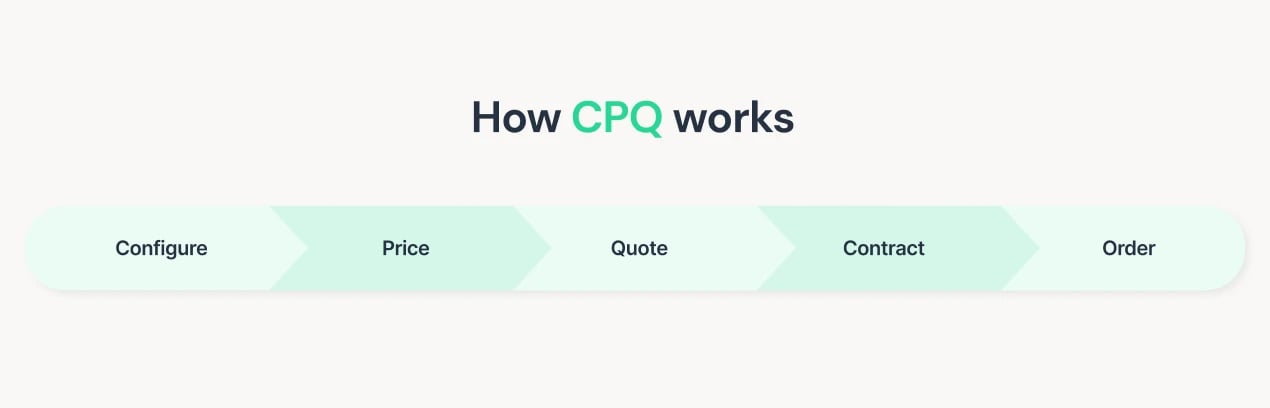
CPQ stands for Configure-Price-Quote: software that helps reps choose the right products, price them correctly and turn them into a professional quote. It’s built for teams selling products with many options, bundles or price points.
A quote or proposal is one of the first ‘bespoke’ documents that your prospects will get from you. It’s the perfect chance to make a lasting impression on your potential customers.
The challenge is, though, that if you’re not careful, your well-intentioned salespeople could make any number of costly mistakes, including:
- Inaccurate pricing
- Typos and grammatical errors
- Including irrelevant or outdated information
- Straying off-brand in their approach
- Wasting too much time producing the proposal and losing the sale
CPQ software is designed to help sales organizations mitigate these risks and ultimately close more sales by producing consistent quotes and proposals that make a lasting impression every time.
It does this by offering users the ability to:
- Centralize pricing, allowing for global updates and greater consistency
- Avoid typos and errors through pre-written product descriptions
- Use a repository of product information so proposals are always up to date
- Reuse pre-prepared images and wording to stay on-brand every time
- Dramatically cut quote preparation time to get ahead of the competition
How is CPQ different from a CRM or ERP?
A CRM tracks customers and deals, CPQ turns a deal into a priced quote and an enterprise resource planning (ERP) system handles orders and billing.
- CRM: stores customer records, contacts and deal stages, so everyone can see who is buying and where each deal stands.
- CPQ: applies your product rules and pricing logic to build an accurate quote, ready to send to the buyer.
- ERP: manages internal operations, from procurement and accounting to supply chain monitoring, and often links to CPQ.
In practice, these systems work best when they’re connected. Quotes can be built inside or alongside your CRM, saving reps from repeatedly entering the same customer and product details.
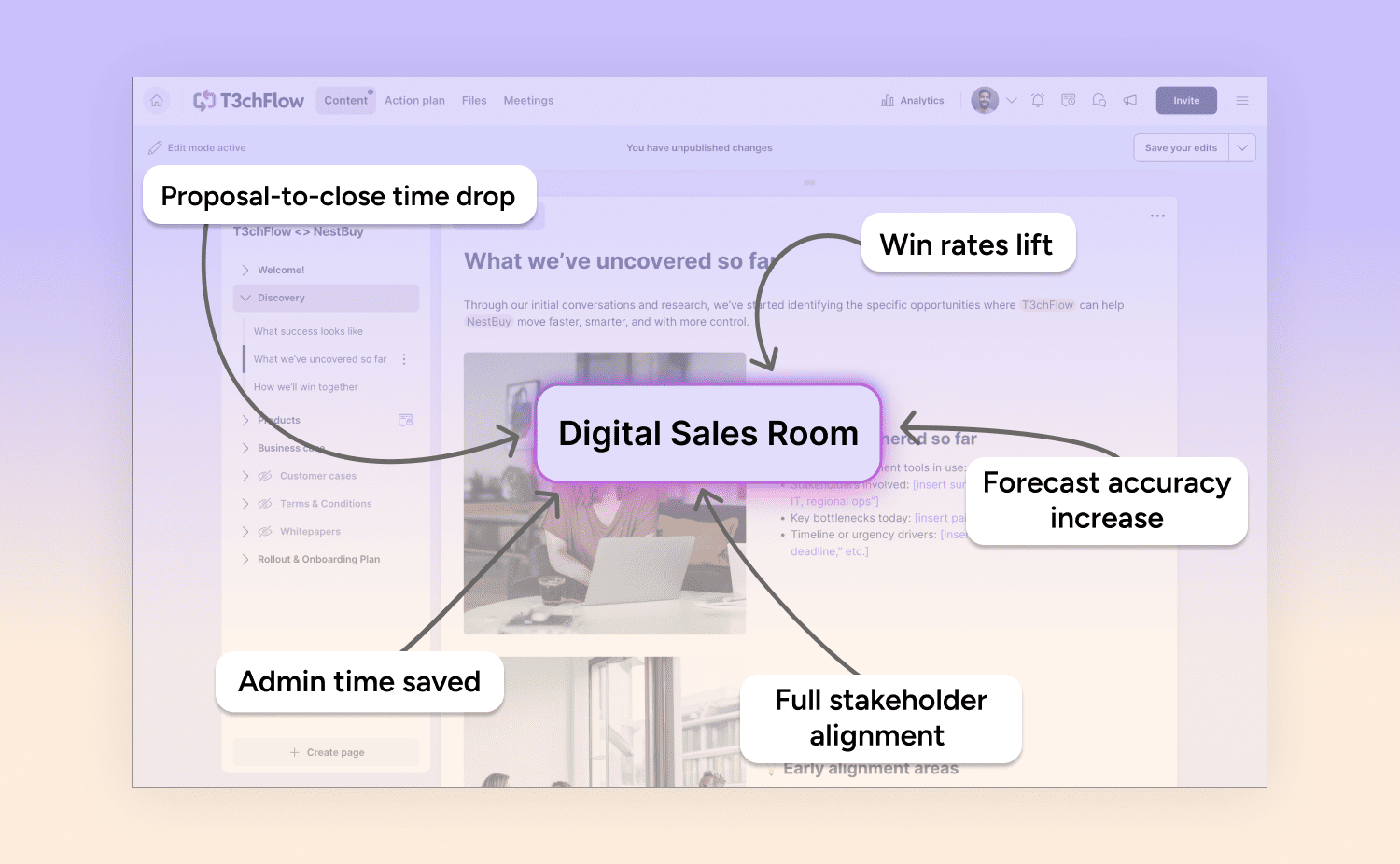
CPQ might come as a CRM add-on or as part of a connected sales platform, such as GetAccept’s Digital Sales Room. Either way, the aim is to keep the process moving without your team having to juggle information between systems.
Key features of CPQ software
At its core, CPQ software is designed to help you manage the configuration, pricing, and quoting processes of sales proposals (hence the acronym).
So, it’ll come as no surprise that configure, price, and quote features are the minimum you should be looking out for when you choose CPQ software.
Configure
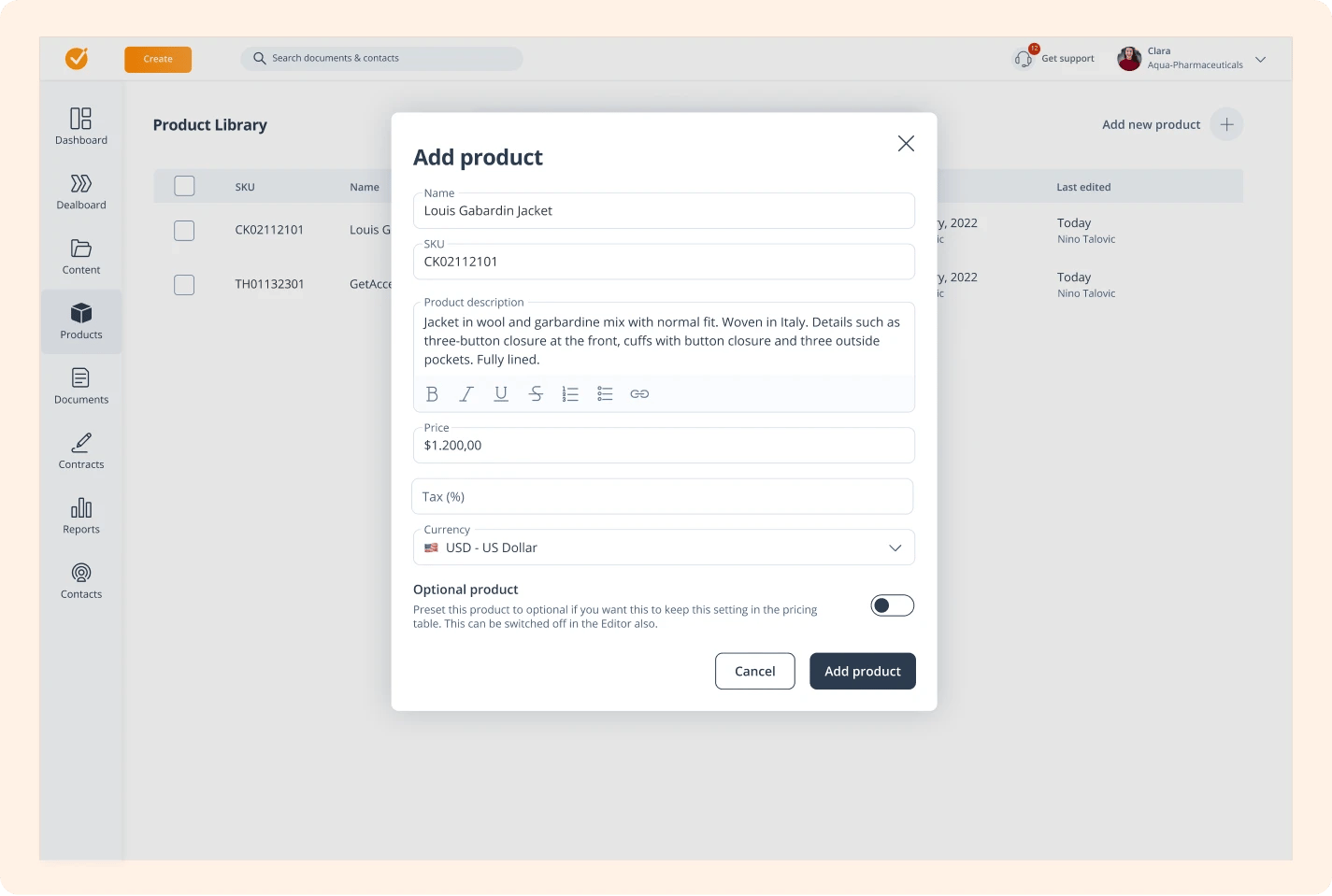
The first component will be a product library or catalog to configure your products and services.
Without a CPQ, most sales teams use a spreadsheet that lists all their products and services, including product descriptions, product numbers, prices, etc.
When engaged in putting together a proposal for a potential customer, a salesperson would copy-paste the information from the spreadsheet into their manually created pricing table to create a solution or a package they want to offer.
CPQ acts as guided selling, helping a salesperson select the products/services from a product library to create customized solutions for buyers.
Price
Price is the step where CPQ applies your pricing rules automatically, including list prices, discounts, volume breaks and margin targets.
The challenge, though, is that every company has its own pricing strategy, which any number of factors and variables can impact.
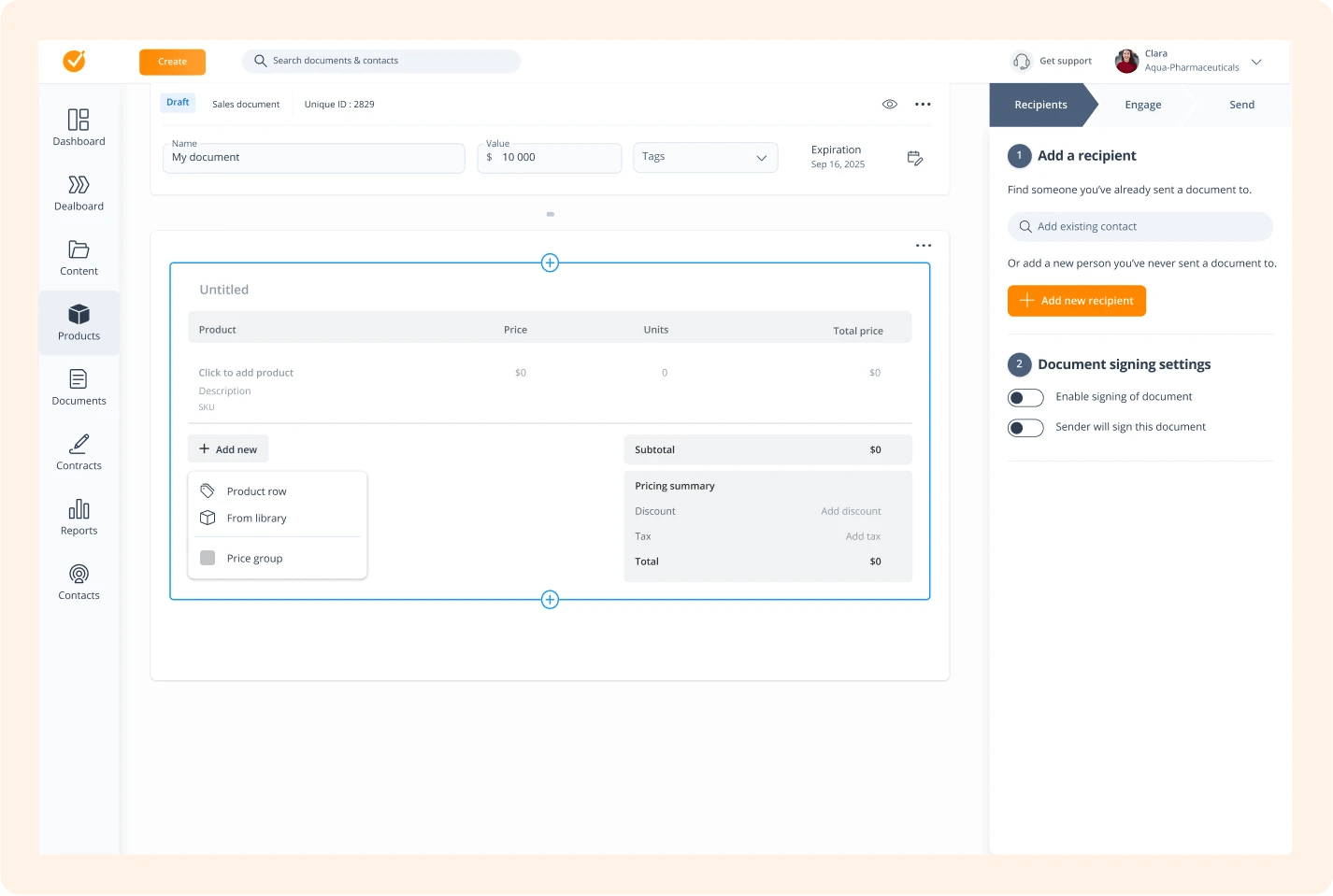
A CPQ tool will automatically calculate pricing based on the different products and services added to the proposal, as well as considering any discounts or expenses (like VAT) added to the mix.
For busy sales reps, this is a huge time-saver.
Meanwhile, for highly customized solutions, it becomes a useful way of avoiding potentially costly calculation errors.
Quote
In the Quote step, CPQ turns the chosen products and prices into an accurate, professional quote ready to send.
This quote will be based on all the information about products, quantities, discounts, taxes and more that your sales rep has selected during the configuration and pricing stages of the process.
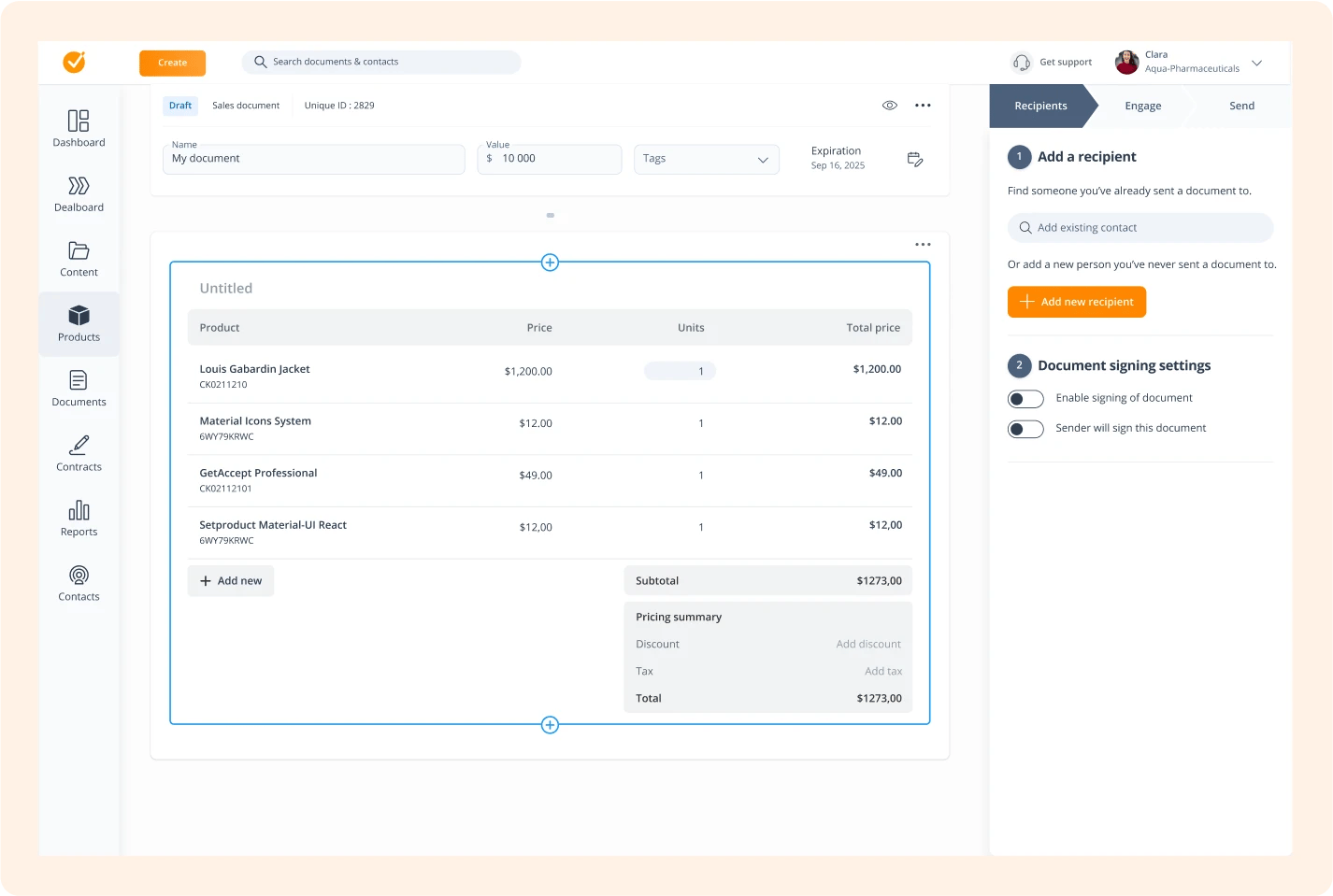
Not sure exactly what your prospect needs yet? Some CPQ tools also allow buyers to receive the business proposal and fill in order quantities themselves. The CPQ software will then automatically calculate the final price.
What happens after the quote is sent?
After a quote is sent, the buyer usually has to open it, agree to it and sign it before it goes back to the CRM.
- Send: reps share the quote by email, a link or a shared buyer space.
- Follow up: tracking shows who opened the quote, so reps know when to reach out.
- Revise: if the price moves, the quote goes back through approval before the buyer sees the new version.
- Sign: the buyer agrees to the final quote with an e-signature.
- Sync: the signed quote moves into orders and invoicing, the next steps in the quote-to-cash process.
GetAccept shows reps which buyers open a quote and for how long, then collects e-signatures and syncs the signed quote to the CRM.
Additional features you might expect to see in CPQ software
Integrations
No software tool should work in isolation. CPQ connects to your CRM, where deals and product data live, and to the ERP or billing system that takes over after signature. This is important to get right, otherwise, you will end up with data silos that provide different teams with inaccurate or out-of-date information. The best CPQ software will have integration capabilities to make sure all your data stays in sync across the entire customer journey.
Renewal management
Better CPQ tools include a feature for renewal quotes that help lower churn among existing customers.
These situations also need more careful consideration around advanced pricing conditions – to cover account-based pricing and loyalty discounts as well as upsell/cross-sell opportunities.
Approval workflows
One of the benefits of having a configure, price, quote solution is the control it gives to sales leaders and sales operations managers in the sales cycle. Gone are the days when account executives offered crazy discounts. A CPQ tool will not only have limits on discounts, but some of them will have approval workflows to get sales managers to sign off on a discount before the quote can be sent to a customer.
Guided selling
To really make life easier for sales reps, some solutions offer a guided selling feature.
In short, it will recommend products and services to sellers as they start adding from the product library. These recommendations are based on the first initial products they select and on historical data.
The other huge plus point of guided selling is that it is smart enough to recognize when account execs have inadvertently selected incompatible products in one solution, alerting them to this before the proposal is sent.
Understanding your CPQ use case
The features that matter most depend on your use case.
Whichever way you use CPQ software, it’s designed to create efficiency in your sales process by automating custom quote generation.
However, not all sales processes are made equally – some are way more complex than others.
If you have a large sales team or a high volume of proposals to produce, but your product catalog is relatively small, then you should focus on an easy-to-use solution that integrates well with your CRM.
On the flip side, if you have a much larger product catalog with countless SKUs to manage, you should also consider more advanced features like approval workflows and complex pricing calculators.
Once you’ve mapped your use case (simple quoting vs. complex SKUs and approvals), it can help to sanity-check your shortlist using a neutral resource like G2’s CPQ software insights, which breaks down common capabilities and what users typically value.
To compare the main tools side by side, see our guide to the best CPQ software.
Why you should use CPQ
Three reasons come up most often: CPQ saves time, cuts quoting errors and enables buyers to buy.Save time
CPQ software reduces the time your team spends on admin tasks like proposal creation or custom pricing.
The average seller spends 40% of their time actively selling, so every minute counts [Salesforce, 2026].
Buying back their time like this, through the use of CPQ technology, means they’re now free to focus more of their efforts on what they do best – prospecting and closing deals.
Generate error-free quotes & proposals
CPQ software cuts quoting errors by building each quote from approved products, prices and discounts.
Typos, miscalculations, incorrect currency, unapproved discounts… The list of potential mistakes from a manually-created quote is, unfortunately, quite large and can have a big impact on the annual contract value (ACV) or even closing the deal itself.
Create a professional buying experience
CPQ software helps every proposal arrive polished and consistent, whoever sends it.
GetAccept’s CPQ page reports a 13% reduction in quote revisions.
Clunky price tables, wrong product names, outdated prices, inconsistent formatting – these basic errors erode trust and make your company look amateur.
Couple this with a potential lack of consistency as customers get a different experience depending on who they’re dealing with – and it all creates a less-than-positive impression.
To help avoid all these potential pitfalls, CPQ software simplifies the process to help make your sales teams look more professional throughout the buyer's journey.
How GetAccept’s CPQ software can help you
GetAccept’s CPQ helps sales teams send professional proposals with accurate quotes and pricing. In a few clicks, reps send tailored pricing tables that move deals closer to a signature. CPQ is included in the Enterprise plan and available as an add-on on Professional.
Our Digital Sales Room platform has everything you need to close deals more efficiently.
Who is CPQ for?
CPQ software is a fantastic tool for any organization whose sales teams regularly deal with long, complex, enterprise-level B2B sales.
This is because these kinds of sales typically tend to be more complex, higher value, and incredibly time-consuming – while still requiring careful management.
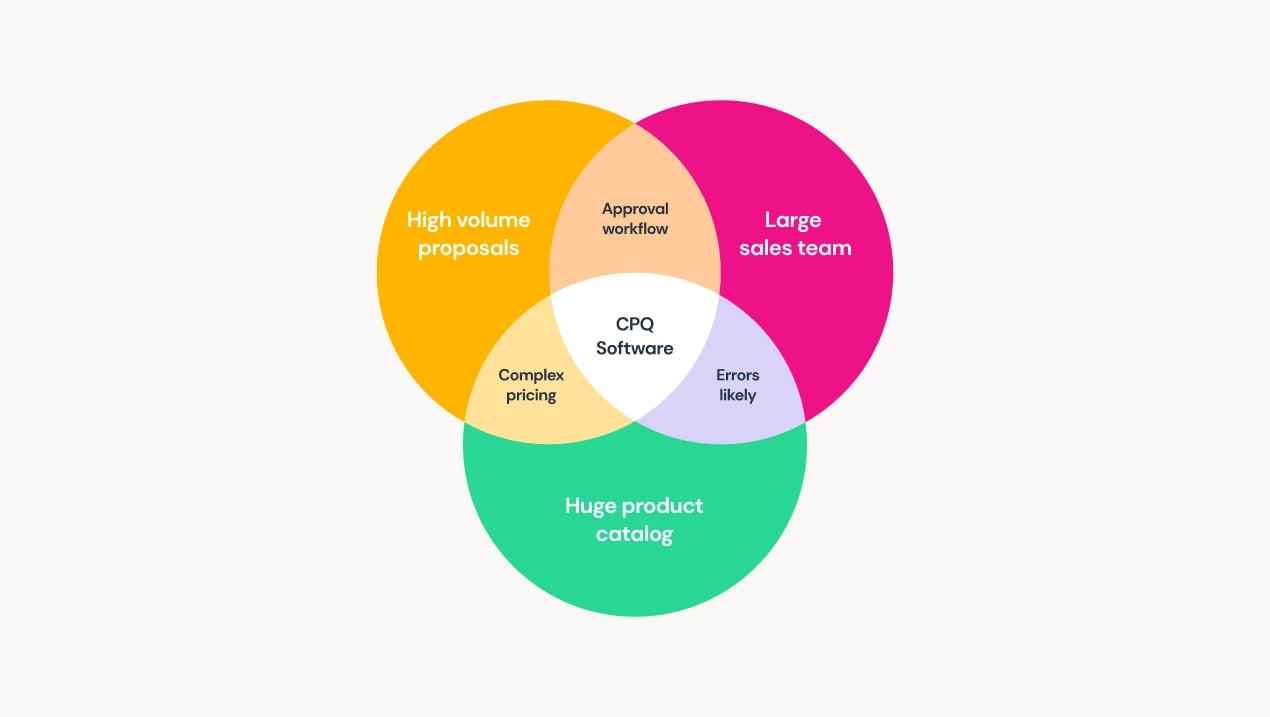
Drilling down more into some of the specific scenarios where you and your team could benefit from adopting CPQ software, do any of these sound familiar?
- You’re struggling to consistently manage a large or growing sales team
- You have to wrestle with a large or ever-changing product catalog
- You have to calculate custom pricing with a complex pricing structure
- You’re sending a high volume of proposals riddled with inconsistencies
If you’re nodding your head and wondering what the solution to all your problems is – then look no further than configure, price, quote software – CPQ.
Now you know that CPQ is for you, you’re probably wondering how it works and what are some of the key features you can expect to use. Read on to find out.
Conclusion
Improving systems and processes in order to make your sales team more effective is a huge opportunity for any business.
By introducing CPQ - or configure, price, quote - software into your company, your reps can spend less time on admin and send more accurate, consistent quotes.
To help you get started on your journey with CPQ software, we put together this guide. In it, we’ve covered the questions sales teams ask most, including:
- What is CPQ software?
- How is CPQ different from a CRM or ERP?
- What are the key features you should expect in any CPQ software?
- What happens after the quote is sent?
- What are some additional features you might expect to see in a CPQ tool?
- How does your use case shape the features you need?
- What are the main benefits of using CPQ?
- How can GetAccept’s CPQ software help me?
- Who is CPQ for?
Still got questions? Then check out our FAQs below - or arrange to speak with one of our experts.