

Only 45% of sales organizations report that their leaders have high confidence in forecasting accuracy [Gartner, 2021]. Which means that the other 55% are basically guessing.
This article breaks down what sales forecasting accuracy actually measures, what breaks it in real sales environments, and how to improve it using better pipeline visibility, consistent data standards, and real-time buyer engagement signals.
What is sales forecasting accuracy?
Sales forecasting accuracy measures how closely your predicted revenue matches what actually closes over a given period. It's a direct reflection of how well you understand what's happening inside your deals and whether the data you're using to predict outcomes is grounded in reality.
Sales forecasting accuracy is calculated by comparing forecasted revenue to actual closed revenue, typically expressed as a percentage. A forecast that predicts $1M and closes $900K has 90% accuracy.
But the number itself matters less than what breaks it: poor pipeline visibility, inconsistent deal data, and a lack of real-time buyer engagement signals.
What sales forecasting accuracy actually measures
Sales forecasting accuracy is the degree to which your predicted revenue aligns with the revenue you actually close in a specific time period. It's expressed as a percentage and calculated using this formula:
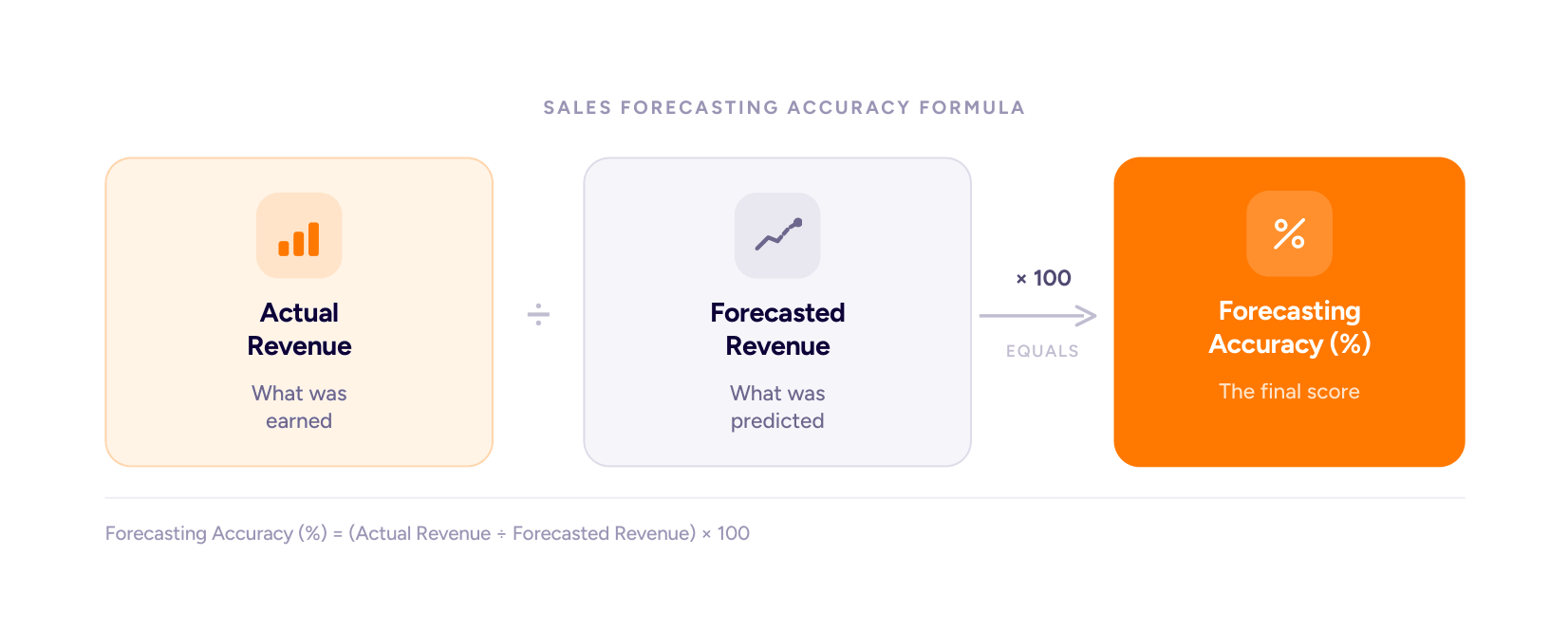
If you forecast $500K for the quarter and close $475K, your accuracy is 95%. If you forecast $500K and close $350K, your accuracy is 70%.
But here's what the formula doesn't tell you: accuracy isn't just about whether your reps can guess correctly. It's about whether the underlying data feeding your forecast reflects what's actually happening in your deals.
When sellers and managers express deal progress inconsistently in the CRM, those variations compound over time, growing further away from the standards set by sales leadership and ultimately reducing the quality of collective pipeline information.
You can have a sophisticated forecasting model. But if your pipeline data is stale, incomplete, or based on gut feel instead of buyer behavior, your forecast will be wrong.
And when your forecast is wrong, every decision built on top of it becomes a gamble.
Why sales forecasting accuracy matters
When your forecast is accurate, you can:
-
Allocate resources confidently (hiring, marketing spend, product investment)
-
Set realistic quotas that motivate reps instead of demoralizing them
-
Identify pipeline gaps early enough to fix them
-
Build credibility with the board and finance teams
When your forecast is consistently off, you lose credibility. Finance stops trusting your numbers. The board questions your ability to execute. And your team starts treating forecasts as a compliance exercise instead of a strategic tool.
Why forecasting accuracy matters for planning and execution
Accurate forecasts drive three critical business functions: hiring, budgeting, and strategic planning. Get the forecast wrong, and all three break.
Hiring decisions depend on pipeline predictability. If you forecast $10M in Q4 and hire 15 reps in Q2 to support that growth, but actual bookings come in at $7M, you've just added fixed costs without the revenue to justify them. Conversely, if you underforecast and hit $13M, you've left money on the table because you didn't have enough capacity to work the pipeline.
Budget allocation follows forecast confidence. Marketing spend, product investment, and operational infrastructure all scale based on expected revenue. When forecasts swing wildly quarter to quarter, CFOs pull back on discretionary spending, which slows growth even when pipeline is healthy. Poor data quality costs most companies between 15% and 25% of revenue, a staggering drag that touches every forecast, every decision, and every strategic plan built on inaccurate inputs [MIT Sloan Management Review, 2017].
Investor confidence lives or dies on forecast reliability. Public companies get punished for missing guidance. Private companies lose credibility with their boards. If you consistently miss your forecast by 15-20%, investors stop believing your growth narrative, and your valuation takes a hit.
The operational cost is just as real. Only 41% of sales managers and executives are satisfied with their current dashboards and the visibility they provide for business decision-making [Gartner, 2021]. When leaders don't trust the data, they waste time second-guessing their pipeline management, running manual audits, and building shadow forecasts in spreadsheets instead of coaching reps or closing deals.
What breaks sales forecasting accuracy
The problem with an inaccurate forecast isn't usually your forecasting model or your math. It's that the data feeding into your forecast is incomplete, subjective, or flat-out wrong.
|
What breaks it |
Why it matters |
Impact on forecast |
|---|---|---|
|
Inconsistent deal data |
Reps update the CRM differently, using subjective judgment instead of objective criteria |
Pipeline looks healthier than it is; deals slip without warning |
|
Lack of buyer engagement visibility |
You don't know if stakeholders are reviewing materials, ghosting, or actively engaged |
Deals marked \"90% likely\" stall in legal review for weeks |
|
Poor data governance |
No clear standards for what qualifies as a qualified opportunity or when to move stages |
Forecast inflates with deals that were never real |
|
Overly optimistic reps |
Reps mark deals as \"Commit\" based on hope, not evidence |
Forecast accuracy drops as deals push or fall out |
|
No real-time signals |
CRM data is stale; updates happen weekly or after deals close |
You're forecasting based on last week's reality, not today's |
You can't see what's actually happening in deals
Your reps update the CRM based on what they think is happening. But they don't actually know.
Did the champion share your proposal with the CFO? Is legal reviewing the contract, or did it get stuck in someone's inbox? Are there hidden stakeholders you don't know about? Your rep marks the deal as "likely to close" because the champion said things are moving forward. But you have no visibility into whether that's true.
Without real-time engagement data, you're forecasting based on rep intuition, not buyer behavior.
Pipeline data goes stale fast
Your pipeline is a snapshot of what was true when someone last updated it. But deals don't pause between CRM updates.
Despite spending an average of $1,866 per sales FTE on CRM and sales force automation technology annually, pipeline management and forecasting remain among the areas where sales operations are least effective, with only 18% of organizations rating them as a strength [Gartner, 2021].
Reps are overly optimistic
Reps want to believe their deals will close. They're optimistic by nature. They also know you're watching their pipeline, so they inflate probabilities to avoid uncomfortable conversations.
Your process isn't consistent across the team
One rep marks a deal as "Qualified" after a single discovery call. Another rep won't move a deal to "Qualified" until they've met with three stakeholders and confirmed budget. Your forecast rolls up data from both reps, but they're using completely different definitions.
When sellers and managers express deal progress inconsistently in the CRM, those variations compound over time, growing further away from the standards set by sales leadership and reducing the quality of collective pipeline information.
You're missing the buying committee
Your rep is talking to one champion. But six other people are involved in the decision, and your rep doesn't know who they are or what they care about. In complex B2B deals, the champion is rarely the decision-maker. They're an advocate. But if you can't see the rest of the committee, you're forecasting blind.
Who is responsible and what are the objectives
Sales forecasting accuracy doesn't live in a single department or rest on one person's shoulders. It's a distributed responsibility that requires coordination across multiple teams, each contributing different pieces of the puzzle.
Sales leadership typically owns the final forecast number. They're the ones presenting to the board, explaining variances, and making resource allocation decisions based on projected revenue. But they're entirely dependent on the quality of data flowing up from their teams.
Revenue Operations (RevOps) owns the infrastructure: the CRM hygiene, the stage definitions, the probability weightings, and the reporting dashboards that surface pipeline health. They set the standards for how deals get tracked and create the systems that make accurate forecasting possible.
Finance needs the forecast to plan budgets, model cash flow, and set expectations with investors. They're not building the forecast, but they're holding everyone accountable to it.
Sales managers are the critical middle layer. They review deals with reps, validate pipeline health, and submit team-level forecasts that roll up into the company number.
Only 55% of sales managers are meeting CSO expectations, and 40% report feeling overwhelmed or burned out [Gartner, 2025]. When managers are stretched thin, forecast quality suffers because they don't have time for rigorous deal reviews.
Individual reps are where forecasting accuracy actually starts. They're the ones updating deal stages, logging buyer engagement, and making judgment calls about close probability. When reps are inconsistent or optimistic in how they report deal status, that error compounds across the entire organization.
The connection between pipeline management and forecast accuracy
Your forecast is only as good as the pipeline feeding it. When your pipeline is a mess, with deals stuck in the wrong stages, reps guessing at close dates, and stakeholders invisible in the CRM, your forecast becomes fiction. You're building revenue projections on top of data that doesn't reflect what's actually happening in your deals.
What good pipeline management looks like
Fixing sales forecasting accuracy starts with fixing pipeline hygiene. Here's what that means in practice:
Clear, enforceable stage definitions. Every rep knows exactly what qualifies a deal to move from "Discovery" to "Proposal" to "Negotiation". The criteria are specific, measurable, and tied to buyer actions, not rep activities.
Visibility into the full buying committee. You know who's involved in every deal, not just your champion. You track engagement at the stakeholder level: which person viewed which content, how long they spent on each section, and when they're most active.
Automated CRM updates. Deal data flows into your CRM automatically based on buyer behavior. When stakeholders engage with your proposal, that activity logs to Salesforce or HubSpot without reps lifting a finger. Your pipeline stays current without manual data entry. Research from Gartner suggests that by 2030, 70% of sales tasks will be automated [Gartner, 2025].
Key forecast accuracy metrics and formulas
The most common metrics are forecast vs actual variance (the gap between prediction and reality), accuracy percentage (what you got right divided by what you predicted), and error margin (how far off you were). Most sales teams track these weekly or monthly to spot patterns in where forecasts break down.
Core forecasting accuracy metrics
-
Forecast Accuracy Rate: (Actual Revenue ÷ Forecasted Revenue) × 100
-
Forecast Variance: Forecasted Revenue − Actual Revenue
-
Mean Absolute Percentage Error (MAPE): Average of |(Actual − Forecast) ÷ Actual| × 100
-
Bias: Consistent over- or under-forecasting pattern across period.
Forecast vs actual variance: the reality check
Variance is the simplest metric. You predicted $500K for the quarter. You closed $425K. Your variance is -$75K, or -15%. This number tells you whether you're consistently optimistic, consistently pessimistic, or all over the place.
The formula: Variance = Forecasted Revenue − Actual Revenue
If the number is positive, you over-forecasted. If it's negative, you under-forecasted. Most sales leaders care less about the direction and more about consistency. A forecast that's reliably 10% high is manageable. A forecast that swings from +20% to -15% quarter over quarter is not.
Accuracy percentage: what you got right
Accuracy percentage flips the variance formula into a success rate. Instead of measuring how far off you were, it measures how close you got.
The formula: Forecast Accuracy = (Actual Revenue ÷ Forecasted Revenue) × 100
If you forecasted $500K and closed $475K, your accuracy is 95%.
Most B2B sales teams aim for 90-95% accuracy. Anything below 85% means your pipeline data is unreliable or your reps don't understand deal progression. Anything above 100% consistently means you're sandbagging, holding back deals to beat expectations, which creates its own problems when leadership can't trust the numbers.
Mean Absolute Percentage Error: the average miss
MAPE measures your average error rate across multiple forecasts. It's useful when you're tracking accuracy over time and want to smooth out the noise from individual quarters.
The formula: MAPE = (1/n) × Σ |(Actual − Forecast) ÷ Actual| × 100
Translation: for each forecast period, calculate how far off you were as a percentage of actual revenue, take the absolute value (so over- and under-forecasts both count), then average those percentages.
If your MAPE is 8%, you're missing your forecast by an average of 8% each period.
Bias: the pattern you can't ignore
Bias measures whether you consistently forecast too high or too low. It's not about being wrong. It's about being wrong in the same direction every time.
The formula: Bias = (Σ (Forecasted Revenue − Actual Revenue)) ÷ Number of Periods
If your bias is positive, you're usually too optimistic. If it's negative, you're usually too conservative. If it's close to zero, your errors are random, which is actually better than consistent bias, because random errors suggest you're reacting to real deal changes, not systematically misreading your pipeline.
How to improve sales forecasting accuracy
Improving sales forecasting accuracy isn't about buying better software or running more pipeline reviews. It's about fixing the structural problems that make your forecasts unreliable in the first place: inconsistent data, invisible buyer behavior, and reps guessing instead of knowing.
Fix your pipeline discipline first
Your forecast is only as good as your pipeline data. And if your pipeline data is a mess, your forecast will be too.
Start by standardizing how deals move through your pipeline. Define clear, objective criteria for each stage. When the rules are vague, reps interpret them differently.
Make stage progression non-negotiable. If a deal doesn't meet the criteria, it doesn't advance. Period. It's about creating a shared language so everyone on your team is measuring the same thing.
Replace assumptions with real engagement signals
You need visibility into what's actually happening on the buyer's side. Who's involved in the decision? Which stakeholders are engaged? What content are they reviewing, and how much time are they spending on it?
Digital Sales Room software give you this visibility. Instead of scattering information across email threads where you can't see what happens after you hit send, you create one shared space where buyers collaborate and you track every interaction. You see the entire buying committee, not just your champion. You know which content drives engagement and which gets ignored.
Automate the busywork so reps can focus on selling
Reps spend their time updating the CRM instead of selling. And when updating the CRM feels like busywork, data quality suffers.
The fix isn't more training on CRM hygiene. It's removing the manual work entirely in order to increase sales rep productivity. When buyer engagement syncs automatically to your CRM, reps don't have to log every email, every meeting, every document view. The system captures it in real time.
This doesn't just save time. It improves forecast accuracy because the data is complete, consistent, and current. You're not relying on reps to remember what happened three days ago or to manually update deal stages when they're juggling 15 other priorities.
Build a single source of truth
Your forecast breaks when different systems tell different stories. The CRM says one thing. Your proposal tool says another. Email activity lives somewhere else entirely. Reps are stuck reconciling conflicting data instead of selling.
You need one integrated platform that handles the entire deal lifecycle. Digital Sales Rooms, proposals, contract management, e-signatures, engagement analytics, all in one place, all syncing bidirectionally with your CRM.
When everything lives in one system, your data is consistent. When your data is consistent, your forecast is reliable.
Make forecasting a team discipline, not a solo activity
Forecasting can't be something reps do alone and managers rubber-stamp. It needs to be a collaborative process where managers coach based on real data, not gut feel.
Run weekly pipeline reviews focused on deal health, not just deal value. Look at engagement signals. Identify blockers. Discuss which stakeholders are missing and how to bring them in. Use the data to coach reps on what's working and what's not.
This builds forecast accuracy over time because reps get better at reading deals. They learn which signals matter. They stop inflating probabilities on deals that aren't real. And managers develop the muscle to spot risk before it tanks the quarter.
Sales forecasting examples: bottom-up, top-down, and layered
Bottom-up forecasting: building from the ground up
Bottom-up forecasting starts with your reps. Each Account Executive (AE) evaluates their individual deals, assigns close probabilities, and rolls those numbers up to create the team forecast. It's the most granular approach, and when your pipeline data is clean, it's also the most accurate.
Strengths:
-
Grounded in reality, the forecast reflects actual deals in motion, not abstract targets or historical trends
-
Rep accountability, when reps own their numbers, they're more invested in accuracy
-
Early warning system, changes in individual deal health surface quickly, giving managers time to intervene
Limitations:
-
Garbage in, garbage out, if your CRM data is stale, incomplete, or inconsistent, the entire forecast collapses
-
Optimism bias, reps tend to overestimate their chances
-
Time-intensive, every rep needs to review every deal, every week
Bottom-up works best when you have strong CRM hygiene, clear stage definitions, and reps who understand the difference between activity and progress.
Top-down forecasting: starting with the target
Top-down forecasting flips the script. Instead of building from deals, you start with revenue targets and historical performance, then work backward to estimate what the team should close.
Leadership sets the quarterly or annual number based on company goals, market conditions, and past results. Then you divide that target across regions, teams, and individual reps.
Strengths:
-
Speed, you can generate a forecast quickly
-
Strategic alignment, the numbers tie directly to business objectives and board commitments
-
Simplicity, no need to audit every deal or chase reps for updates
Limitations:
-
Disconnected from reality, targets don't care about your pipeline health
-
No deal-level visibility, you can't see which deals are stalling, which buyers are ghosting, or where coaching might help
-
Reactive, not predictive, by the time you realize the forecast is off, it's too late to course-correct
Top-down forecasting works for high-level planning and board reporting, but it's dangerous as your only method.
Layered forecasting: combining both approaches
Layered forecasting (sometimes called hybrid forecasting) merges bottom-up deal data with top-down targets and historical trends. You get the granularity of rep-level inputs and the strategic context of company goals, then reconcile the two.
Strengths:
-
Balanced perspective, you're not flying blind on targets or drowning in deal-level noise
-
Built-in validation, when bottom-up and top-down align, confidence goes up. When they diverge, you know where to investigate
-
Adaptability, you can weight each method based on what's working
Limitations:
-
Complexity, you're managing two forecasting processes, not one
-
Reconciliation overhead, when the numbers don't match, someone has to figure out why
-
Still dependent on data quality, layered forecasting doesn't fix bad data, it just exposes it faster
Layered forecasting is the most mature approach, but it only works if you have the infrastructure to support it: clean CRM data, consistent stage definitions, and managers who can interpret the gaps between bottom-up and top-down without defaulting to gut feel.
How GetAccept supports more accurate forecasting
The problems you just read about – invisible stakeholders, stale data, rep optimism – aren't unsolvable. They're solved by replacing manual CRM updates with automatic buyer behavior tracking.
Invisible committees become visible.
GetAccept surfaces every stakeholder who's accessed your Digital Sales Room,, including the ones your rep never knew existed.
You see who's reviewing materials, which roles are engaging (and which are ghosting), and when new people suddenly jump into the deal.
That full stakeholder visibility goes straight into your CRM, so your forecast reflects who's actually involved, not who your rep thinks is involved.
Pipeline data stays current.
Instead of waiting for weekly CRM updates (or hoping reps remember to log them), GetAccept tracks buyer engagement in real time.
When a stakeholder reviews your proposal at 2 AM, when they spend 45 minutes on pricing, when they go silent for three days, you see it immediately. No manual entry or delay.
And it syncs directly to your CRM, so your pipeline reflects what's happening today, not what happened last week.
Rep optimism gets replaced with evidence.
A rep marks a deal "Commit" because the champion sounded positive. GetAccept shows you whether that optimism is backed by actual buyer behavior:
-
Are multiple stakeholders engaging?
-
Is activity accelerating or stalling?
-
Are they reviewing the contract, or stuck on pricing?
When reps can see the same engagement data you can, they stop guessing. Forecasts become more accurate because they're based on what the buying committee is actually doing.
Want to see what that looks like in practice? Book a demo or start a free trial – no lengthy onboarding required.
Better forecasts start with better data
You can't eliminate uncertainty in B2B sales. But most forecast misses are caused not by uncertainty, but by bad data dressed up as a number.
Fix what's feeding your forecast:
-
Replacing assumptions with real buyer engagement signals
-
Automate the updates that kill data quality when done manually
-
Build visibility into what's happening inside deals before it's too late to act on it
GetAccept helps sales teams improve forecasting accuracy by replacing rep intuition with real-time buyer engagement data. You see the full buying committee, track which content drives engagement, and sync everything automatically to your CRM.