-1.jpg?width=48&height=48&name=55f40cc2763590699ea313bb5c9f08b5%20(chosen)-1.jpg)

The conversation around AI in sales has a trust problem. Not because AI isn't capable (it clearly is) but because capability without constraint is its own kind of risk. An AI that can generate anything isn't always an AI that generates the right thing.
Nowhere is this more visible than in pricing.
The rogue quote problem
Ask an ungrounded AI to build a quote based on a meeting with a prospect and it will. Confidently. It will populate rows with product names that sound plausible, prices that feel roughly right, and configurations that look professional. It will do all of this without knowing a single thing about what your company actually sells.
The result isn't a quote. It's a performance of a quote. And when a rep sends it – or worse, when a buyer sees it – the damage isn't just one bad deal. It's trust in AI-assisted selling, eroded a little further.
This is what it means for AI to go rogue: not a dramatic malfunction, but a quiet, confident deviation from reality. The model doing exactly what it was asked, with none of the context it needed to do it right.
Guardrails aren't a limitation. They're the point.
The instinct in AI development is often to maximize capability, and to give the model more freedom, more surface area, more things it can do. But in a sales context, what reps actually need is an AI they can hand something to and trust the output. That requires constraint, not just capability.
Grounding is how you build that constraint. When AI operates within a defined data layer – in this case, the product library – it can only draw from what's real. It can't invent a product that doesn't exist, because the product doesn't exist in its working data. It can't approximate a price, because the price is right there, structured and accessible.
The model becomes, in the best sense, bounded. Not limited in what it can do, but anchored in what it should do.
What this looks like in GetAccept
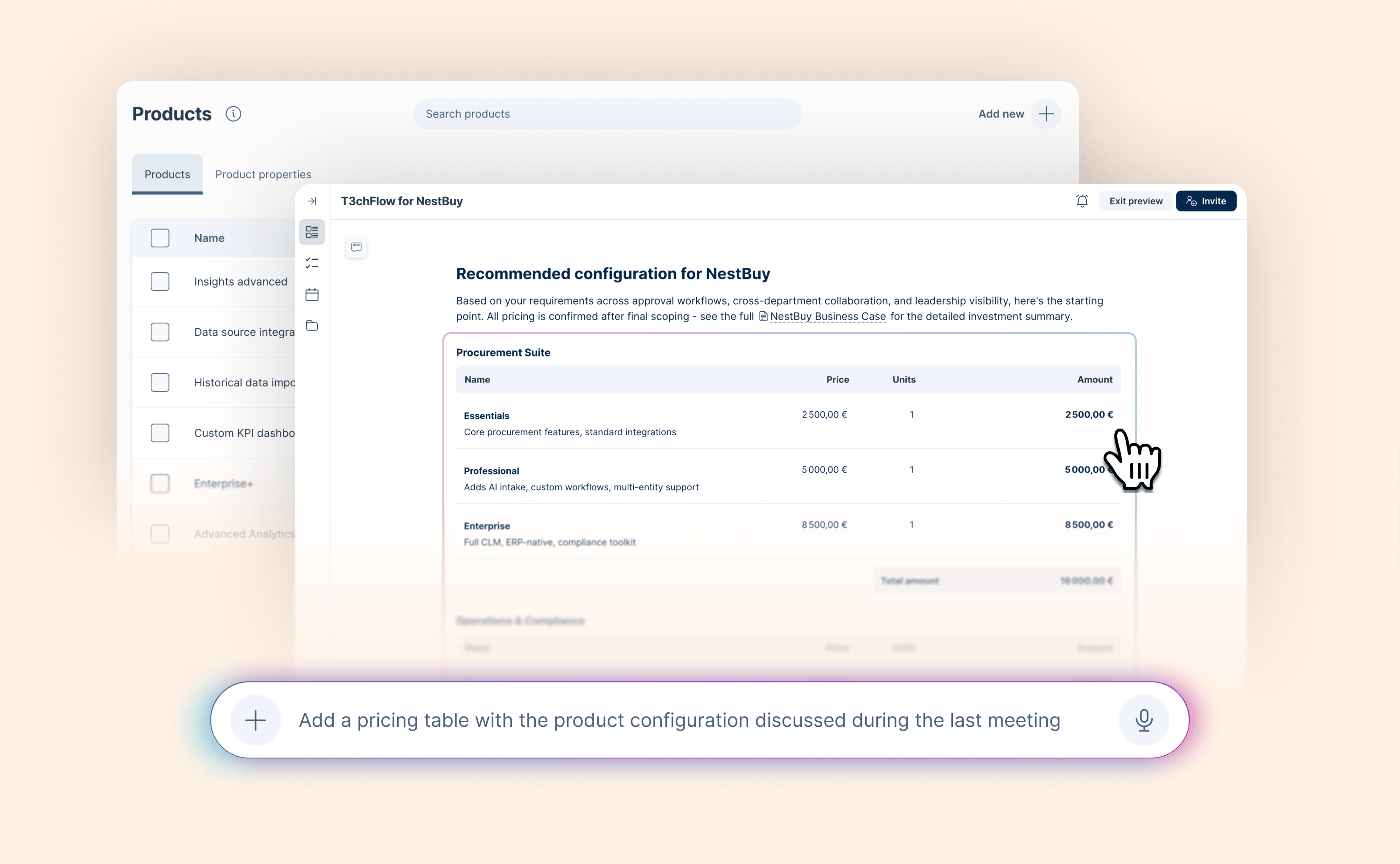
GetAccept AI is connected to the native product library. When a rep asks it to generate a pricing table, from a query or from meeting context, the AI builds the table from the actual catalog.
It can read a meeting transcript and surface the products that came up in the call. It can handle optional products, variable products, and product groups. And it does all of this without requiring a cleanup pass, because the output is grounded in data the rep already knows is correct.
The AI isn't guessing. It's working from a source of truth.
Why this matters for the sales motion
A pricing table is often the moment a deal becomes real for a buyer. It's where interest turns into evaluation, where a conversation becomes a commitment to consider. Getting that moment right – the right products, the right pricing, the first time – is not a minor operational detail. It's a trust signal.
When a rep sends a quote that's accurate and fast, it tells the buyer something: this team knows what they're doing. When they send one that has to be revised, or that contains products that don't exist, it tells them something else.
Grounded AI gets that moment right, consistently, across every rep on the team. Not just the experienced ones who know the catalog cold.
The through-line is the same at every step: AI that knows what it's working with, operating within boundaries that make the output trustworthy. Not AI that can do anything, but AI that consistently does the right thing.
That's what guardrails are for. And that's what makes this kind of AI actually useful in a sales motion.
-1.jpg)