
You're spending 2+ hours on a single proposal. Your contracts live everywhere - emails, DocuSign, servers - with no single source of truth. You send a proposal and have no idea if anyone opened it or when to follow up.
Every contract management software solves this problem differently.
The internet has ~400 articles on this topic, most ranking the same 5-7 tools while ignoring which tool is built for your job.
Our roundup aims to fix it.
To be straight with you: GetAccept is on this list, and this article is published on GetAccept's blog. We have a stake.
What we can offer instead of fake neutrality is honesty - about where GetAccept genuinely fits, where it doesn't, and where other contract lifecycle management companies on this list are the smarter call depending on your situation.
The goal is a comparison you can actually use.
TL;DR: Overview of the top contract management software in 2026
- GetAccept: AI-native Digital Sales Room with comprehensive CRM-connected sales contract management workflows; best for sales and revenue teams closing contracts inside Salesforce, HubSpot, or Pipedrive without switching tools.
- PandaDoc: Document automation platform built around reusable templates and approval workflows; best for teams sending high volumes of proposals, NDAs, and service agreements.
- Proposify: Proposal-first platform with branded templates, e-signatures, and engagement tracking; best for small and mid-sized sales teams sending high volumes of branded proposals without deep CLM needs.
- DocuSign CLM: Full contract lifecycle management layered on top of DocuSign eSignature infrastructure; best for enterprises already embedded in the DocuSign ecosystem.
- Ironclad: Workflow-driven CLM with a powerful no-code configuration layer; best for in-house legal teams at growth-stage companies that have outgrown basic e-sign.
- Juro: Browser-native contract platform with no Word dependency; best for companies where legal and commercial teams need to work in the same tool.
- DealHub: CPQ and contract management in a single Salesforce-native workflow; best for revenue ops teams connecting quoting and contract execution in one motion.
- Conga CLM: End-to-end Salesforce-native revenue workflow combining CPQ and CLM; best for teams in regulated industries that need quoting and contracting connected without custom integration.
- ContractSafe: Lightweight contract repository with automated renewal alerts and flat-rate pricing; best for small teams that need organized storage without enterprise overhead.
How we built this list
- G2 data: We cross-referenced G2's contract management category (June 2026) to confirm which tools belong on this list and pull real user sentiment - not vendor marketing.
- Product and positioning review: We included review summaries and publicly available product information to frame each tool's use case.
- Competitive experience: GetAccept is part of this market. We know it from the inside, which gives us useful context - and also means you should weigh our perspective accordingly.
- Exclusions: We excluded tools that G2 classifies under contract management but are primarily e-signature or point-of-sale products. This list covers platforms that manage the contract lifecycle, not just the signature moment.
Why trust us?
We've spent the last 10 years talking to AEs, sales leaders, and RevOps teams about what breaks down between the first meeting and a signed contract. We know this space from the inside.
That experience is what led us to build GetAccept - a platform that connects proposals, buyer collaboration, and contract management in one CRM-connected workflow, what G2 now calls a Digital Sales Room. We co-created that category with G2 in 2021, and contract execution sits at the core of it.
Several tools on this list come up in our own sales conversations. Sometimes we're the stronger fit, sometimes another tool serves the client better. Over time we've developed an honest read on which platform fits which situation. That perspective informs how we've written every section here.
9 best contract management software platforms in 2026
A quick overview before we go deeper on each tool:
| Tool | Core Strength | Best For | G2 Rating | Starting Price |
|---|---|---|---|---|
| GetAccept | Digital Sales Rooms + contract management + proposals + e-signatures |
B2B revenue ops and sales teams with complex, multi-stakeholder deals, closing contracts inside their CRM |
4.6 | $25/user/month |
| PandaDoc | Document automation with templates, proposals, and e-sign | Template-driven proposal and contract workflows | 4.7 | $19/user/month |
| Proposify |
Document automation with templates, proposals, and e-sign |
Template-driven proposal and contract workflows | 4.6 |
$19/user/month |
| DocuSign CLM |
Full contract lifecycle management on DocuSign infrastructure |
Enterprise teams already running on DocuSign | 4.3 |
$11/user/month (e-sign); |
| Ironclad | No-code workflow builder for in-house legal |
In-house legal teams at growth-stage companies | 4.4 | Not publicly listed |
| Juro | Browser-native contract editor with no Word dependency | Companies where legal and sales work in the same tool | 4.7 | Not publicly listed |
| DealHub | Quote-to-revenue platform with CPQ | Revenue ops teams connecting quoting to contract | 4.7 | Not publicly listed |
| Conga CLM | Salesforce-native CPQ and CLM for enterprise | Salesforce-native teams needing CPQ and CLM together | 4.3 | Not publicly listed |
| ContractSafe | Simple repository with renewal alerts and flat-rate pricing | Small teams that need organized storage and renewal alerts | 4.7 | Flat, from $540/month |
1. GetAccept
🏆 Best for: RevOps and sales teams that manage complex, multi-stakeholder deals and need contracts, proposals, e-signatures, and buyer collaboration in one CRM-connected workflow
Trusted by: SIEMENS, Dealfront, ScaleWise, and more.
Most contract lifecycle management companies manage the contract itself well. We're connecting it to everything happening before and around it - the proposal, the pricing conversation, the stakeholder who joined late and needs context.
GetAccept puts the contract inside the deal. Reps work from Salesforce or HubSpot. The buyer gets a single shared space where proposal, pricing, and contract live together.
Stakeholders who join late can catch up without a forwarded email chain. When the contract is signed, it saves back to the CRM automatically.
The result is one connected workflow from first meeting to signed agreement inside the tools your team already uses, not alongside them.
If you're wondering what that shared buyer space looks like in practice, we call it a Digital Sales Room.
GetAccept's AI contract management software also reads and extracts key terms from contracts you didn't create in the platform – PDFs signed elsewhere, legacy agreements, anything you upload – so migrating from a spreadsheet or an old CLM tool doesn't mean re-keying hundreds of contracts by hand.
Where GetAccept is still maturing is deep contract lifecycle depth for legal-heavy organizations (think redlining at scale, proprietary legal-AI clause review, and complex multi-entity permissioning). If that's your primary need today, pair GetAccept with your legal team's roadmap expectations, or consider our AI contract management module (below) as a fast-growing but not yet fully mature alternative to legacy CLM leaders.
GetAccept also works standalone, without the deal room. If you're centralizing existing supplier, HR, or vendor contracts – and mainly need one place to store them, get renewal reminders, and control who sees what – GetAccept's contract management module works on its own, with a simpler setup than a full CRM-connected deal workflow. This is a common starting point for finance and ops teams before (or instead of) adopting the full Digital Sales Room.
What it’s praised for [G2]:
- Time saved on admin, with multiple reviews citing significant reductions in contract creation time
- Deep CRM sync, with users highlighting contracts auto-populating from CRM data and signed copies saving back automatically
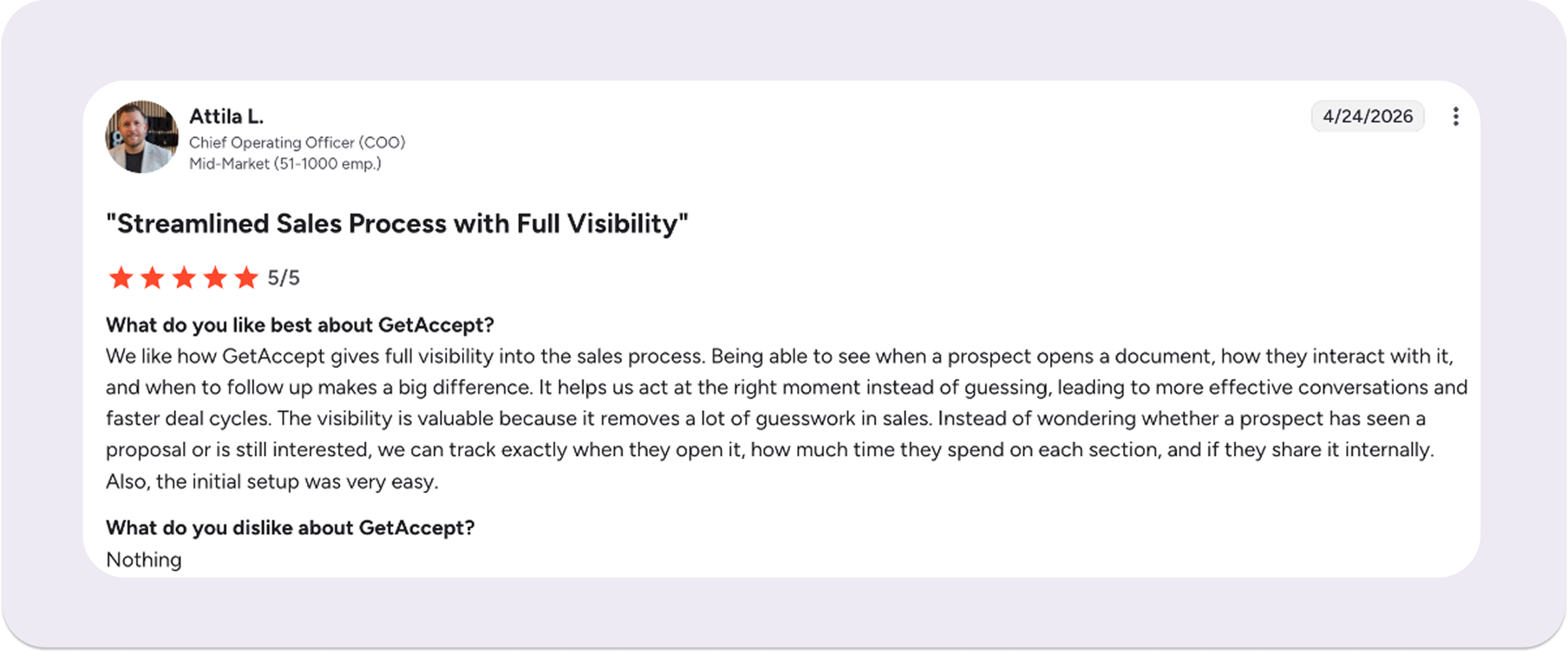
- Buyer engagement visibility and analytics, with reviewers mentioning removed guesswork, more effective conversations and faster deal cycles.
- AI data extraction, with users noting the ability to pull and edit key terms from uploaded contracts without manual review
- All-in-one deal experience, with reviewers citing the convenience of proposals, content, and contracts living in one buyer-facing space
Potential drawbacks [G2]:
- Feature depth that can feel like more than needed for teams that only want basic e-sign
- To unlock advanced automation and analytics, you need higher-tier plans
- For enterprise-scale CLM with complex obligation tracking across thousands of contracts, deep clause libraries, or regulated-industry compliance infrastructure, a dedicated CLM platform is the better call, either alongside or instead of GetAccept
What our customers say:
Himani Gupta, Head of CRM Operations at a workforce management platform Florence UK: "I don't have to go anywhere else to get my contracts. It's all in my CRM. I stay in one space and stay focused. We had an absolutely incredible experience with GetAccept!"
Index Hospitality cut contract creation time from 40 minutes to under 10 minutes. That’s a 75% reduction after replacing manual Word templates with GetAccept's CRM-connected workflow.
Pricing:
- eSign+contract management: $25/user/month
- Professional: $49/user/month
- Enterprise: Custom pricing
- Free trial available
2. PandaDoc
🏆Best for: Teams that need a proven, template-driven document workflow.
PandaDoc has one of the strongest review footprints in the category. It's genuinely strong at what it does: reusable templates, clean document creation, proposal tracking, and a straightforward signing experience.
Where it shines is volume. Teams that send a lot of similar documents (proposals, service agreements, NDAs) find it fast to set up and easy to standardize across a team. CRM integrations cover the major platforms.
What it’s praised for [G2]:
- Template quality, quantity, and reusability are the most cited reasons people choose it
- Ease of setup, with users describing getting up and running quickly
- Document tracking, like knowing when proposals and contracts are opened
- Workflow automation for repeatable document types
Potential drawbacks [G2]:
- Some users find PandaDoc too expensive for small teams
- Teams working with highly customized or complex documents may want to test formatting and editing before committing
Pricing:
- Free eSign: $0/month
- Starter: $19/user/month
- Business: $49/user/month
- Enterprise: Custom pricing
3. Proposify
🏆Best for: Large organizations already running on DocuSign eSignature.
Proposify is proposal-first by design. It's built around one core workflow: create a branded proposal from a template, send it, track how buyers engage with it, and collect a signature without leaving the platform.
The platform has a large library of pre-built templates, a content library for reusable sections, and a drag-and-drop editor.
It doesn't try to be a CLM or a CPQ. That focus is both its strength and its ceiling.
What it's praised for [G2]:
- Template speed, with reviewers consistently citing proposals going from 30-60 minutes to under 10, in some cases under 5
- Engagement tracking, with users highlighting the ability to see exactly when buyers open a proposal, which sections they spend the most time on, and when to follow up
- Brand consistency, with marketing and sales ops teams noting that locking templates prevents reps from editing pricing and boilerplate without oversight
- CRM integration, with HubSpot and Salesforce users citing data flowing directly into proposals without manual re-entry
Potential drawbacks [G2]:
- The editor is a recurring frustration in reviews - alignment issues, glitchy pricing tables, and copy-paste from Word breaking formatting
- The Basic plan caps sends at 5 per month, which pushes most active sales teams to the Team plan ($49/user/month) faster than the entry price suggests
- Salesforce deep integration requires the Business plan, which has a 10-user minimum - a significant cost jump for smaller teams that rely on Salesforce
Pricing:
- Basic starts at$19/user/month
- Team plan at $49/user/month
4. DocuSign CLM
🏆Best for: Large organizations already running on DocuSign eSignature.
If your organization already runs DocuSign for signatures and needs a full contract lifecycle on top of that e-signature infrastructure, DocuSign CLM is the natural upgrade path. It delivers e-signature-integrated contract management in a single ecosystem.
The integration between the two products is tight, and for teams already embedded in the DocuSign ecosystem, the move is relatively straightforward.
What it's praised for [G2]:
- Brand familiarity and trust, with many teams choosing it because they already use DocuSign for e-sign
- Centralized contract visibility, with users citing a clearer picture of where agreements sit in the process
- Built-in approval workflow, with reviewers noting contracts moving through the right stakeholders without manual chasing
- Remote signing convenience, mentioned frequently across review segments
Potential drawbacks [G2]:
- Some users describe a steep learning curve, especially when moving beyond e-signature into broader CLM workflows
- Complex setup that often requires dedicated admin support or external implementation help
- Pricing that reviewers describe as high relative to what smaller teams actually use
Pricing:
- DocuSign eSignature starts at $10/user/month, but CLM is a separate enterprise product
- CLM pricing is custom only
5. Ironclad
🏆Best for: In-house legal teams at growth-stage companies.
Ironclad is the go-to CLM for in-house legal teams, and it's one of the strongest contract automation tools available for workflow-driven CLM. Its workflow builder is genuinely powerful - legal teams can configure approval routing, counterparty collaboration, and template logic without engineering support.
What it's praised for [G2]:
- Intuitive workflow builder, with legal teams describing configuration without needing engineering support
- Cross-functional collaboration, with users citing legal and commercial teams working in the same tool
- Strong support during implementation, mentioned consistently in reviews
Potential drawbacks [G2]:
- Search and repository navigation described as frustrating by some users
- Learning curve on configuration, with reviewers noting it takes time to set up correctly
- Can feel heavyweight for very small teams.
Pricing:
-
Custom pricing only
-
No free trial publicly listed
6. Juro
🏆Best for: Companies where legal and commercial teams need to work in the same tool.
Juro's browser-native editor is its clearest differentiator. Everything happens in the platform, no Word dependency, no PDF exports. That makes it genuinely usable by both legal and commercial teams in the same workflow.
What it's praised for [G2]:
- Genuine ease of use across legal and non-legal teams, the most consistent theme in reviews
- Fast setup and implementation, with users describing a smooth onboarding experience
- Browser-native editing, with reviewers appreciating no dependency on Word or PDF exports
Potential drawbacks [G2]:
- Teams with complex approval routing should test whether Juro’s workflow options match their process
- Some users note limits around advanced customization
- If your team depends heavily on existing document workflows, test the handoff between Juro, Word, and your current process before committing
Pricing:
-
Custom pricing based on contract volume, not per user
-
Free trial available
7. DealHub
🏆Best for: Revenue ops teams that need quoting and contract execution in one workflow.
DealHub sits at the intersection of CPQ (configure, price, quote) and contract management, built tightly around Salesforce.
If your primary pain is the gap between generating a quote and getting a contract signed, and you want that entire motion to live in one system, DealHub addresses it directly. G2's "Easiest to Use" in this category.
What it's praised for [G2]:
- Speed of quote creation, with users citing professional output generated quickly
- Salesforce alignment, with reviewers mentioning quotes and contracts staying inside the CRM motion
- Onboarding support quality, described as responsive and hands-on during setup
Potential drawbacks [G2]:
- Some users mention a learning curve for implementation, advanced features, or one-off configurations
- G2 reviewers mention some limits around customization and complex approval workflows
- Because DealHub is strongest around quote-to-revenue workflows, teams with simpler contract needs should check whether they need the full CPQ-style footprint
Pricing:
- Custom pricing only
- No published per-user or per-month rates
8. Conga CLM
🏆Best for: Salesforce-native teams that need CPQ and CLM connected end to end.
Conga combines contract lifecycle management with CPQ in a single Salesforce-native platform. Used heavily in Healthcare, Life Sciences, Technology, and Financial Services.
If you're running Salesforce and need quoting, contracting, and legal governance to stay connected without building a custom integration between separate tools, it's worth evaluating.
What it's praised for [G2]:
- Deep Salesforce integration, with users describing contracts and quotes staying connected inside one system
- End-to-end workflow automation across quoting, contracting, and approvals
- Configurability for complex workflows, with reviewers citing flexibility for industry-specific processes
Potential drawbacks [G2]:
- Some users describe a steep learning curve
- G2 reviewers mention complex setup, especially around configuration and advanced workflows
- Some users report slow performance or time-consuming workflows with large documents or complex contract generation
Pricing:
- Custom pricing only
- No published per-user rates
9. ContractSafe
🏆Best for: Small teams that need organized storage and renewal alerts without enterprise overhead.
ContractSafe does a focused job well: centralized contract repository, automated renewal and expiry alerts, fast setup, flat-rate pricing.
If your primary pain is contracts scattered across inboxes and shared drives - and you just need a clean, searchable place to put them with reminders for key dates - ContractSafe gets you there without a lengthy implementation.
What it's praised for [G2]:
- Automated renewal and expiry alerts, the most cited reason teams choose it
- Clean and simple interface that non-legal staff describe as easy to use without training
- Fast setup, with multiple reviewers mentioning being live within a day
- Customer support quality, described as responsive and genuinely helpful
Potential drawbacks [G2]:
- Teams needing advanced drafting, approvals, or negotiation workflows should compare broader CLM tools
- Some users note that AI/OCR extraction may still require manual checking
- Reviewers mention limited customization and occasional search limitations, so teams with complex repository or workflow requirements should test those scenarios
Pricing:
- Basic: From $450/month (annual billing)
- Professional and Enterprise tiers available at higher rates
- Pricing based on number of contracts in database, not per user
- Free trial available
CLM, e-signature, CRM - what's actually different?
Contract management technology space uses a lot of overlapping terminology, and the category gets muddy.
E-signature software collects signatures. It doesn't manage what happens before or after signing. Send a document, get it signed, download the PDF – that's it.
CRM software manages your customer relationships and pipeline. It tracks deal stages and contact data, but the contract itself lives somewhere else.
Contract management software(CLM - contract lifecycle management) covers the full journey: drafting, templates, approval workflows, negotiation, signing, storage, renewal tracking, and obligation management. It's the layer that connects the commercial intent in your CRM to the signed agreement your business needs.
Some tools, like GetAccept, sit deliberately between CRM and CLM. They give sales teams a contract workflow that runs inside their existing tools rather than requiring a separate system.
👉 Further reading: 8 Contract management best practices for revenue teams
Critical features in contract management software
When comparing platforms, these capabilities actually move the needle. Not every team needs all of them, but you should know which ones matter for your situation before you start demoing.
| Feature | Importance | Matters most for | Why it matters |
|---|---|---|---|
| Contract templates | Table stakes | Sales, legal, RevOps | Cuts creation time from hours to minutes. Reps stop building contracts from scratch; legal stops fielding the same drafting requests. |
| Approval workflows | Table stakes | Legal, finance, sales leaders | Routes contracts to the right people automatically. Removes legal as a bottleneck without removing legal from the process. |
| Native e-signature | Table stakes | Sales and customer-facing teams | Keeps signing inside the same platform. Sending buyers to a separate tool to sign breaks momentum at the worst possible moment. |
| Renewal and deadline tracking | Table stakes | Legal, finance, operations | Alerts you before contracts auto-renew or notice periods expire. Missed renewals are silent revenue leakage. |
| Contract repository | Table stakes | Every team | One searchable place for every agreement. The alternative is hunting through email threads and shared drives. |
| Audit trail and compliance | Table stakes | Legal, finance, regulated teams | Tamper-proof record of who signed what and when. Required for legal enforceability under ESIGN and eIDAS. |
| CRM integration | Differentiator | Sales and RevOps | Contracts auto-populate from your CRM data and signed copies save back automatically. Without this, data entry falls on your reps. |
| AI data extraction | Differentiator | Legal ops, RevOps, finance | Reads uploaded or signed contracts and pulls out key terms automatically - dates, values, notice periods. Saves hours of manual review. |
| Engagement tracking | Differentiator | Sales teams | Shows when buyers open contracts and how long they spend on each section. Turns follow-up from guesswork into a signal. |
For a deeper look at how to evaluate these against your situation, see our Complete guide to choosing contract management software.
Which contract management software is right for you
| If your main problem is... | Look at... | Why |
|---|---|---|
|
Sales contracts slow down inside the deal cycle |
GetAccept, PandaDoc, Proposify, DealHub |
Built around sales workflows, CRM data, proposals, approvals, and signing. |
| Legal needs better control over drafting, approvals, and negotiation
|
Ironclad, Juro, DocuSign CLM |
Stronger for legal-led contract lifecycle management. |
| You already have hundreds or thousands of signed contracts with limited visibility
|
ContractSafe |
Help legal and operations teams find, organize, and track existing agreements. |
|
Your quote-to-contract process lives in Salesforce or HubSpot |
GetAccep, DealHub, Conga CLM |
Connect CRM data, quoting, contract generation, and execution. |
If you think GetAccept fits your situation, you can try it free or book a demo with us.
Best contract management software by company size
The right tool changes with team size. A 5-person sales team and a 500-person RevOps org aren't solving the same problem, even when they're both typing "contract management software" into Google.
Top-rated contract management apps for small business
ContractSafe, GetAccept, and PandaDoc are the top-rated contract management apps for small businesses.
If contracts are scattered across email and Google Drive and you just need one searchable place with renewal alerts, ContractSafe does that job for $450/month flat, no per-seat pricing to worry about as you hire.
If you're a small sales team and the contract needs to move with the deal, not just get stored after signing, GetAccept starts at $25/user/month and keeps the contract inside your CRM instead of a separate silo.
If proposals are the volume driver, not the contract lifecycle, PandaDoc's template system starts at $19/user/month and is built for exactly that.
Top-rated contract management tools for midsize businesses
GetAccept, DealHub, and PandaDoc are the top-rated contract management tools for midsize businesses managing multi-stakeholder deals through Salesforce or HubSpot.
At GetAccept ($25 to $49/user/month) contracts populate from CRM data, and signed copies sync back automatically. DealHub is the stronger call if quote-to-contract is the bottleneck, since CPQ and contract execution live in one motion. PandaDoc still holds up here if the real pain is proposal and document volume rather than deal-stage collaboration.
Top-rated contract management software for enterprise teams
DocuSign CLM, Ironclad, and Conga CLM lead for enterprise teams that need legal-led governance across large contract volumes.
DocuSign CLM makes sense if you're already running DocuSign for e-signature and want CLM on the same infrastructure. Ironclad is the strongest pick for in-house legal teams that need a no-code workflow builder without pulling in engineering. Conga CLM fits Salesforce-native enterprises, especially in regulated industries like healthcare or financial services, that need CPQ and CLM connected without a custom build.
GetAccept's enterprise tier can work here too, but only if the contract process is still sales-led and CRM-centric. For enterprise-scale legal governance, a dedicated CLM is the better call.