-1.jpg?width=48&height=48&name=55f40cc2763590699ea313bb5c9f08b5%20(chosen)-1.jpg)

Highspot isn't Highspot anymore. On August 18, 2026, Seismic completed its acquisition, and the product now operates under the Seismic name. If you signed with Highspot, you signed with a company that no longer exists as an independent business.
Staying is still a fine choice - Highspot works well for plenty of teams, and is still one of the market leaders. But if your renewal is coming up, or adoption was already a struggle, it's worth a minute to see what else is out there.
We're on this list too, so we're not pretending to be neutral. GetAccept is an AI Digital Sales Room, built for running the buyer-facing side of the deal, not content management. We're often compared to Highspot, so we'll tell you exactly where we help and where we don’t, same as every other tool here.
Try GetAccept's Digital Sales Room for Free
TL;DR: Highspot alternatives for sales enablement
- GetAccept: For mid-market sales and revenue teams whose Highspot pain point was buyer-facing execution, not internal content governance.
- Showpad: For mid-market teams that want content and coaching balanced evenly without going full enterprise.
- Mindtickle: For teams whose Highspot frustration centered on rep readiness and onboarding speed, not content findability
- Allego: For teams prioritizing training and video coaching over content management depth, often as a lower-cost alternative to the bigger suites
- Guru: For teams that want fast content findability without a multi-week rollout.
- Paperflite: For teams that want transparent pricing and a lighter footprint than Mindtickle, Seismic, or Showpad.
Why teams are evaluating Highspot alternatives right now
First, the merger itself. Gartner's read on the deal: it's a defensive consolidation against pricing pressure and AI competition, and buyers should expect less negotiating leverage and slower feature releases while the two roadmaps merge.
If you're renewing this year, get commitments in writing about what happens to your specific modules and support tier. Favor a shorter term over locking in multi-year right now.
Second, the recurring problems some teams are experiencing. Talking to teams that have come to us from Highspot and reading public reviews, a few reasons keep coming up:
- Adoption is a recurring complaint. For teams without a dedicated sales enablement manager or RevOps support, the ramp-up can feel disproportionate to the value they get in the early months. Reps might not use it the way it was set up to be used, and admins end up reteaching the same workflows every quarter.
- Deal room and content setup takes too long, and the room functionality is limited. Highspot is primarily a seller-side tool, so the buyer-side functionality gets less attention. Building a shareable space for one specific deal can eat an hour when it should take minutes. The deal room functionality is also limited.
- Integration depth varies a lot by CRM. Teams on HubSpot report weaker sync than teams on Salesforce, and end up paying for features they don't use as a result.
How we evaluated
We used the same criteria across all Highspot competitors: what job it replaces, CRM integration depth, what the AI capability does, whether it's built for internal enablement or external buyer engagement, and pricing model.
6 best Highspot alternatives for sales enablement in 2026
|
Tool |
Segment
|
Best for |
Pricing |
Setup time
|
|---|---|---|---|---|
|
GetAccept |
Buyer-facing deal execution
|
B2B teams closing complex, multi-stakeholder deals |
From $25/user/month |
Weeks
|
|
Showpad |
Full platform replacement
|
Mid-market teams that want content and coaching balanced evenly |
Quote-only |
Weeks
|
|
Mindtickle |
Full platform replacement
|
Teams whose Highspot frustration centered on rep readiness and onboarding speed |
Quote-only
|
Weeks
|
|
Allego |
Full platform replacement
|
Teams prioritizing training and video coaching over content management depth
|
Quote-only |
Weeks
|
|
Guru |
Content management focus
|
Teams that want fast content findability without a multi-week rollout
|
Free up to 3 users, paid from ~$10/user/month |
Days
|
|
Paperflite |
Content management focus
|
Teams that want transparent pricing and a lighter footprint than the bigger suites
|
From $30/user/month
|
Days |
1. GetAccept
Best for: Mid-market sales and revenue teams whose Highspot pain point was buyer-facing execution, not internal content governance.
Highspot tells you which content your reps are using. GetAccept tells you what your buyers are doing with it.
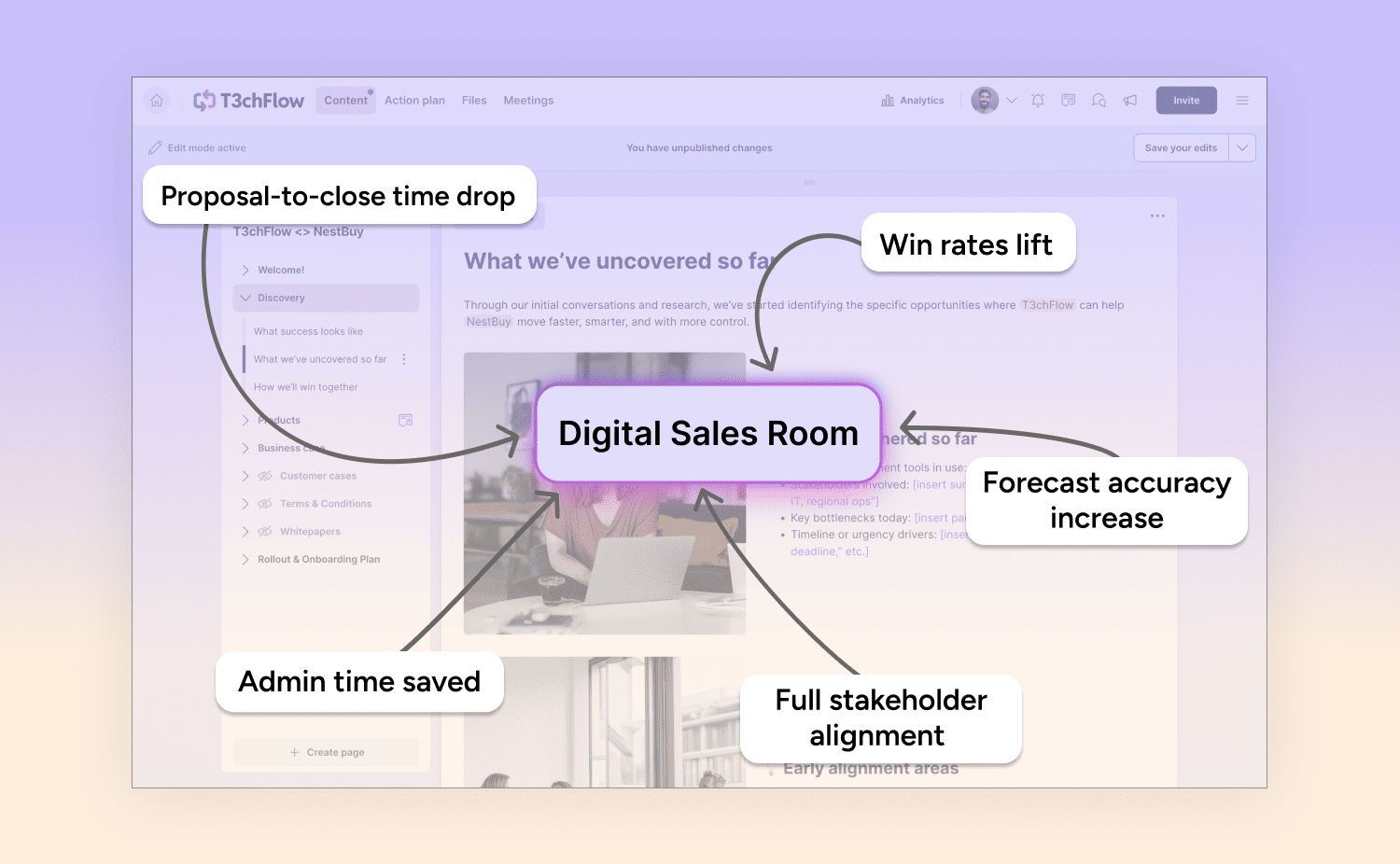
Our AI Digital Sales Room built around the part of the sales process Highspot's SmartPages never fully solved: a collaborative workspace where the buyer can comment, review a mutual action plan, and move through the deal alongside your reps, not just view a page you sent them.
Key features
-
Digital Sales Rooms that give every deal a single, branded destination where buyers can access demos, pricing, case studies, contracts, and meeting summaries in one link
- Fast, template-driven room creation - reps can spin up a personalized, on-brand room in minutes without hunting through a content library or learning platform-specific terminology
-
Stakeholder-level engagement tracking showing which person viewed which content, how long they spent on each section, and when they were last active
-
Native bidirectional integrations with Salesforce, HubSpot, Dynamics, Pipedrive, and SuperOffice - not middleware
-
AI built for sales that draws on CRM data, meeting transcripts, and room content to help reps create rooms and personalized materials at scale
-
Mutual Action Plans and in-room buyer collaboration - buyers can comment, ask questions, and track shared milestones directly in the room, so the deal moves forward as a joint effort instead of a one-way document you sent them
- Proposals, contracts, and e-signature built infor when a deal is ready to close - configurable signing order, automatic reminders, and instant CRM sync, without adding another tool to the stack
What it offers over Highspot
A few specifics teams moving off Highspot to GetAccept mention:
-
Deal room setup and day-to-day use feel less manual than with Highspot. AI drafts business cases and follow-ups from actual meeting transcripts and deal context, not generic prompts.
-
Buyer-level engagement analytics show which specific stakeholder hasn't engaged, not just which content performs best in aggregate.
-
Contracts and e-signature live in the same workspace instead of moving to a separate tool at the finish line.
- CRM integration runs both directions on Salesforce and HubSpot. Buyer activity updates CRM fields automatically instead of a rep logging it manually after the fact.
Pros
-
Fast enough that reps actually adopt it, no dedicated admin required to keep usage alive
-
Real-time buyer engagement data at the stakeholder level, not just "someone opened your link"
-
CRM integrations that are native and bidirectional, so buyer activity logs automatically
-
AI that understands the full state of a deal, not just a single document or call
-
Proposals and e-signature available natively, so closing doesn't require a separate tool
-
Transparent, predictable per-user pricing with no volume surprises
Cons
-
GetAccept is purpose-built for B2B sales teams - if you need a broad internal knowledge base or HR/learning management capabilities, it's not designed for that
-
Teams running purely transactional, single-buyer sales cycles may find the Digital Sales Room model more than they need
- The out-of-the-box trial environment leans more blank-canvas than pre-templated; teams evaluating quickly may want to ask for a populated demo room upfront rather than building one from scratch
G2 rating
Pricing
-
E-Sign: $25/user/month (billed annually) - unlimited legally binding e-signatures, in-browser document editing, engagement video options, automated reminders, and templates
-
Professional: $49/user/month (billed annually) - everything in E-Sign plus Digital Sales Rooms, advanced branding, full template editor, pricing tables, product library, premium CRM integrations, and buyer engagement insights
-
Enterprise: Custom pricing - contract management, robust CPQ rules, unlimited product library, SSO, advanced integrations, and API access
What our customers say
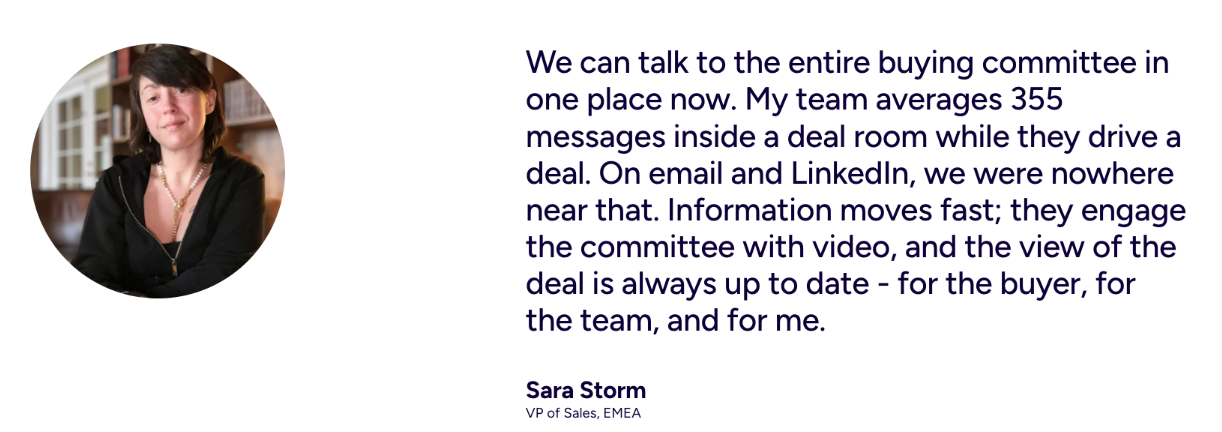
N.Rich's enterprise sales team was building deal rooms that took 4 to 8 hours each in a previous tool. Their deals stalled between scattered content and stakeholder conversations running one-to-one over email, after a previous digital sales room failed to get adopted.
VP of Sales Sara Storm moved the team to GetAccept, bringing entire buying committees into one HubSpot-native room built in minutes instead of hours.
Deal room setup dropped from 4-8 hours to 10 minutes, and a €100K+ deal survived losing 3 of its 4 stakeholders mid-cycle, because nothing lived in an inbox.
2. Showpad
 Best for: Mid-market B2B sales teams that want content and coaching balanced evenly without going full enterprise.
Showpad is a sales enablement platform that combines content management, sales coaching, and buyer engagement tools into one workspace.
It bundles content management, coaching, buyer engagement, and analytics . Genie AI handles content recommendations by deal stage, Roleplay AI lets reps practice against an AI counterpart, and Field Meeting AI captures notes from in-person conversations and updates CRM fields automatically.
Key features
-
Centralized content management for organizing, tagging, and distributing sales assets to reps across the team
-
Sales coaching and training tools to support rep readiness and consistent messaging
-
Buyer engagement features that allow sellers to share content with prospects and track how it's consumed
-
Content analytics to understand which materials are being used and driving results
-
Integrations with major CRM platforms to connect content usage to pipeline data
What it offers over Highspot
Showpad combines content management and sales coaching in a single platform, reducing the need for separate tools. The buyer-facing sharing capabilities give prospects a more organized experience than raw email attachments.
Pros
-
Combines content management and sales coaching in a single platform
-
Buyer-facing sharing capabilities give prospects a more organized experience
-
Designed for revenue teams, so the use cases are more sales-specific than a general knowledge management tool
Cons
-
Like Highspot, Showpad is primarily a seller-side and content-organization tool - deal-level buyer engagement visibility is limited compared to purpose-built Digital Sales Room platforms
-
Pricing is not publicly listed, which makes it harder to evaluate fit without going through a sales process
-
Mobile experience is strong, but admins report a setup learning curve similar to Highspot's.
G2 rating
Pricing
Pricing is not publicly listed - contact the vendor for a quote.
3. Mindtickle
 Best for: Teams whose Highspot frustration centered on rep readiness and onboarding speed, not content findability.
Mindtickle is a revenue enablement platform built around the idea that rep readiness is the foundation of sales performance. It gives frontline managers structured workflows for coaching, skills development, and onboarding - with analytics that help leaders understand where reps need support.
If Highspot's training capabilities feel thin for what your team needs, Mindtickle goes significantly deeper on that dimension.
Key features
-
Sales training and onboarding workflows for ramping new reps quickly and consistently
-
Coaching and skills development tools that give frontline managers structured ways to assess and develop their team
-
Content and enablement capabilities that support customer-facing selling activities
-
Analytics to track rep engagement with training programs and measure learning progress over time
-
Customer-facing enablement features for sales and success organizations
What it offers over Highspot
Mindtickle's coaching and readiness workflows go well beyond what most content-focused enablement platforms offer. The analytics help revenue leaders understand rep skill gaps, not just content usage.
Pros
-
Deep coaching and readiness workflows that go well beyond what most content-focused enablement platforms offer
-
Strong analytics for revenue leaders who want to understand rep skill gaps, not just content usage
-
Built for both sales and customer success teams, making it useful across the full revenue organization
Cons
-
Primarily focused on the seller side - deal-level buyer engagement and Digital Sales Room capabilities are not Mindtickle's core strength
-
If content governance at scale is the primary need, this isn't built to be your content system of record
G2 rating
Pricing
Pricing is not publicly listed - contact the vendor for a quote. List pricing typically runs $35 to $60 per user monthly, often negotiated to $22 to $32 on multi-year commitments.
4. Allego
Best for: Teams prioritizing training and video coaching over content management depth, often as a lower-cost alternative to the bigger suites.
Allego started as video-based coaching and has grown into a broader enablement platform, but coaching and peer learning are still where it's strongest. Reps record pitches, managers give asynchronous feedback, and AI role-play adds repetition for common scenarios.
Useful for teams that want reps to rehearse pitches, handle objections, and get structured feedback before they're in front of a buyer.
Key features
-
Centralized sales enablement content management for organizing and distributing assets to reps
-
Video-based coaching and practice tools that let reps record pitches and receive structured feedback from managers
-
Revenue enablement workflows designed for teams that need content, learning, and reinforcement in one platform
-
Analytics to track content usage, coaching activity, and rep engagement with training programs
What it offers over Highspot
Allego combines content, learning, and coaching in one suite. The video-based practice workflows give managers a structured way to develop reps before they're in front of buyers.
Pros
-
Helps centralize sales enablement resources, making it easier to organize and share content with teams
-
Useful for coaching and training reps with video-based practice and feedback workflows
-
Positioned as a broader enablement suite for teams looking for content, learning, and coaching capabilities in one place
Cons
-
Setup and day-to-day administration can take time, especially for larger teams with more complex enablement needs
-
Finding specific content or navigating the interface can feel cumbersome at times
-
Pricing is not publicly available, which makes it difficult to assess cost before engaging with sales
G2 rating
Pricing
Pricing is not publicly listed - contact the vendor for a quote. Generally cited in the $25 to $60 per user monthly range.
5. Guru
Best for: Teams that want fast content findability without a multi-week rollout. Setup can be live in a day, versus the weeks typically needed for Highspot, Seismic, or Mindtickle.
Guru takes a different angle from most tools on this list. Rather than focusing on sales content or rep coaching, it's an AI-powered knowledge management platform built for teams that need fast, reliable answers during customer conversations.
Think internal wikis, FAQs, and playbooks - surfaced in context, right where your team is already working. If Highspot feels like overkill for what is essentially a knowledge organization problem, Guru is worth a look.
Key features
-
Centralized knowledge base for storing FAQs, playbooks, and internal documentation in a single, searchable location
-
Contextual knowledge delivery via browser extension and workflow integrations so answers surface where teams already work
-
AI-assisted search and answer retrieval that helps customer-facing teams find accurate information quickly
-
Verification and content governance tools to flag outdated content and keep the knowledge base current
What it offers over Highspot
Guru solves a different problem - fast, reliable knowledge access for customer-facing teams. The browser-based and workflow-friendly delivery means knowledge is available in context, not buried in a separate platform.
Pros
-
Makes knowledge easy to capture and access, especially for teams that need fast answers during customer conversations
-
Helps centralize information and reduce time spent searching across scattered docs
-
Browser-based and workflow-friendly delivery means knowledge is available in context
Cons
-
Maintaining content quality and keeping knowledge up to date requires ongoing admin effort
-
Large or complex knowledge bases can become harder to organize over time
-
Compared with sales enablement tools like Highspot, Guru is less focused on content coaching, deal-level analytics, and enablement-specific reporting
G2 rating
Pricing
Pricing is not publicly listed - contact the vendor for a quote.
6. Paperflite
Best for: Small to mid-sized revenue and sales teams that want transparent pricing and a lighter footprint than Mindtickle, Seismic, or Showpad.
Paperflite's core identity is content management, sales engagement, and content intelligence, narrower than the full suites above but sharper if that's specifically your gap.
Key features
-
Content organization and sharing tools for sales teams that need a central library of buyer-facing materials
-
Content tracking and analytics to see how prospects engage with shared materials - opens, time spent, and activity
-
Sales enablement workflows designed for revenue teams managing collateral and buyer-facing content
-
Content discovery so reps can find and send the right asset without digging through folders
What it offers over Highspot
Paperflite is simpler and more focused than enterprise enablement platforms. Easier to get up and running for smaller teams than Highspot, with content tracking that gives reps visibility into how buyers interact with shared materials.
Pros
-
Simpler and more focused than enterprise enablement platforms - easier to get up and running for smaller teams
-
Content tracking gives reps visibility into how buyers interact with shared materials
-
Designed specifically for revenue teams, so the use cases are sales-relevant rather than general knowledge management
Cons
-
Less depth in coaching, training, and rep readiness features compared to platforms like Mindtickle or Allego
-
Pricing is not publicly available, which adds a step to the evaluation process
G2 rating
Pricing
Pricing is not publicly listed - contact the vendor for a quote.
How to choose: 2-minute self-check
Check every box that's true for your team. Whichever group has the most checks is where to start.
Full platform replacement
✔️ Manager coaching and call review matter as much as content delivery
✔️ We have budget and time for a multi-week implementation
✔️ Content governance across a large team is a top-3 requirement
3+ checked: Mindtickle if onboarding speed is the bigger pain than content findability. Showpad if it's roughly even between the two. Allego if coaching and video are the priority and you want a lower price point than either.
Content management only
✔️ Reps mainly used Highspot to find the right deck or one-pager, nothing more
✔️ We don't need training paths, certification, or coaching workflows
✔️ Setup speed matters more than feature depth
✔️ We'd rather not touch our stack right now if we don't have to
3+ checked: Guru for the lightest footprint and fastest setup. Paperflite if you also need buyer-facing content tracking. Staying on the merged Seismic platform and renegotiating if migration cost outweighs the frustration.
Buyer-facing deal execution
✔️ The actual complaint is about running the deal with the buyer, not finding content internally
✔️ Building or updating a deal room/proposal manually eats more time than it should
✔️ We want buyer-level engagement data (who's engaged, who hasn't) rather than just content performance stats
✔️ E-signature and contracts currently live in a separate tool from your content or proposal tool
3+ checked: GetAccept. You get Deal Rooms as the buyer-facing workspace, contracts and e-signature in the same place instead of a separate tool, buyer-level engagement analytics down to the stakeholder, and two-way Salesforce and HubSpot sync so activity flows back to CRM automatically. Teams making this switch have cut sales cycles by more than half by giving buyers one place to track everything.
If you're split between two categories: Some teams (like the ones we've talked to) run a lighter Highspot-style tool for internal content alongside GetAccept for the buyer-facing motion, rather than replacing everything at once.
This comparison is based on publicly available information and reflects GetAccept's independent view. Features, capabilities, pricing, and product scope may change over time. All trademarks and product names are the property of their respective owners.
-1.jpg)



![[Guide] Why you need sales enablement in your organization](https://www.getaccept.com/hubfs/Blogg_Thumbnail_sales_enablement_guide.jpg)