
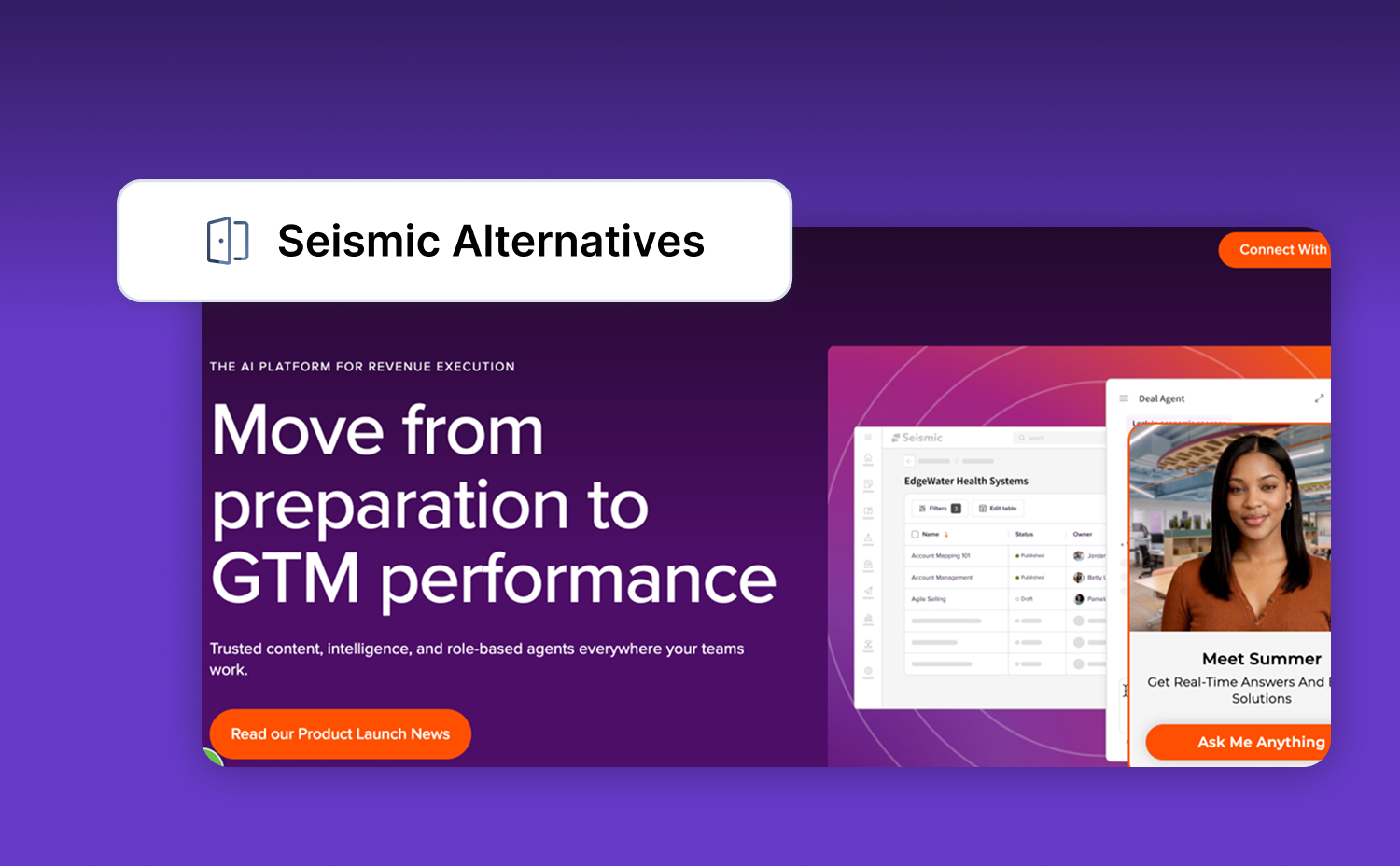
Seismic is a good product that plenty of teams outgrow, or never quite grow into.
If you’re searching for an alternative, one of four things is probably true. The rollout took longer than planned. The cost is hard to justify. Reps still open Google Drive instead of the platform. Or content goes out to buyers and then you lose sight of it.
Those are four different problems with four different solutions. Below are six Seismic alternatives, and for each one we say which problem it solves and which it doesn’t.
GetAccept is on the list, and we built it for the last problem, so we’re biased. We’ve tried to be straight about where the other tools beat us.
TL;DR: Top Seismic alternatives at a glance
- GetAccept for buyer-facing deal execution with Digital Sales Rooms, e-signatures and buyer engagement tracking
- Highspot for content management and coaching at scale
- Mindtickle for rep training and readiness
- SalesHood for training, coaching and buyer rooms in one platform
- Kendo AI for AI roleplay and conversation practice
- Conga for document generation and contracts in Salesforce
What is Seismic?
Seismic is an enterprise sales enablement platform designed to help sales and marketing teams manage content, train reps, and improve go-to-market execution.
The platform centralizes sales collateral, automates content personalization, and provides analytics on how content is used across the sales process. It's primarily built for large enterprise organizations with complex content libraries and distributed sales teams.
Why teams consider Seismic alternatives
Four complaints come up most often when teams are switching from Seismic, and each points to a different alternative:
-
Implementation takes real time and admin effort. Getting Seismic configured, content loaded, and reps actually using it often takes months. For teams without a dedicated enablement administrator or a large IT function, that investment can be hard to justify.
-
The price point is built for enterprise budgets. Seismic doesn't publish pricing publicly, and for good reason - it's expensive. Total cost of ownership typically includes licensing, implementation, and ongoing support, and it's rarely a comfortable fit for teams below a certain headcount or revenue threshold.
-
The buyer’s side of the deal is less central. Seismic is built to help reps find and deliver content. But once a rep sends that content to a buyer, Seismic's involvement beyond showing you the doc was opened ends.
- Adoption suffers when finding content feels like work. Seismic's depth - which is one of its strengths - can also make it harder for reps to find what they need quickly. Many reviews repeatedly say that the platform feels like work to navigate, so reps default to their own files and workarounds.
6 best Seismic alternatives for sales enablement teams in 2026
|
# |
Tool |
Core Strength |
Why Choose Over Seismic |
Best For |
Pricing |
|---|---|---|---|---|---|
|
1 |
GetAccept |
Buyer-facing deal execution: Digital Sales Rooms, e-signatures, engagement tracking |
Covers the full deal cycle from enablement to close - not just internal content management |
B2B sales teams with complex, multi-stakeholder deals |
From $49/user/month |
|
2 |
Highspot |
AI content management and rep coaching |
More accessible than Seismic for mid-market teams; tiered packaging |
Enterprise enablement teams scaling content programs |
Quote-based |
|
3 |
Mindtickle |
Sales readiness and training workflows |
Stronger focus on rep readiness and structured coaching programs |
Distributed sales teams needing structured onboarding |
Quote-based |
|
4 |
SalesHood |
Training, coaching, content, and buyer engagement combined |
Includes Digital Sales Rooms and MAPs - bridges internal enablement and buyer experience |
Mid-market teams consolidating their enablement stack |
From $45/user/month |
|
5 |
Kendo AI |
AI sales roleplay and conversation coaching |
Focused specifically on rep conversation quality with transparent pricing |
Enablement teams improving seller readiness through practice |
From $55/seat/month |
|
6 |
Conga |
Document generation and contract lifecycle automation |
Stronger for revenue teams that need document and contract workflows, especially in Salesforce |
Salesforce-centric revenue operations teams |
Quote-based |
1. GetAccept - Best for buyer-facing deal execution from Content to Close
Best for: Mid-market B2B sales teams selling complex deals to multiple stakeholders who need to enable reps, engage buyers, close contracts, and onboard customers from one platform.
GetAccept is a Digital Sales Room platform purpose-built around the buyer-facing execution layer: a collaborative deal space where sellers and buying committees can access content, align on next steps, communicate, and move from opportunity to signature to onboarding - all with one link.
GetAccept isn't trying to replace your LMS or your content management system. It solves a specific problem that Seismic doesn't: the gap between "proposal sent" and "deal closed."
Key features
-
Digital Sales Rooms that consolidate all deal content - decks, pricing, contracts, demo recordings, and meeting summaries - into a single link for the entire buying committee
-
Stakeholder-level engagement tracking & analytics that shows which person viewed which content, for how long, and when - not just "someone opened your link"
- Native bidirectional CRM integrations with Salesforce and HubSpot - buyer engagement activity logs automatically, no manual entry required
-
Mutual Action Plans to align sellers and buyers on milestones, timelines, and next steps inside the deal room
-
Practical, deal-aware AI layer with agents that reduces the work of preparing buyer-facing content and surfaces relevant deal context in minutes - without duplicating the jobs already handled by your CRM, conversation intelligence, or sales-assistant tools
- Built-in e-signatures with signing order, role transfer, and automated reminders - no downloading PDFs or chasing paper
What GetAccept offers over Seismic
Seismic helps teams manage enablement content. GetAccept helps sellers and buyers use that content to execute the deal. It's the buyer-facing deal-execution layer for teams that want to move beyond Seismic’s content hub.
-
Buyer enablement & collaboration: Seismic mainly acts as a content-distribution place. GetAccept combines engagement data with buyer collaboration, chat, Mutual Action Plans, and next steps so the deal room becomes an active workspace for progressing the deal.
-
End-to-end deal coverage: GetAccept handles the full cycle from first touchpoint to signed contract. Seismic requires additional tools to cover proposals, e-signatures, and buyer collaboration.
-
Faster time to value & better rep adoption: GetAccept is built for sales teams to use without a dedicated enablement administrator. Reps can create and send a Deal Room and sales content in minutes from templates, CRM data, and meeting notes, not after a multi-month implementation.
-
CRM-native deal execution: Reps shouldn't have to leave Salesforce or HubSpot to create, send, or monitor a Deal Room. Our CRM connections allow create and manage the buyer-facing rooms, send the right content, and surface engagement from the CRM your reps already use.
- Improved post-sale handoff: GetAccept Deal Room serves as a shared operating space for onboarding, expansion, QBRs, and executive reviews, so customer-facing teams don't have to reconstruct the sales story from scattered emails, calls, and documents.
- Transparent, predictable pricing: GetAccept publishes pricing publicly. No surprise enterprise contracts or usage-based billing that scales unpredictably.
Cons
-
GetAccept is not a standalone LMS or training platform - if your primary need is rep onboarding courses and certification programs, you'll want to pair it with a dedicated training tool
-
The full feature set is most valuable for teams with multi-stakeholder, complex deals. Transactional sales with single buyers won't get the same return on investment
Pricing
-
E-Sign: $25/user/month (billed annually) - unlimited legally binding e-signatures, document editing, engagement video, automated reminders, and templates
-
Professional: $49/user/month (billed annually) - everything in E-Sign plus Digital Sales Rooms, advanced branding, pricing tables, product library, and premium CRM integrations (Salesforce, HubSpot, Dynamics, Pipedrive, SuperOffice)
-
Custom pricing - contract management, advanced CPQ rules, SSO, API access, HR and payment integrations
What our customers say...
Dealfront, formerly Leadfeeder and Echobot, had just set up an Enterprise Sales team. Sellers were spending about 2 hours per opportunity exchanging information with prospects, and their sales cycle was over 150 days long.
Since moving all their deal content into a GetAccept Digital Sales Room, the time reps spend exchanging information reduced by 75%, and their sales cycle length cut down by 67%, from 150 days to roughly 50.
Read the full Dealfront case study →
2. Highspot - Best for starting with content and adding coaching later
Best for: Mid-market and enterprise sales enablement teams that need an AI-powered platform for content management, rep coaching, and scalable enablement programs.
Acquired by Seismic in 2026, Highspot is no longer an independent competitor.
For teams evaluating Seismic who want similar capabilities at a potentially more accessible entry point, Highspot is worth a close look. But it is now a choice between two product lines inside one company. If your reasons for leaving Seismic are about the vendor itself, such as cost, complexity, or support, Highspot may not get you out of them.
Key features
- AI sales enablement platform for organizing, governing, and delivering content to reps, with AI search and content recommendations
- Highspot Agents, including Deal Agent and GTM Agent, that surface deal context and suggest next steps
- Three packages (Equip and engage, Train and practice, Coach and reinforce), with enterprise capabilities such as advanced content management and document autogeneration listed separately
- AI Role Play, training authoring, and coaching tools for rep practice and skill building
- Digital Sales Rooms and analytics on content, plays, and buyer engagement, with rooms included from the entry package
Pros
- Tiered packaging lets teams start with content and add training and coaching later, instead of buying the full suite upfront
- Broad AI layer: agents, role play, and, in the top package, integrations with Salesforce Agentforce, Microsoft Copilot for Sales, and Slack AI
-
Positioned specifically for sales enablement workflows, making it relevant for teams comparing it directly to Seismic
Cons
- Roadmap uncertainty: two overlapping product lines now sit under one company
- Not an exit from Seismic: for teams leaving over vendor-level issues like cost, complexity, or support, switching to Highspot means staying with the same parent company
-
Third-party pricing estimates suggest a relatively high total annual cost, which may be a concern for budget-sensitive teams
-
No free plan or trial is confirmed in available sources
Pricing
Highspot doesn't publish pricing. Third-party research estimates tiered offerings (Core, Advanced, Enterprise) at roughly $600-$1,200 per user per year on annual-only contracts, with 50+ user minimums and setup fees. Contact the vendor for a quote.
3. Mindtickle - Best for onboarding and certifying distributed sales teams
Best for: Mid-market and enterprise sales enablement teams that need a structured platform for training, coaching, and readiness programs across distributed sales organizations.
Mindtickle focuses on the rep readiness side of sales enablement - getting sellers prepared before they get in front of a buyer. Its training workflows, coaching tools, and readiness analytics make it a strong fit for organizations that have a formal enablement function and need to manage rollouts across large or geographically distributed sales teams.
If Seismic's content management depth feels like overkill and what you really need is a platform that helps reps practice and improve, Mindtickle is worth evaluating.
Key features
-
Sales readiness and training workflows for structured onboarding programs and ongoing rep development
-
Coaching and practice tools to help sellers prepare for calls, handle objections, and improve execution before customer conversations
-
Enablement content and program management for distributing and tracking sales materials across teams
-
Analytics and reporting to monitor adoption rates and measure readiness outcomes over time
Pros
-
Organizes sales training and readiness programs in one place, making it easier for enablement teams to manage rollouts without juggling multiple systems
-
Coaching and rep practice workflows are well-suited for preparing sellers before customer conversations - not just after the fact
-
Sales readiness and enablement capabilities align with training, coaching, and content delivery needs for distributed sales teams
Cons
-
Public pricing information is not available, which can make evaluation and budgeting harder without engaging the sales team first
-
Like Seismic, Mindtickle is focused on internal enablement - it doesn't cover buyer-facing engagement, Digital Sales Rooms, or e-signatures
Pricing
Pricing is not publicly listed - contact the vendor for a quote. No free plan or trial is confirmed in available sources.
4. SalesHood - Best for consolidating training, coaching & buyer rooms
Best for: Mid-market to enterprise sales enablement teams that want an all-in-one platform for training, coaching, content, and buyer engagement instead of a content-only tool.
SalesHood is one of the more complete alternatives on this list because it bridges the gap between internal enablement and the buyer experience.
For teams that are tired of managing separate tools for rep readiness and buyer engagement, SalesHood offers a more consolidated approach than Seismic without requiring a second platform to cover the deal-execution side.
Key features
-
Digital Sales Rooms for buyer-facing collaboration, content sharing, and deal organization in a single link
-
Mutual Action Plans to align sellers and buyers on milestones and next steps throughout the deal cycle
-
AI Call Recaps to support sales coaching and follow-up workflows after customer conversations
-
Personalized site branding for buyer-facing sales environments to maintain a consistent brand experience
-
Client Sites for organizing customer-specific content and engagement in one place
Pros
-
Brings training, coaching, content management, and buyer engagement into one platform - reducing tool sprawl for enablement teams
-
Digital Sales Rooms and Mutual Action Plans make it useful for structured buyer collaboration in complex sales cycles, which Seismic doesn't cover
-
AI Call Recaps and AI content tools help teams scale coaching and content workflows without adding headcount
Cons
-
Public pricing climbs quickly from the entry tier to higher plans, which may make it less attractive for budget-conscious teams evaluating total cost of ownership
-
No free plan is available - teams will need to engage sales for full pricing and packaging details beyond what's publicly listed
Pricing
-
Essential: Starting at $45/user/month
-
Approximately $65-$75/user/month (based on publicly referenced figures)
-
Unlimited/Transform: $85+/user/month or custom quote
No free plan or free trial is confirmed in available sources.
5. Kendo AI - Best for AI roleplay and call practice
Best for: Sales enablement teams at mid-market or enterprise companies that want an AI roleplay and coaching tool to improve seller readiness and conversation quality.
Kendo AI takes a focused approach to one of the hardest parts of sales enablement: getting reps to actually practice. It's an AI-powered roleplay and coaching platform where sellers can rehearse conversations, handle objections, and get scored against custom criteria.
It's not a full content management platform like Seismic, but for teams whose primary gap is rep conversation quality rather than content organization, it's a sharp, purpose-built tool.
Key features
-
AI-powered sales roleplay for practicing rep conversations and objection handling in a realistic, low-stakes environment
-
Custom scorecards to evaluate seller performance against enablement criteria defined by your team
-
Advanced analytics to track coaching and practice outcomes over time and identify skill gaps
-
Enterprise plan with custom AI models and VIP support for larger enablement programs
-
Free trial available for evaluation before purchase - no lengthy procurement process required
Pros
-
Public pricing makes it easy for sales enablement teams to evaluate quickly without a lengthy procurement process or a demo-gated conversation
-
Customizable scorecards and advanced analytics are useful for measuring and improving rep performance against specific enablement criteria
-
DFY (done-for-you) setup and support can reduce implementation effort for enablement teams without dedicated technical resources
Cons
-
Kendo AI is focused on roleplay and coaching - it's not a full sales enablement content management platform like Seismic, so it won't replace your content library or training curriculum
-
The lowest public plan includes only 180 roleplay minutes per seat per month, which may be restrictive for heavier training programs or teams with frequent practice requirements
Pricing
-
Free Trial: $0/seat/month - available for evaluation
-
Pro: $55/seat/month - includes 180 roleplay minutes per seat per month
-
Max: $100/seat/month - includes 480 roleplay minutes per seat per month
-
Enterprise: Custom pricing - includes custom AI models and VIP support
6. Conga - Best for document and contract automation in Salesforce
Best for: Mid-market or enterprise revenue teams, especially Salesforce-centric sales operations groups, that need document generation and contract workflow automation alongside their sales process.
Conga sits at the intersection of document generation, contract lifecycle management, and revenue process automation. It's not a sales enablement platform in the traditional sense - it won't help you train reps or manage a content library - but for teams whose primary pain point is the document and contract side of the deal cycle, it's a strong fit.
If your Seismic evaluation is about solving document chaos and contract bottlenecks inside Salesforce, Conga is worth considering.
Key features
-
Document generation for sales collateral, proposals, and customer-facing agreements, pulling data directly from CRM records
-
Contract lifecycle management to support quote-to-close and post-sale agreement workflows from a single platform
-
Revenue process automation with Salesforce-native deployment options for teams already operating inside Salesforce
-
Per-user monthly licensing for Conga Composer, making the document-generation component straightforward to budget
-
Annual contract minimums for purchased subscriptions
Pros
-
Combines document creation, contract management, and process automation in one platform - well suited to revenue workflows that span the full quote-to-close cycle
-
Salesforce-native deployment is attractive for sales teams already operating inside Salesforce and wanting to minimize context switching
-
Per-user monthly pricing for Conga Composer can make the document-generation component straightforward to understand for budgeting purposes
Cons
-
Pricing is not publicly listed, and annual contract minimums may reduce flexibility for smaller teams or those still evaluating fit
-
Conga is not a sales enablement content management platform - it won't replace Seismic's training, coaching, or content library capabilities
Pricing
Pricing is not publicly listed - contact the vendor for a quote. No free plan or trial is mentioned in available sources.
Choosing the right Seismic alternative in 1 minute
-
If you need to cover the buyer side of the deal - Digital Sales Rooms, proposals, e-signatures, and stakeholder engagement tracking - GetAccept is the most complete option.
-
If you need enterprise-grade content management with AI-powered recommendations and you're evaluating Seismic head-to-head, Highspot is the closest direct alternative with tiered packaging.
-
If rep readiness and structured training programs are your primary gap, Mindtickle offers a focused platform built around onboarding, coaching, and readiness analytics.
-
If you want to consolidate training, coaching, content, and buyer engagement into one tool, SalesHood bridges the internal and external sides of enablement better than most alternatives on this list.
-
If your biggest pain point is rep conversation quality and you want reps to practice before they get in front of buyers, Kendo AI is a focused, transparent-pricing option worth trialing.
-
If document generation and contract lifecycle management inside Salesforce is the real problem, Conga is purpose-built for that workflow.





![[Guide] Why you need sales enablement in your organization](https://www.getaccept.com/hubfs/Blogg_Thumbnail_sales_enablement_guide.jpg)