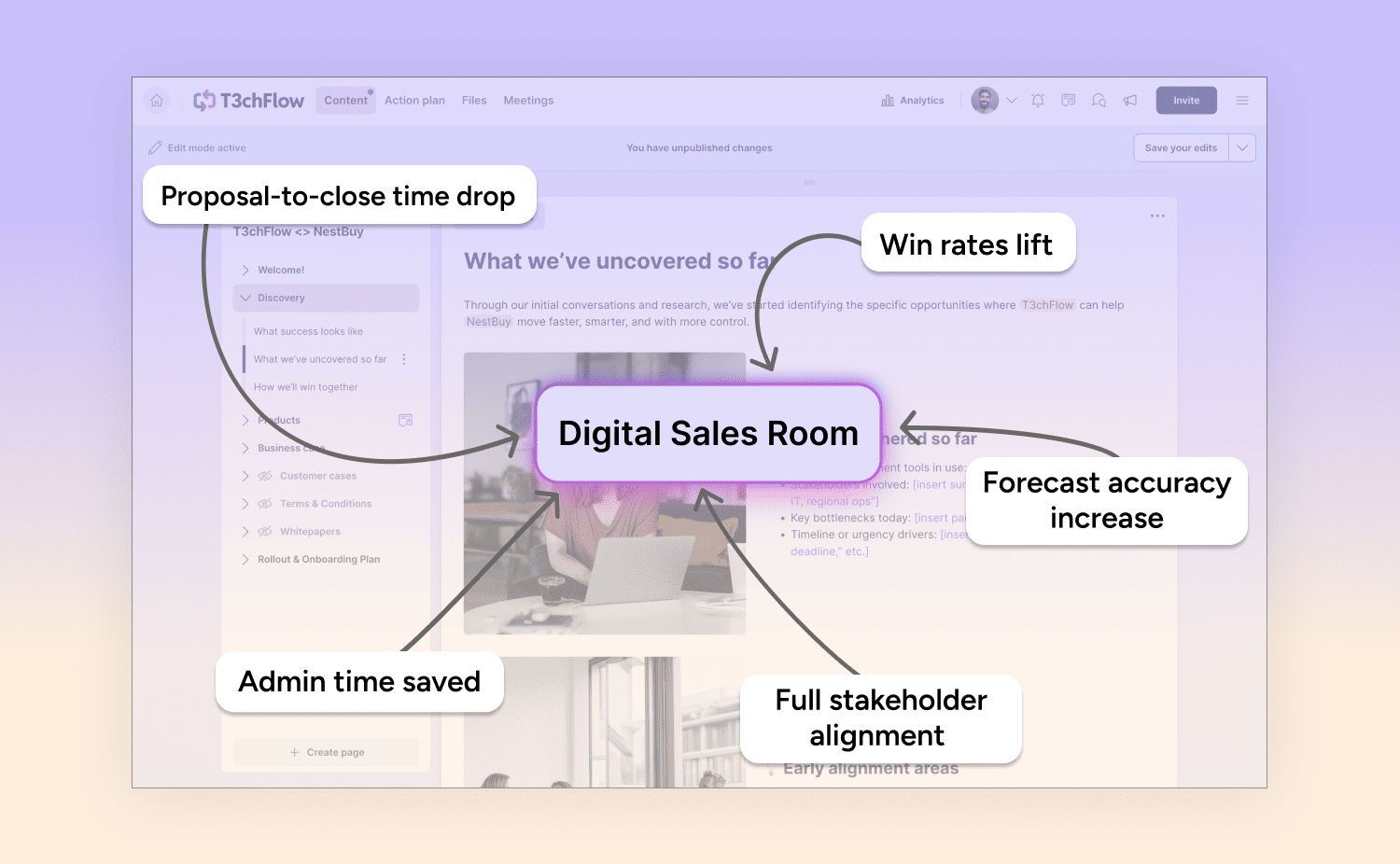
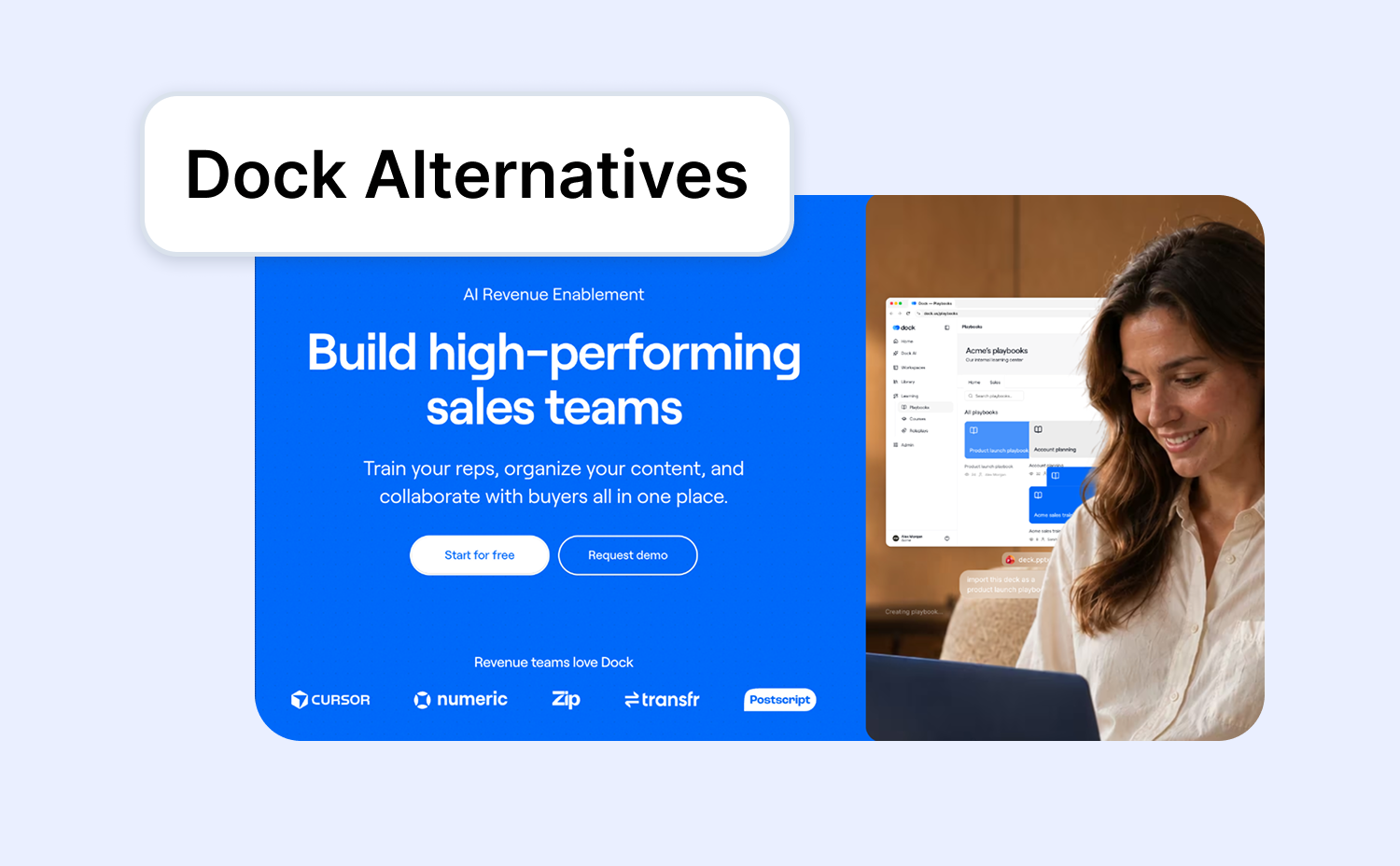
The teams evaluating Dock alternatives rarely conclude it's badly built; rather, they're asking: "Can this platform become part of how we actually run the deal?"
This article covers four alternatives: GetAccept for end-to-end deal execution and buyer-facing rooms; Highspot for sales enablement and content management at scale; Valuecase for customer onboarding; and PandaDoc for AI-assisted proposal and document generation.
GetAccept gets the most space, because we publish this article and we're one of the four tools on it. We've used the same five criteria listed below for every vendor, including ourselves.
Top Dock alternatives at a glance
- GetAccept for mid-market sales & revenue teams that want the buyer-facing digital sales room to run inside the CRM and carry complex deals end-to-end.
- Highspot for enablement teams managing a large content library and training program across a big sales org, more than running individual buyer-facing rooms.
- Valuecase for teams that want a buyer-facing workspace centered on customer onboarding, after the deal is already won.
- PandaDoc for teams whose main need is fast, AI-assisted proposal and document generation, with e-signature attached.
What is Dock?
Dock is an AI-native revenue enablement platform built around buyer-facing client workspaces, often called deal rooms or client portals. It combines content management, AI-assisted slide and document generation, and a learning layer (playbooks and courses) that spans the deal and post-sale onboarding.
Why teams look for a Dock alternative
-
A deal room is not the whole deal workflow. Teams looking to run the complete sales process may look for a platform with deeper CRM-connected execution, buyer engagement, next steps, and analytics.
-
CRM depth has a ceiling. Teams that want the room, the CRM record, and an AI assistant all acting in sync run into that ceiling fast.
-
Broader functionality can create unnecessary complexity. Dock’s learning and certification capabilities may be excessive for teams primarily focused on sales execution.
-
High cost at the floor. Dock’s Standard plan runs $350/month for 5 users and Premium $1,000/month for 10, plus $50 per added seat, which is a higher effective floor than tools built specifically for the deal-room job.
How we compared
Five questions decided where each tool landed:
- Sales motion fit. Does the tool match how this team actually sells: enterprise and multi-stakeholder, proposal-heavy, trial-led, or content-led?
- CRM depth. Does data flow one way (CRM to room) or both ways (digital sales room activity back into CRM fields and workflows)?
- Depth of close. Does the platform carry the deal through quoting and signature itself, or hand off to another tool partway through?
- Buyer engagement visibility. Can a rep see what a specific stakeholder actually read, not just that a link was opened?
- Effective cost. What does a real team actually pay per seat, at the floor, not the headline number on the pricing page?
1. GetAccept - Best for end-to-end deal execution
GetAccept is a complete deal execution platform that covers the same buyer-facing Digital Sales Room and AI content that Dock leads with, but closes at greater depth with automated proposals, native e-signing, AI contract management, and EU data residency.
GetAccept was founded in 2015 and co-created the Digital Sales Room category with G2 in 2021; it's trusted by 5,000+ revenue teams, and holds a 4.6/5 from 1,268 reviews on G2 as of 2026.
Where Dock centers on the buyer-facing room and extends out into content and learning, GetAccept centers on the deal itself, consolidating where the deal gets built, negotiated and closed, end-to-end, with the CRM as the system of record on both sides.
Key features
- Digital Sales Rooms built from templates & meeting notes. In GetAccept, reps start from a template with pre-built sections or uploaded meeting notes, standard files and branding, so most rooms get assembled automatically in minutes. Content can be locked by admins to protect approved pricing, legal and security language, and locked content is also protected from AI edits.
- Advanced Mutual Action Plans. A shared execution plan inside the deal room with milestones and tasks that both buyer and seller can see and update, useful for long, complex sales cycles with multiple stakeholders or a security and procurement review ahead of it.
- Two-way CRM sync. GetAccept connects to Salesforce, HubSpot, Microsoft Dynamics, Pipedrive and SuperOffice, plus Salesforce Agentforce. Buyer activity in the room (visits, task completions, signatures) can update CRM fields automatically, and CRM changes can update a live room even after it's been shared with the buyer.
- EU-hosted AI. GetAccept's in-product AI runs on a tuned version of Claude, hosted on GetAccept's own EU infrastructure, with no data sent to OpenAI or other third-party AI providers. It drafts meeting summaries, business cases, proposal content and contract data extraction from the deal's own context.
- Native e-signature. Signing happens in the same flow as the proposal and contract, with handwritten, advanced (AES) and qualified (QES) signature levels.
- Buyer engagement analytics down to the section. Reps can see in real-time which stakeholder opened the room, which sections they spent time on, and where a deal has gone quiet, with in-depth analytics per deal.
- An MCP server with a write path. GetAccept's MCP server lets a rep's own AI assistant like Claude, ChatGPT, Gemini, Slackbot, and more build a Deal Room from a template, tailor it to a call, publish it and invite the customer, in one request the rep approves. It can also surface buyer signals, log meetings, update Mutual Action Plan tasks, and send reminders.
- CRM-native deal room creation via GetAccept's agent. In Salesforce, GetAccept's agent lets reps create and manage Deal Rooms with natural-language prompts without leaving the CRM, pulling in the record's deal data and any attached meeting notes.
What GetAccept offers over Dock
-
Wider, bidirectional CRM coverage. GetAccept syncs both ways with five major CRMs plus Salesforce Agentforce. Dock's integrations center on Salesforce and HubSpot.
-
A deeper, owned e-signing stack. Dock's order forms can quote and collect a signature in-product, through an embedded Dropbox Sign integration. GetAccept owns the signing stack itself: quoting (CPQ), qualified electronic signature, Nordic eID identity verification and contract management in one flow, from one vendor.
-
A lower effective floor per seat. Compare the real cost, not the sticker price. GetAccept Professional has no base platform fee: $49 per user per month, billed annually, works out to roughly $245 a month at a 5-user floor. Dock's Standard plan is $350 a month for 5 users (about $70 per user), and Premium is $1,000 a month for 10 users (about $100 per user), plus $50 for each additional seat beyond that.
-
An MCP server that can act, not just answer. GetAccept's MCP server lets reps build, publish and invite a customer to a full Deal Room in one approved prompt. Dock's own MCP launch documentation describes an assistant that can only query workspace data, not create or publish it.
Limitations
GetAccept doesn't try to be everything Dock is, by design.
-
Customer-facing courses. Dock includes course authoring: your team can build and deliver structured courses, playbooks and certifications to your own customers, with SCORM support added in mid-2026. GetAccept Academy trains your own team on the platform; it doesn't publish courses to your buyers. If a true LMS for your customers is the requirement, that's a genuine Dock strength.
-
A general-purpose AI agent builder. Dock lets customers build their own custom AI agents inside the platform, while GetAccept's AI is built specifically for the deal: proposal drafting, meeting summaries, business cases, contract data extraction. It isn't a general toolkit for assembling other AI agents. If extensibility into your own custom agents is what you're after, Dock is built for that.
Pricing
- eSign: $25 per user per month.
- Professional: $49 per user per month, billed annually with a 5-user minimum.
- Enterprise: custom pricing. Adds CPQ, unlimited product library, single sign-on and premium CRM integrations.
For more information, check GetAccept's pricing page.
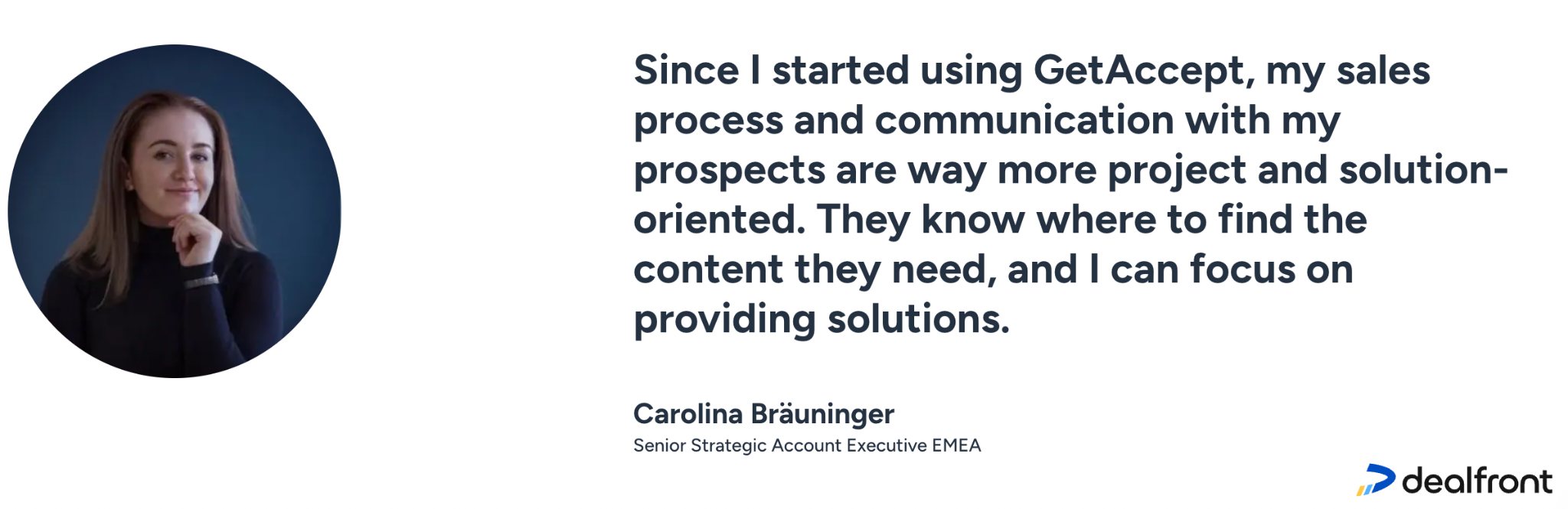
What GetAccept customers say: Dealfront
Dealfront, a SaaS company (formerly Leadfeeder and Echobot) that helps businesses find and reach the right buyers, had just formed an Enterprise Sales team and needed a tighter sales process. Sellers spent about 2 hours per opportunity swapping information with prospects, and tracking what each buyer had already received was slow and invited duplicated work.
The team moved its enterprise deals into GetAccept Digital Sales Rooms, connected to Salesforce. Content, Mutual Action Plans, in-document chat and engagement tracking now live in one shared space. Sellers can see which stakeholders are reading what, so they follow up with the warm leads first.
The results came quickly. Time spent exchanging information dropped by 75%. In several cases, sales cycles shrank from 150 days to 50, a 67% cut. And the Salesforce integration gave the team cleaner opportunity reporting and more accurate forecasts.
Want your own Dealfront-style results? Start a free trial and build your first Digital Sales Room, or book a demo and we’ll walk you through it using your own deal flow.
2. Highspot by Seismic
Best for: Enablement teams at large sales organizations that want content, training and coaching in one platform, and treat the buyer-facing room as a secondary need.
Highspot is a sales enablement platform that puts content management, training, coaching and AI-guided selling in one place for go-to-market teams. Seismic completed its merger with Highspot in 2026, and the product now runs as Highspot by Seismic. It holds a 4.7 average from 1,206 reviews on G2, as of 2026.
Key features
- Sales content management. Content is governed, searchable and matched to deal stage, buyer and play. AutoDocs automates document creation.
- AI agents. Deal Agent flags deal risk and recommends the next play. GTM Agent helps govern content. AI Role Play lets reps practice against different buyer personas.
- Training and coaching. Adaptive learning paths, deal-specific coaching feedback after calls, and on-demand courses and certifications through Highspot University.
- Digital sales rooms and analytics. Sellers can build personalized buyer experiences, and initiative scorecards show leaders what drives wins.
Limitations
-
Highspot is built for enablement leaders first. The buyer-facing room is one module in a wide platform, and Highspot describes it in far less detail than its content, training and coaching tools.
-
G2 reviewers most often mention a steep learning curve during setup and large content libraries that are hard to search. The merger closed in August 2026, so teams evaluating it now should ask how the roadmap will change.
Pricing
Pricing isn't published. Highspot sells three tiers by quote: Good (content management, sales plays, digital sales rooms, analytics), Better (adds training and practice) and Best (adds meeting intelligence, coaching and advanced AI agents).
Check our Highspot alternatives and Seismic alternatives.
3. Valuecase
Best for: Teams whose main moment is post-sale: customer onboarding and implementation plans, with one branded space from late-stage selling through go-live.
Valuecase is a collaborative workspace where B2B teams run deals and customer onboarding with buyers in one branded, shared space. It holds a 4.7 average from 74 reviews on G2, as of 2026.
Key features
- Onboarding plans. Interactive plans with assignees and due-date reminders, customer-facing intake forms, and a dashboard for progress, tasks and engagement.
- Digital sales rooms. Shared spaces for proposals, business cases, pricing and recordings, with mutual action plans and activity tracking by buying-committee member.
- CRM-driven setup. HubSpot, Pipedrive and Salesforce integrations, with spaces created automatically from CRM data.
- AI and MCP. An AI assistant builds templates, drafts emails and schedules meetings. An MCP server gives Claude, ChatGPT and Cursor access to Valuecase data.
- Security. ISO 27001 certified, GDPR compliant and hosted on AWS in Germany.
Limitations
Valuecase's depth is the shared workspace. Quoting, contract execution and signature typically sit in other tools, and the Salesforce integration comes only with the top, quote-based Scale plan. With 74 G2 reviews, it also has a thinner public track record than the other tools here.
Pricing
Starter starts at €59 a month with one internal user included and up to 3 templates. Growth starts at €119 a month and adds unlimited templates, the HubSpot and Pipedrive integrations, analytics and API access. Scale is quote-based and adds Salesforce, SSO and advanced team management. A 14-day free trial is available.
4. PandaDoc
Best for: Teams whose main need is fast proposal, quote and contract generation with e-signature and payments attached, and whose sellers spend more time in documents than in meetings.
PandaDoc is a document platform for creating, approving, tracking and e-signing proposals, quotes and contracts. It holds a 4.7 average from 3,823 reviews on G2, as of 2026.
Key features
- Templates and document generation. A drag-and-drop editor, template and content libraries, approval workflows, and smart content that adapts a document to each recipient.
- AI assistance. An AI Document Assistant drafts and refines copy in the editor. Agreements can also be created from a natural-language prompt, through native Claude and ChatGPT connectors or PandaDoc's MCP server.
- E-signature, CPQ and payments. Signing order, identity verification and qualified electronic signature (QES), catalog-based quoting with CPQ, and embedded payments through gateways like Stripe and PayPal.
- Deal rooms and tracking. Basic rooms for working through a deal with buyers, plus audit trails and document analytics. CRM integrations include Salesforce, HubSpot and Pipedrive.
Limitations
PandaDoc is document-first, and the deal room is an add-on to that workflow. Business includes up to 3 rooms, and unlimited rooms need Enterprise plan. CRM integrations start on Business, CPQ is an Enterprise add-on, and API and automated documents run on usage credits, so costs grow with volume.
Pricing
Free is $0 with capped documents and templates. Starter is $19 per seat per month and Business is $49 per seat per month, both billed annually. Enterprise is custom, per seat or per document.
How to choose in 60 seconds
Find your main job in the left column - that row is your shortlist.
|
If your main job is |
Start with |
Why |
|---|---|---|
|
Running the deal inside the CRM, from room to signed contract |
GetAccept |
Two-way CRM sync, proposals, Mutual Action Plans and e-signature in one workspace |
|
Qualified e-signature or Nordic eID in the same flow as the room |
GetAccept |
Quoting, QES and eID verification sit with the room, from one vendor |
|
EU-hosted AI for regulated or European buyers |
GetAccept |
AI runs on GetAccept's own EU infrastructure, with no data sent to third-party AI providers |
|
Training and coaching a large sales team, plus governing a big content library |
Highspot by Seismic |
Content management, learning paths, coaching and AI role play in one platform |
|
Onboarding customers after the deal closes |
Valuecase |
Onboarding plans, intake forms and a branded space built around go-live |
|
Generating proposals, quotes and contracts fast, with payments attached |
PandaDoc |
Template-driven document generation, e-signature, CPQ and embedded payments |
|
Building structured courses for your own customers |
Dock |
A genuine strength of Dock, and the one job GetAccept doesn't do |
Final thoughts
There is no universal best Dock alternative. The right choice depends on what matters most to your team: whether optimizing for speed of contract generation, the depth of sales coaching and rep development, customer onboarding after close, or running buyer-facing processes inside your CRM without context switching.
Test the ones that match your top priority, watch how your team adopts them, and make the call based on your own workflow, not the marketing.
Disclaimer: This list is based on publicly available information and reflects GetAccept's independent view. Features, capabilities, pricing, and product scope are current as of October 2026 and may change over time.