
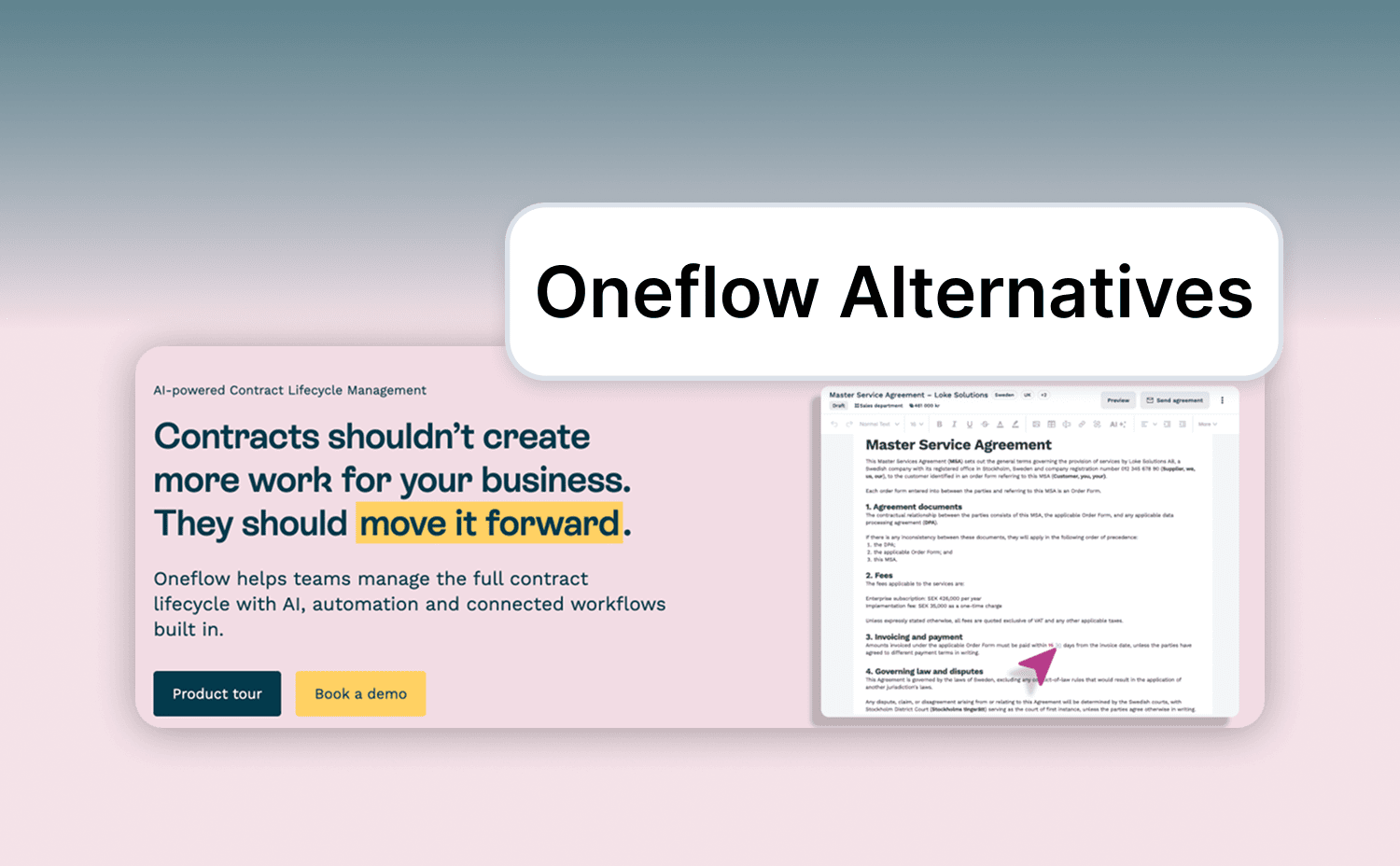
When sales teams evaluate Oneflow against other tools, signing is rarely what decides it. What decides it is everything before the signature:
-
How long an agreement takes to build
-
Whether the options a customer picks make it back into the CRM once they sign
-
Whether a rep can tell which of 5 stakeholders actually read the proposal.
Oneflow handles that last step well, and its 2026 quote-building push brings it closer to sales. The deal itself, however, is won or lost weeks earlier, in meetings, business cases and email threads Oneflow never sees.
This list is for teams whose needs sit before the signature, whether they use Oneflow today or are shortlisting it next to other tools. GetAccept is one of the six tools on it, and we publish this article, so we're biased. We used the same five criteria for every tool, including ours, and we say where Oneflow and the others are the better choice.
Top Oneflow alternatives at a glance
- GetAccept for sales and revenue teams that need the full pre-signature deal (Digital Sales Room, business case, CPQ and meeting context) around a CRM-connected signature
- DealHub for revenue operations teams with complex pricing, deal desks and multi-level approvals
- PandaDoc for teams producing a high volume of proposals, quotes and contracts, with payments attached
- DocuSign for organizations that mainly need e-signature at scale, from the category's best-known brand
- Proposify for mid-market teams that want structured proposals and approval workflows on HubSpot or Pipedrive
- Qwilr for teams whose priority is design-led, interactive web proposals
|
Tool |
Best for |
Digital Sales Room |
Pricing and quote depth |
Starting price |
|---|---|---|---|---|
|
GetAccept |
Full pre-signature deal experience |
Yes, core product |
Pricing tables, Pricing Groups, CPQ rules on Enterprise |
$25/user/month |
|
DealHub |
Complex quoting and approvals |
Yes, but as a quote-sharing interface only |
CPQ is the core product |
Quote-based |
|
PandaDoc |
High document volume with payments |
Add-on rooms (3 on Business) |
Catalog quoting, CPQ add-on on Enterprise |
Free plan; paid from $19/seat/month |
|
DocuSign |
Signing at scale |
No |
Not in eSignature plans |
About $30/user/month |
|
Proposify |
Structured proposals and approvals |
No |
Interactive pricing, approvals on Business |
$19/user/month |
|
Qwilr |
Design-led web proposals |
No |
Interactive pricing tables |
$35/user/month |
|
Oneflow (baseline) |
Cross-functional contract operations |
No |
Quote-building, no pricing rules or approval workflows |
EUR 250/month for 5 users |
What is Oneflow?
Oneflow is a Stockholm-based contract lifecycle management platform that helps sales, HR, finance and legal teams create, sign and manage contracts in one place. It was founded in 2012 and is strongest with Nordic and European mid-market and enterprise companies. In 2026, Oneflow repositioned as an operating system for contracts across departments.
Oneflow's Business plan costs EUR 250 a month, billed annually, with 5 users included. Enterprise is priced by quote.
Why sales teams look for a Oneflow alternative
Oneflow is a weaker fit for sales teams that need the full pre-signature deal experience. Sales teams usually look past it when their core problems are deals that run over email with no shared space, offers that can't handle their pricing, no view of which stakeholder is engaged, and CRM records that still need manual fixing after signing.
1. The deal happens in email, and only the contract happens in Oneflow
Oneflow comes in at the contract step. Everything before it, the discovery notes, the business case, the security review, the pricing back-and-forth, runs through inboxes and attachments.
That's manageable for a one-buyer deal. For a six-month cycle with finance, IT and an executive sponsor, it means nobody has the full picture, including the rep.
2. Your pricing outgrows a product table
Options the customer picks, bundles, conditional or usage-based pricing and approval chains are hard to fit into static templates. Static templates get painful to update, and quotes end up rebuilt every time a customer changes their mind.
Oneflow's 2026 quote-building helps with tax and line items, but it doesn't add pricing rules or approval workflows.
3. You see that the contract was opened, not who is engaged
Knowing a document was opened doesn't tell you much in a deal with 6 stakeholders. Reps want to know who read the pricing page, how long the CFO spent on the business case, and whose silence means the deal is cooling.
4. The CRM still needs a human after the signature
Sales teams need the products and options a customer signed for to land in the CRM without extra work, and the agreement itself to come out of the CRM in a step or two. When either takes manual effort, someone ends up auditing records by hand after every signed deal.
When Oneflow is still the better choice
- Legal, HR or procurement leads the evaluation and needs CLM depth, such as clause libraries, contract review AI and hire-to-onboard flows
- You have many occasional users sending a low volume of documents, where Oneflow's team-based pricing comes out cheaper
- You only need to upload, send and sign
If that's you, you may not need to switch at all.
How we compared Oneflow alternatives
We judged every tool on this list, including GetAccept, on the same five questions:
- Pre-signature deal experience. Does the tool give buyers and sellers a shared space for content, Mutual Action Plans and next steps, or does it start at the document?
- Pricing and quote depth. Can it handle options, bundles, conditional pricing and approvals, or only a product table?
- CRM depth. How much deal data moves between the tool and your CRM, in both directions, without manual work?
- Signing and compliance. Which signature levels (SES, AES, QES) and national eIDs does it support, and where is data hosted?
- Effective cost. What does a 5-person or a 20-person team actually pay, and how does the pricing model treat occasional users?
1. GetAccept: best for the full pre-signature deal experience
Recommended for: Sales and revenue teams running multi-stakeholder B2B deals that need a Digital Sales Room, business case, pricing logic and meeting context around a CRM-connected signing step.
G2 rating: 4.6/5 (1,268 reviews)
GetAccept is an AI Digital Sales Room that runs a B2B deal from first meeting to signed contract, with proposals, pricing, Mutual Action Plans and e-signature in one buyer-facing space connected to your CRM.
Where Oneflow starts at the contract, GetAccept starts at the first meeting. The signature is the last step of the same workflow, so nothing gets copied between tools on the way there.
GetAccept was founded in 2015 in Malmö, co-created the Digital Sales Room category with G2 in 2021, and runs its AI on EU-hosted infrastructure.
What can sales teams do with GetAccept?
Run multi-stakeholder deals from one shared room
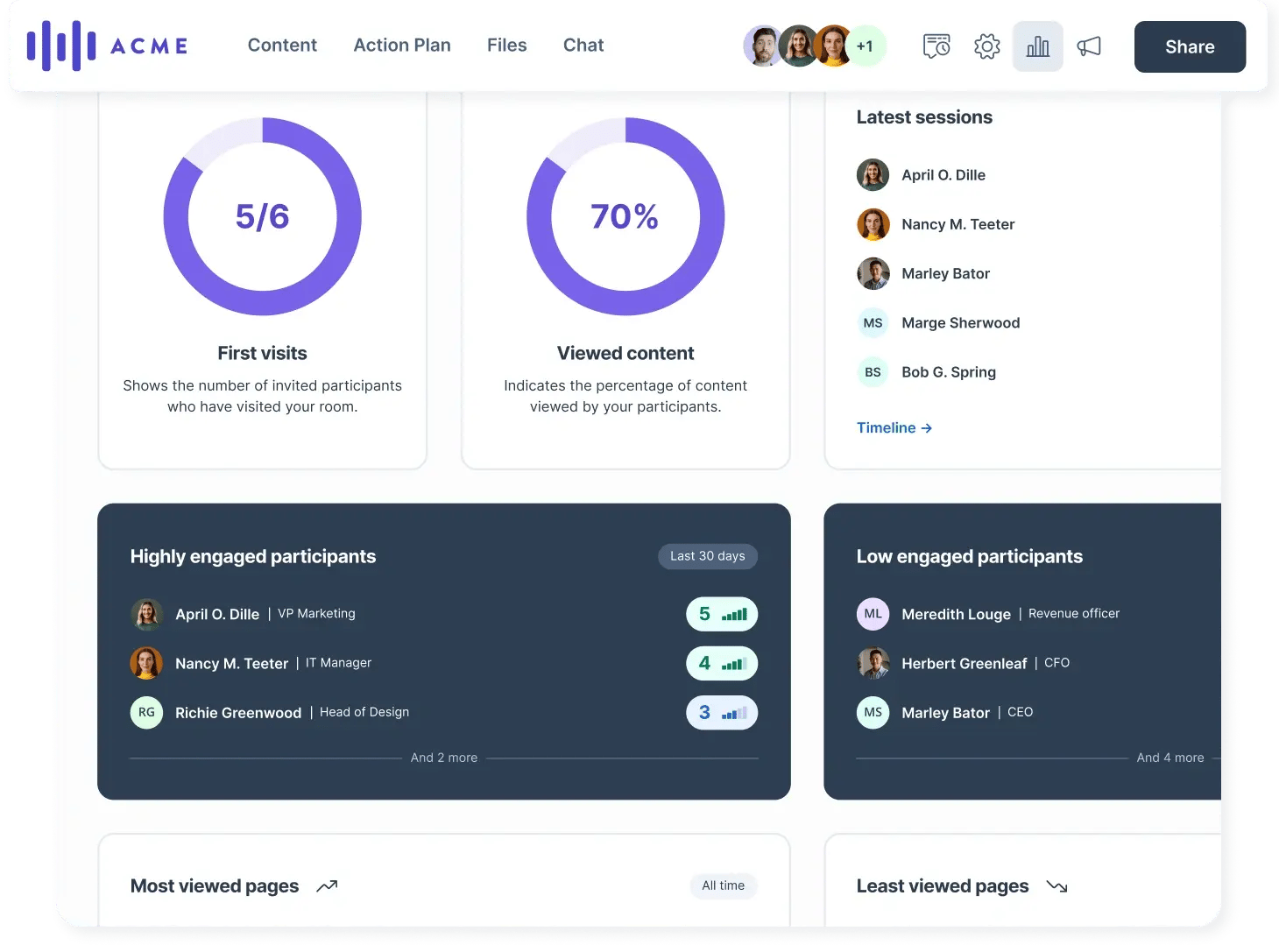
GetAccept allows you to put the business case, proposal, call recordings, security docs and a Mutual Action Plan behind one link for finance, legal, IT and the executive sponsor. Meeting context from Gong, Salesloft, Airspeed, Fathom, Trale, Garba, Zoom, Teams or Google Meet feeds the business case and room content, so reps don't rebuild the story after every call.
Give buyers an offer that matches how you actually price
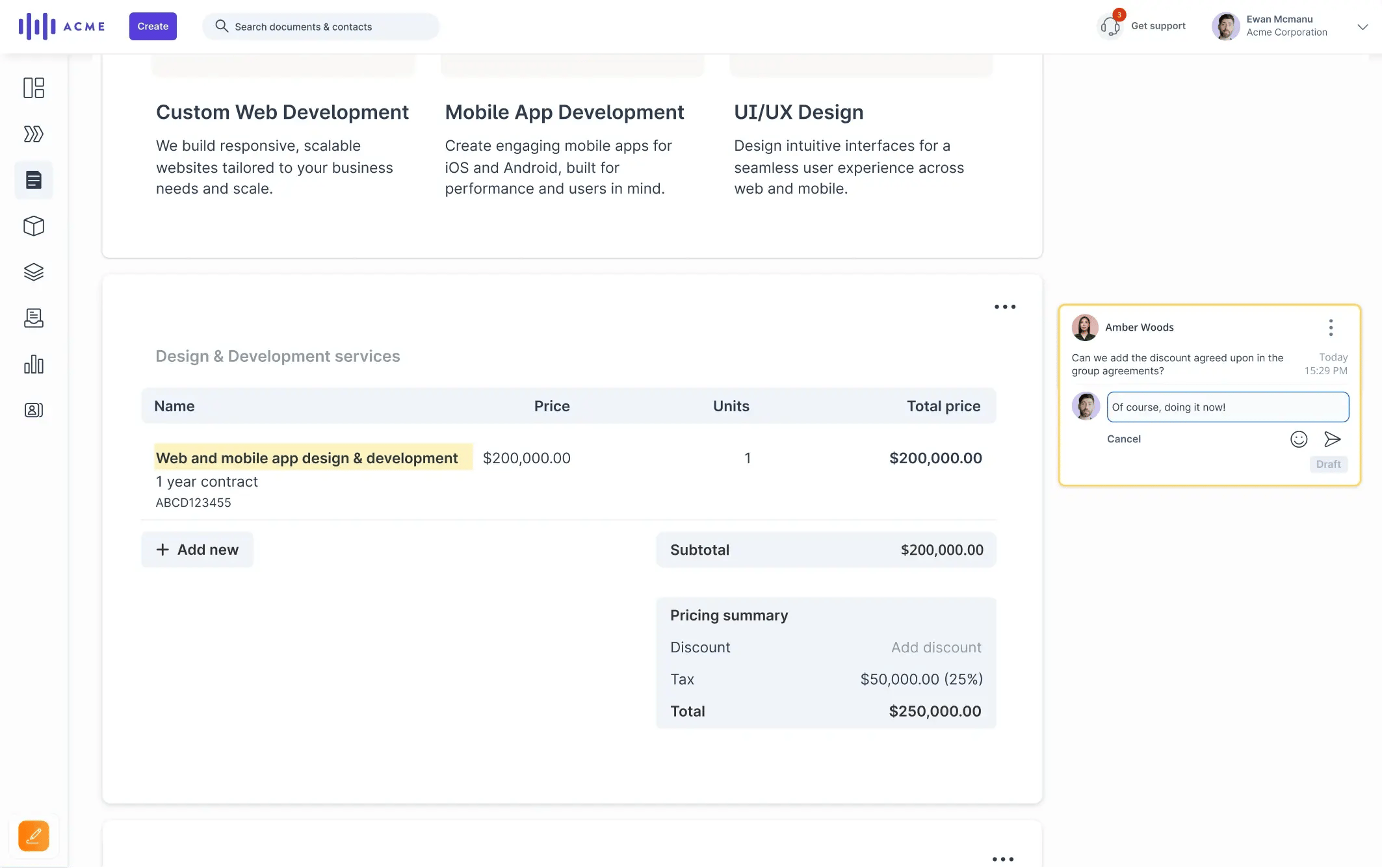
Pricing tables and Pricing Groups handle options, bundles and conditional pricing, backed by a product library. Teams on Salesforce CPQ can pull that data straight into the offer. Buyers pick their configuration, and the totals recalculate in front of them.
Create, send and sign from the CRM, then keep the CRM right
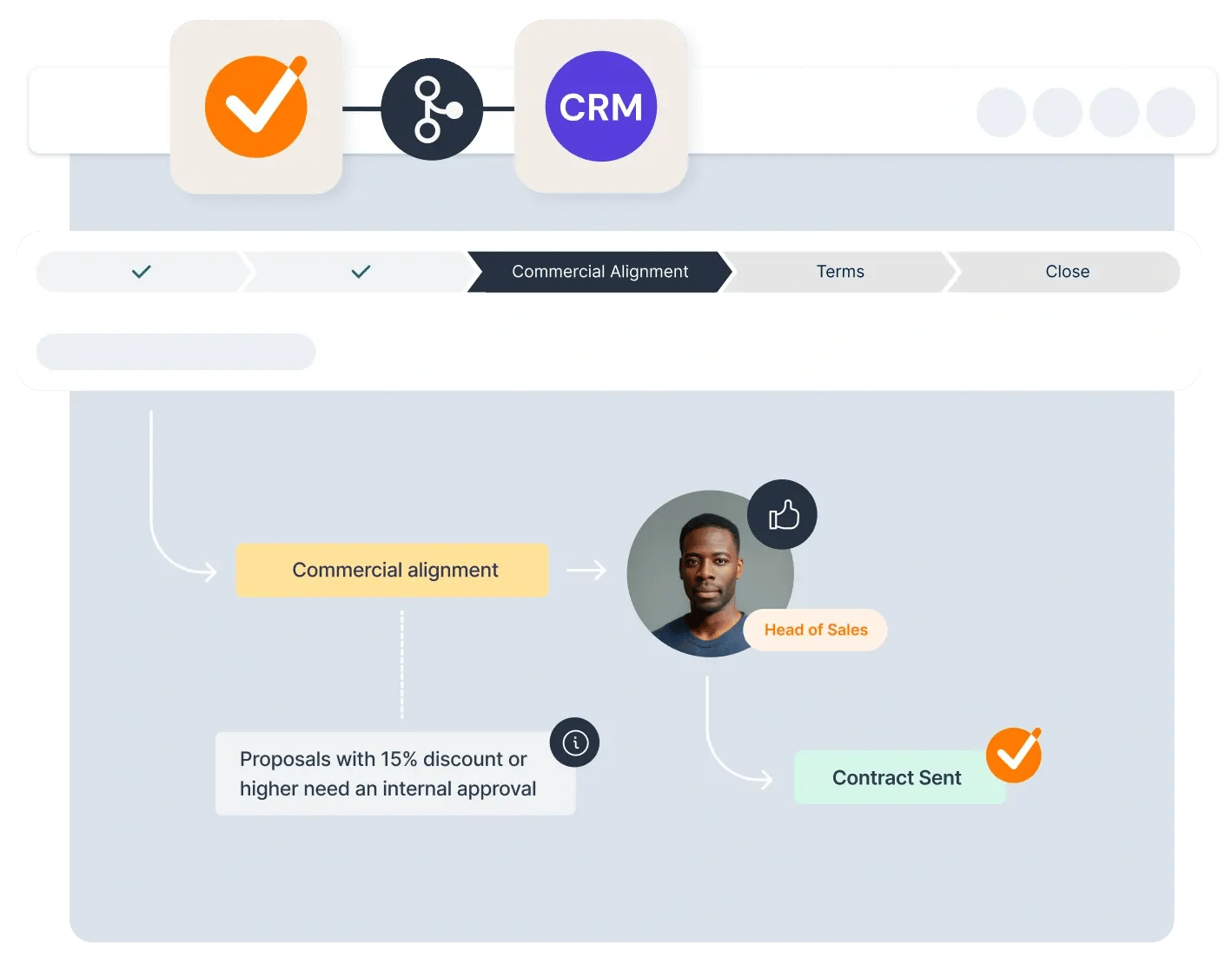
Build branded proposals from a Salesforce, HubSpot, Dynamics, Pipedrive or SuperOffice record, with templates filled from CRM fields. Engagement, deal stage and signed data go back to the record. DivideBuy cut proposal creation time by 80% this way and saves up to 20 hours a month with the Salesforce integration.
Close with approvals, negotiation and the right signature
Route offers through approval before they go out, set signing order and transfer signer roles. Since September 2026, buyers can suggest wording changes right on the signing page of GetAccept-editor contracts. Signing covers Nordic eID in Sweden, Denmark, Norway and Finland, plus QES in Norway.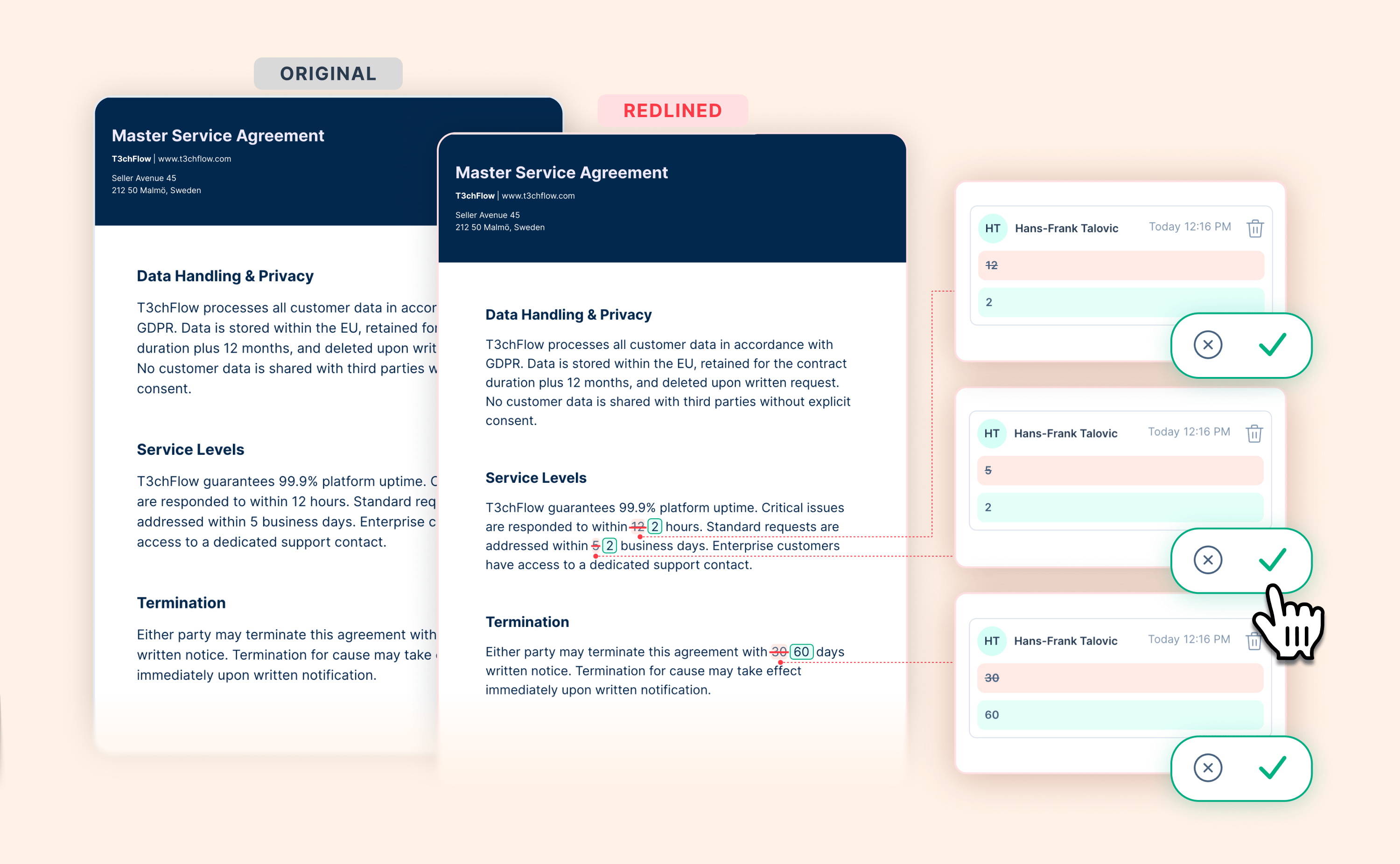
Key features
- Digital Sales Rooms built from templates and meeting notes, with admin-locked pricing and legal content
- Mutual Action Plans with milestones, owners and CRM sync
- Stakeholder-level engagement analytics showing who viewed which section and for how long
- GetAccept AI, hosted in the EU, for business cases, proposal drafts, meeting summaries and contract terms such as renewal dates, payment terms and notice periods
- Pricing tables, Pricing Groups and CPQ rules for complex offers
- Two-way CRM integrations with Salesforce, HubSpot, Microsoft Dynamics, Pipedrive and SuperOffice, plus Salesforce Agentforce
- E-signature at SES, AES and QES levels, with Nordic eID
- MCP server that lets a rep's own AI assistant build, publish and share Deal Rooms, surface buyer signals and edit deal room content
What GetAccept offers over Oneflow
- The full deal, from first buyer interaction to signed contract. Oneflow has no dedicated deal room product. GetAccept covers the whole deal, with the contract as its final step.
- Engagement by stakeholder. Real-time data and analytics on who read what, for how long, and which room has gone quiet.
- Pricing logic for complex offers. Oneflow's 2026 quote-building adds tax-aware product tables but, by Oneflow's own description, no pricing rules or approval workflows. GetAccept adds conditional pricing, Pricing Groups and CPQ rules.
- AI that works from the whole deal. Oneflow's AI drafts, summarizes and reviews contracts, with AI Review and AI Insights on Enterprise only; GetAccept AI works from CRM data, meeting transcripts and room engagement.
- Security track record. GetAccept holds SOC 2. Oneflow's July 2026 attestations are SOC 1 and SOC 2 Type 1.
Limitations
GetAccept is built for sales-led deals, and that shows in 3 places:
- CLM depth for legal teams. Oneflow is more mature for legal and operations teams managing high-volume contract portfolios, including an Enterprise Content Library that keeps clauses synced and locked across templates.
- HR and cross-functional contract flows. Oneflow's hire-to-onboard playbooks move candidate data from an ATS into contracts and on into HR systems. GetAccept doesn't target that buyer.
- Negotiation scope. Buyer suggestions work on GetAccept-editor contracts. They don't cover uploaded PDFs, Word round-trips or pricing tables.
Pricing
- eSign: $25/user/month
- Professional: $49/user/month, billed annually with a 5-user minimum. Adds Digital Sales Rooms, GetAccept AI, pricing tables, product library and premium CRM integrations
- Enterprise: custom pricing. Adds CPQ rules, contract management, SSO, API access, and HR and payment integrations
At 5 users, GetAccept Professional ($245 a month) and Oneflow Business (EUR 250 a month) cost about the same. The difference is that GetAccept Professional includes the Deal Room, AI and Mutual Action Plans.
See GetAccept's pricing page for details.
What GetAccept customers say: SalesScreen
SalesScreen, a sales performance software company, went into 2023 with one big OKR: lift its enterprise win rate from 13% to 25% within a year. Reps needed to present business cases and Mutual Action Plans with the same quality on every enterprise deal, at scale.
After switching from its previous provider, the team built every enterprise deal in a GetAccept Deal Room. Reps start from a template that walks them through the buyer's challenges, the metrics to move, expected ROI and next steps. Proposals and contracts stay inside Salesforce.
Engagement analytics show where buyers spend time and whether new stakeholders have joined the room. As Remi Morken, SVP of Sales, puts it, the data helps answer: "Is this deal ice cold or warm?"
The team beat its goal. Win rate doubled from 13% to 26%, and revenue growth doubled from Q2 to Q3 after the switch.
 Want SalesScreen-style results? Book a demo and we'll build a Deal Room around one of your current deals.
2. DealHub
Primary focus: CPQ, approvals and contract workflows in one quote-to-revenue platform.
DealHub is a quote-to-revenue platform that combines configure-price-quote (CPQ), approval automation and contract lifecycle management in one system. It's built for mid-market and enterprise revenue teams where pricing complexity and deal desk involvement are daily work.
Key features
- CPQ for complex product catalogs and pricing structures
- Automated approval workflows for discounts and pricing exceptions
- Contract lifecycle management in the same platform as quoting
- CRM-connected workflows that tie quotes and contracts back to the pipeline
Choose DealHub over Oneflow if pricing rules and multi-level approvals are your bottleneck, which is the gap Oneflow's quote-building leaves open.
Limitations
- DealHub is built around a deal desk, which makes it a heavier rollout than a proposal-first tool
- Pricing isn't public, so you'll need a sales conversation before you can compare costs
Pricing
Pricing is quote-based. Contact DealHub for a quote.
3. PandaDoc
Primary focus: proposal, quote and contract generation with e-signature and payments attached.
PandaDoc is a document platform for creating, approving, tracking and e-signing proposals, quotes and contracts. It's a good match for teams whose reps spend more time in documents than in meetings. PandaDoc holds a 4.7/5 average from 3,823 reviews on G2.
Key features
- Drag-and-drop editor with template and content libraries
- AI Document Assistant, plus Claude, ChatGPT and MCP connectors for creating agreements from a prompt
- Catalog-based quoting, with CPQ as an Enterprise add-on
- QES and embedded payments through Stripe and PayPal
Choose PandaDoc over Oneflow if document volume and payment collection matter more to you than contract lifecycle depth, and you want a free plan to start on.
Limitations
- PandaDoc is document-first. Deal rooms are an add-on, capped at 3 on Business and unlimited only on Enterprise
- CRM integrations start on Business, and API usage runs on credits, so costs grow with volume
Pricing
Free (capped documents), Starter at $19/seat/month and Business at $49/seat/month, both billed annually. Enterprise is custom.
For a closer look, see our PandaDoc alternatives.
4. DocuSign
Primary focus: e-signature at scale, with agreement workflows on its Intelligent Agreement Management (IAM) plans.
DocuSign is the best-known e-signature brand, used for signing agreements with counterparties around the world. Its IAM plans add no-code agreement workflows (Maestro), an AI-searchable contract repository (Navigator) and AI agreement analysis on top of signing.
Key features
- E-signature with bulk send, PowerForms and payment collection on Business Pro
- Maestro workflows and Navigator repository on IAM plans
- Identity verification add-ons for signers
- A large catalog of integrations
Choose DocuSign over Oneflow if you mainly need signing at enterprise scale, with international counterparties who already know the brand.
Limitations
- DocuSign's eSignature plans don't include proposals, pricing tables or deal rooms
- Standard and Business Pro cap envelopes at 100 per user per year, and Salesforce document generation sits on custom-priced plans
Pricing
eSignature Standard is about $30/user/month and Business Pro about $45/user/month on annual billing, after DocuSign's 2026 list price increases. IAM plans start at about $45/user/month.
5. Proposify
Primary focus: proposal creation with interactive quoting, CRM connections and approval routing.
Proposify is a proposal and contract tool for sales teams that want more process control than a basic document builder gives them. It leans into workflow: CRM-connected proposals, approval routing and reusable content that keep proposals consistent across a team.
Key features
- HubSpot and Pipedrive integrations on the Team plan
- Unlimited e-signatures and document sends
- Approval workflows and conditional routing on the Business plan
- SSO and multiple workspaces for larger teams on Business
Choose Proposify over Oneflow if you want a proposal-first tool with approvals for a mid-market team running on HubSpot or Pipedrive.
Limitations
- Proposify has no Digital Sales Room or Mutual Action Plans for multi-stakeholder deals
- API access and SSO sit on Business, which starts at $3,900 a year with a 10-user minimum
Pricing
Basic is $19/user/month and Team is $41/user/month, both billed annually. Business starts at $3,900 a year.
For more options, see our Proposify alternatives.
6. Qwilr
Primary focus: design-led, interactive web proposals.
Qwilr is a proposal tool that turns proposals into branded, interactive web pages instead of PDFs. Its main appeal is how the offer looks to the buyer, with embedded video, interactive pricing and an accept button built in.
Key features
- Web-page proposals with embedded video and interactive pricing tables
- Accept and sign inside the proposal
- Open tracking and notifications
- HubSpot, Salesforce and Pipedrive integrations
Choose Qwilr over Oneflow if the look of your offer is the main gap and your contracts are simple.
Limitations
- Qwilr is built around a single proposal, without stakeholder-level engagement or contract management
- AI, conditional content and the Salesforce integration sit on the top plan
Pricing
Plans start at $35/user/month, with Growth at $55 and Scale at $75, billed annually.
For more options, see our Qwilr alternatives.
How to choose a Oneflow alternative in 60 seconds
Find your main job in the left column. That row is your shortlist.
|
If your main job is |
Start with |
Why |
|---|---|---|
|
Running multi-stakeholder deals from first meeting to signature |
GetAccept |
Digital Sales Room, business case, Mutual Action Plans and e-signature in one CRM-connected space |
|
Giving buyers an offer with options, bundles and conditional pricing |
GetAccept |
Pricing tables, Pricing Groups and CPQ rules, with Salesforce CPQ data pulled in |
|
Keeping the CRM accurate from proposal to signed deal |
GetAccept |
Create, send and sign from the CRM record, with engagement and signed data synced back |
|
Signing with Nordic eID or QES inside the sales flow |
GetAccept |
Nordic eID in 4 countries and QES in Norway, in the same flow as the Deal Room |
|
Running a deal desk with complex pricing rules and approvals |
DealHub |
CPQ, approvals and CLM in one quote-to-revenue platform |
|
Producing a high volume of documents and collecting payment |
PandaDoc |
Template-driven documents with e-signature, a CPQ add-on and payments |
|
Collecting signatures at scale with global counterparties |
DocuSign |
The best-known e-signature brand, with IAM for agreement workflows |
|
Structured proposals with approvals on HubSpot or Pipedrive |
Proposify |
Proposal-first tool with approval routing at mid-market prices |
|
Making proposals look better on the web |
Qwilr |
Design-led, interactive web proposals |
|
Managing contracts across HR, legal and procurement |
Stay on Oneflow |
Its CLM depth and cross-functional flows are built for that job |
Final thoughts
The right Oneflow alternative depends on where your deals stall.
If they stall at the contract, Oneflow or DocuSign may be all you need. If they stall before it, in stakeholder threads, pricing back-and-forth and follow-ups that never went out, you need a tool built to run the deal. That's the job GetAccept was built for.
Disclaimer: This list is based on publicly available information and reflects GetAccept's independent view. Features, capabilities, pricing and product scope are current as of October 2026 and may change over time.
Frequently asked questions