What is a Digital Sales Room?
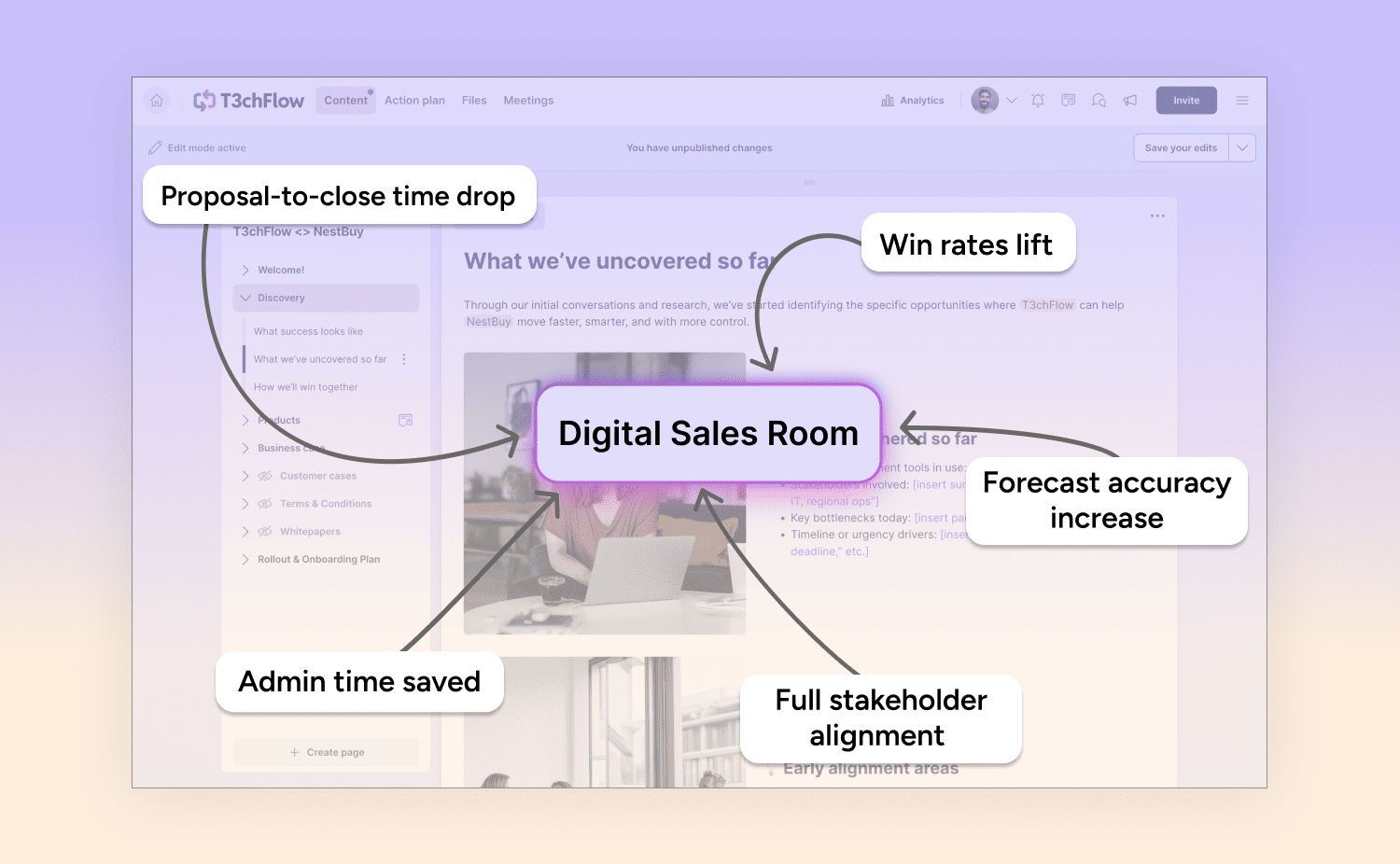
A Digital Sales Room is a shared online workspace where B2B sellers and buyers collaborate throughout the sales cycle, from opportunity to closed-won deal. It replaces scattered emails and static PDFs, and with a single hub that tracks engagement, surfaces buying committee activity, and keeps deals moving forward.
Digital Sales Rooms track which stakeholder views what content, when they engage, and who is active, giving you real-time visibility into deal health. Think of it as your deal's mission control: everything buyers need lives there, and you see exactly what's happening on their side.
Unlike static PDFs, spreadsheet business cases, and slide decks sent via email, Digital Sales Rooms are interactive. Buyers can comment on specific sections, share content with colleagues, and chat with you as the seller, all without leaving the room. You see which stakeholders engage, what content they prioritize, and when deals lose momentum.
This solves a specific problem: the space between opportunity created and deal closed, where 60% of deals die from indecision, as research cited in Harvard Business Review suggests.
Gartner predicted that 30% of B2B sales cycles would run through Digital Sales Rooms by 2026, driven by buyers' demand for better digital experiences and sellers' need for accurate forecasting.
What’s the difference between Digital Sales Rooms, Virtual Sales Rooms, and Online Deal Rooms?
Often, Digital Sales Rooms, Virtual Sales Rooms, and Online Deal Rooms are used interchangeably and refer to the same concept. Each one is a shared online space where buyers and sellers collaborate throughout the sales cycle.
GetAccept uses "Digital Sales Room" because the name accurately describes what the platform does: it gives every deal its own room online. GetAccept is an AI Digital Sales Room platform where sellers and buying committees share content, track engagement, and sign contracts in one place. When G2 launched its Digital Sales Room category in October 2021, GetAccept was among its first leaders.
How does a Digital Sales Room work?
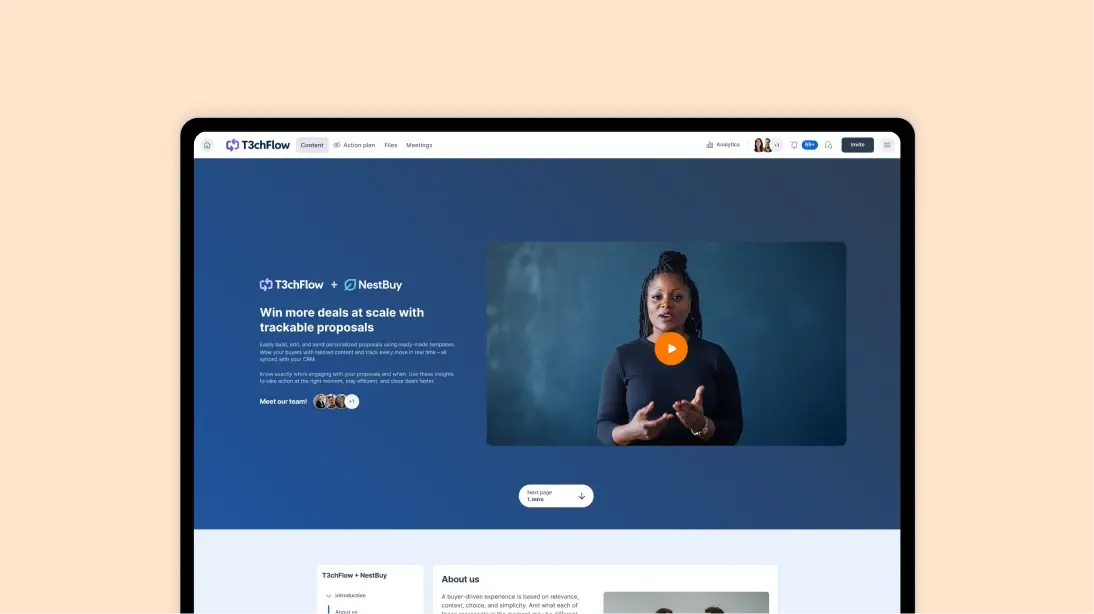
A Digital Sales Room works by creating a secure, branded microsite for each deal. Think of it as a private workspace where your buyer and your team collaborate in real time instead of juggling email threads and version-controlled PDFs.
Here's the step-by-step flow:
Step 1: You create the room
After your discovery call, you build a Digital Sales Room directly from your CRM. You add your slides, pricing, case studies, ROI calculator, technical specs - whatever your buyer needs. Everything lives in a single URL instead of being scattered across 7 email attachments.
Step 2: You invite your buyer
You send a single link. No downloads, no logins, no friction. Your buyer clicks and lands in a branded space that feels professional, organized, and built specifically for them.
Step 3: Your buyer explores (and you watch)
This is where DSRs shine. You see who opens the room, what they view, how long they spend on each section, and when they share it with colleagues. If your champion forwards the link to procurement, you know. If the CFO just glances at the business case, you know. If a new stakeholder appears 14 days into the deal, you know, and you can act in time.
Step 4: Collaboration happens in the room
Buyers leave comments, ask questions, and tag colleagues, all inside the DSR. You respond in the same space, so all communication and key information is visible to everyone. No more "let me forward this to my team and circle back next week." The room becomes the single source of truth for the entire buying committee.
Step 5: You close the deal
When your buyer is ready, you send the proposal, and they sign the contract in the same room. The entire journey, from qualified opportunity to signed contract, happens in one place, tracked in your CRM automatically.
The result?
- You replace the chaos of email-based selling with a structured, visible process.
- Your buyer gets a great experience.
- You look professional.
- You get engagement data that tells you exactly where deals stand.
- And your forecast becomes grounded in buyer behavior, not rep intuition.
We have seen similar results with our customers after implementing GetAccept’s Digital Sales Rooms, with customers reporting increased win rates and decreased sales cycles.
Why sales teams are using Digital Sales Rooms
Sales teams adopt Digital Sales Rooms because they solve 3 problems that directly impact quota attainment:
- Invisible buyer engagement
- Fragmented workflows
- Unreliable forecasting
The benefits aren't theoretical. They are measurable improvements in metrics that sales leaders actually care about.
Reps see what happens after hitting send
Traditional sales processes create a visibility black box. You send a slide deck and meeting follow-up by email, then wait. Is anyone reading it? Which stakeholders are engaged? Are they stuck on pricing or technical specs?
Stakeholder-level visibility reveals buying committee dynamics invisible in traditional sales processes.
An added benefit is that engagement signals enable coaching interventions earlier than reactive approaches do. When deals go several days without buyer activity, managers receive alerts that enable proactive outreach rather than discovering stale deals during forecast calls.
Reps reclaim time lost to administrative chaos
Salesforce's State of Sales Report shows reps now spend just 28% of their time actually selling, down from 34% in 2018. The rest? Administrative tasks, CRM updates, internal meetings, and content formatting.
Digital Sales Rooms consolidate collateral, proposals, engagement tracking, and sales content management into single CRM-connected hubs, reclaiming hours weekly previously spent on drafting content, following up, CRM admin, and so on.
The productivity gain directly translates into increased deal capacity without headcount expansion. Instead of juggling separate tools for proposal creation, contract routing, electronic signatures, and engagement analytics, reps work in a single space that syncs automatically with the CRM.
Reps and leaders forecast with confidence
Improvements in forecast accuracy help alleviate a scary scenario: missing quarterly targets due to hidden pipeline risks. Traditional forecasting relies on rep-reported confidence scores, subjective estimates that vary wildly across reps and hide deal risks until it's too late to course-correct.
Digital Sales Rooms ground their predictions in observable buyer behavior instead of intuition. Tracking stakeholder activity patterns, content interaction, and hidden stakeholders helps predict outcomes. This data surfaces risks earlier. When deals show declining engagement or incomplete coverage by the buying committee, sales leaders receive alerts that enable intervention before deals slip. If no noticeable improvements are made rather quickly, the deal can be removed from the forecast.
👉 Explore the best Digital Sales Room software in 2026.
Common use cases of Digital Sales Rooms
Digital Sales Rooms work across every sales motion where complexity, multiple stakeholders, or long cycles create friction. Here's where they deliver the most impact:
Enterprise deals with multiple stakeholders
When you're selling to organizations with 5+ decision-makers, DSRs give you visibility into who's actually engaged. You'll see which executives opened your pricing deck, which technical buyers skipped the security documentation, and if the champion forwarded materials to legal. This stakeholder-level tracking helps you multithread effectively and stay in control of the buying committee.
Complex product sales requiring education
If your solution needs technical validation, security reviews, or integration planning, Digital Sales Rooms consolidate all supporting materials in one space. Buyers access technical specs, compliance documentation, implementation guides, and case studies without hunting through email threads. And you can be confident that you are always sending the correct and up-to-date materials.
High-velocity mid-market deals
Teams closing 15-30 deals monthly use Digital Sales Rooms to standardize proposal delivery while keeping communication personal. Instead of reformatting proposals for every opportunity, Account Executives deploy branded templates with dynamic content blocks, embedded videos, and mutual action plans. This consistency reduces cycle times while improving win rates through better buyer experiences.
Cross-functional sales requiring internal alignment
When deals involve Sales, Customer Success, Implementation, and Legal, Digital Sales Rooms allow all parties to collaborate more easily. Internal stakeholders review proposals, add comments, and track buyer engagement without forwarding email chains. This visibility prevents last-minute surprises, such as discovering that procurement wasn't looped in until signature day.
Best practices for getting value from a Digital Sales Room
Getting the most out of a Digital Sales Room requires a few things. Most importantly, it needs to integrate with your CRM so it doesn’t become another standalone tool. Secondly, consider how you can use the DSR to consolidate existing tools and keep your tech stack lean.
The implementations that fail usually add Digital Sales Rooms on top of existing proposal software, e-signature tools, contract management solutions, and engagement-tracking tools, creating the exact tool sprawl they're trying to avoid.
Let leaders lead
When leadership asks "Who's engaged on the buyer side?" instead of "What's the status of this deal?", reps get the message fast. Organizations where VPs, Directors, and Managers actively use engagement metrics during deal reviews achieve higher adoption rates.
Consolidate tools, don't add to the stack
Identify 3-5 legacy tools to retire post-DSR implementation: proposal software, e-signature platforms, engagement trackers, and collaboration spaces.
Communicate the consolidation benefit clearly: "This replaces 3 tools you currently juggle." Then ensure two-way CRM sync eliminates double-entry. If reps still need to manually export engagement data or copy-paste stakeholder updates, you've created an administrative burden instead of reducing it.
Better templates = better results
Considering that a Digital Sales Room will be used in almost every sales process, it’s a good idea to create solid templates. This ensures you create a great buying experience every time, while allowing your reps to spend more time on the customer than creating rooms.
At GetAccept, we help you with this during onboarding.
The role of Digital Sales Rooms in 2026 and beyond
Digital Sales Rooms aren't experimental anymore. Gartner predicted that 30% of B2B sales cycles will run through Digital Sales Rooms by 2026, up from single digits just 3 years ago.
We see the same shift happening here at GetAccept. More and more sales teams are realizing the benefit of using DSRs in their sales process.
The shift reflects a broader truth: B2B buying now happens across multiple channels. McKinsey's 2024 B2B Pulse found B2B buyers now use more than 10 distinct channels to interact with vendors.
Here's what's driving DSR adoption through 2026 and beyond:
Engagement data becomes the new forecast currency: Sales leaders are done trusting gut-feel pipeline calls. DSRs capture buyer signals, stakeholder activity, and content interaction patterns, grounding predictions in observable actions rather than intuition.
Tool consolidation beats feature sprawl: Research from the American Psychological Association have found that switching contexts between different tools can waste up as much as 40% of an employee’s productive time.
The DSR platforms that survive will be the ones that replace multiple point solutions, proposals, e-signatures, engagement tracking, collaboration spaces, mutual action plans, and so on, rather than adding to the chaos
Buyer experience becomes competitive differentiation: When your competitor sends a slide deck, and you deliver a branded digital workspace with personalized content, mutual action plans, and real-time collaboration, you're not just selling better, you're selling differently.
Frequently asked questions
-
No. Digital Sales Rooms amplify your CRM by capturing buyer engagement data that flows back into opportunity records. Your CRM remains the system of record for pipeline management while the Digital Sales Room gives you control of the entire sales process.
-
Email proposals are static, one-way communications with zero visibility into buyer behavior. DSRs are interactive workspaces where you see which stakeholders engage, what content they prioritize and when deals lose momentum, enabling proactive intervention instead of reactive firefighting.
-
Digital Sales Rooms deliver great ROI for complex B2B deals involving multiple stakeholders, longer sales cycles, and higher average contract values.

About the author
GetAcceptGetAccept is a Digital Sales Room platform trusted by more than 5000 revenue teams to help reps spend more time selling and less time on admin. We bring static sales content and scattered communication into one shared space where every stakeholder can access the latest content, timelines, and context throughout the whole sales cycle. And with purpose-built AI that truly understands the context of your deals, creating and updating personalized content takes minutes. Native integrations with popular CRMs let reps work with their existing tools, while making sure activity is automatically synced and updated everywhere it matters. In short – we help sales teams work smart, close faster, and win more.