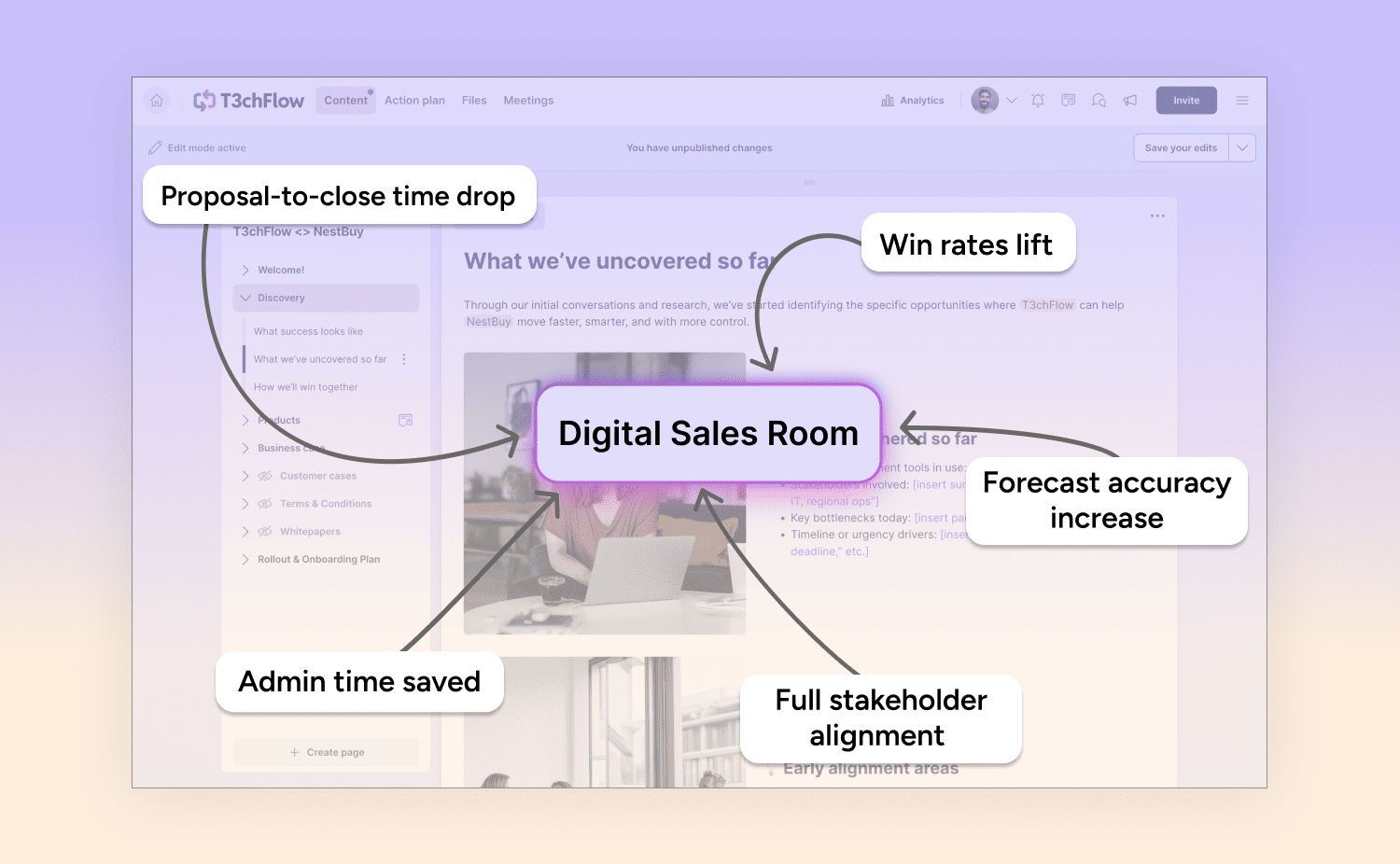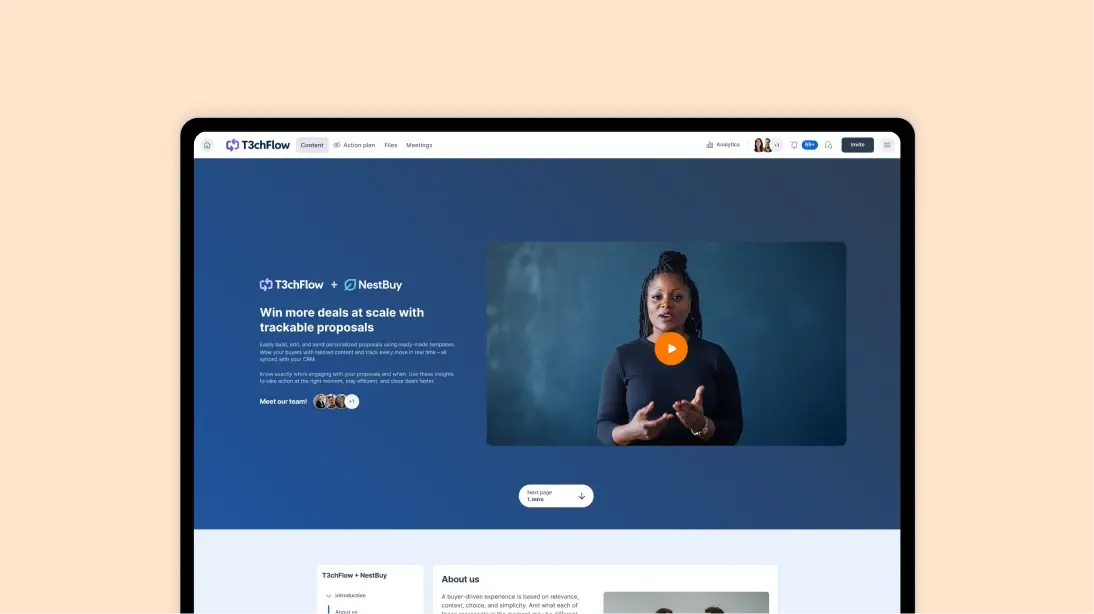
A Digital Sales Room is a shared online workspace where sellers and buyers collaborate throughout the sales cycle, from opportunity to closed-won deal. For Account Executives managing complex B2B deals, Digital Sales Rooms replace scattered emails and static decks with a single hub that tracks engagement, surfaces buying committee activity, and lets both reps and buyers access it anytime.
The shift from managing the sales process via email and Teams chats to Digital Sales Rooms (or “DSRs” for short) mirrors the evolution of B2B buying. According to Gartner's B2B Buying Report, the average enterprise B2B buying group now consists of 5 to 11 stakeholders. Each stakeholder needs different information, operates on different timelines, and has distinct approval criteria. Email threads can't handle this complexity, but DSRs can, by giving every stakeholder access to the same up-to-date materials while tracking who's engaged and who's blocking progress.
For Account Executives, this means fewer deals lost to “no decision”, shorter sales cycles, and more accurate forecasts. And for buyers? They get a professional, organized experience instead of hunting through email for the latest pricing deck.
Why digital sales rooms matter now more than ever for AEs
As soon as you hit send on the follow-up or proposal, it’s usually impossible to know what’s happening on the buyer side. You don't know if anyone is reading the materials or whether your champion is even sharing them with the right people. Forrester reports that 86% of deals stall due to internal buyer misalignment, not product fit or pricing.
This directly impacts the AE’s quota attainment, and possibly their bonus, too.
Digital sales rooms solve this visibility blind spot. They turn static sales content into collaborative workspaces where you can see exactly who's engaged, what content matters most, and when to follow up. Instead of guessing, you're working with real buyer behavior data.
And the trend is real. Melissa Hilbert, Vice President at Gartner in the Gartner Sales Technologies Group, has projected 30% of B2B sales cycles will be managed through DSRs by 2026.
How digital sales rooms work for Account Executives in a typical B2B sales process
Here's how digital sales rooms fit into your actual workflow (not some idealized version, but the messy reality of managing 6 deals in different stages while your VP asks for updated forecasts 🥲).
Discovery to proposal:
After your discovery call, you create a Digital Sales Room instead of emailing a deck. You drop in your presentation, pricing, case studies, and a mutual action plan that maps out every step from technical review to contract signature. Your champion gets a link (no login required), and suddenly you're not just another vendor. You're the one who made their internal coordination easier.
Stakeholder tracking:
Here's where DSRs earn their keep. Your champion forwards the room to their CFO, IT lead, and procurement. You get a notification: "3 new stakeholders viewed your proposal." Now you know exactly who's involved before they become blockers. You can see the CFO spent 4 minutes on pricing but skipped the ROI slides. That's your cue to follow up with business case content.
Mid-cycle engagement:
Ebsta research suggests that 40% of opportunities lose momentum after 7 days of silence. Digital Sales Rooms surface that risk immediately. When the buyer stops engaging, you know right away. Instead of guessing, you reach out with a specific offer: "I noticed we got stuck on the security review. Want me to jump on a call with your IT team?"
Contract to signature:
Instead of emailing multiple links to multiple stakeholders, the e-signature workflow lives inside the Digital Sales Room. Your buyer signs on their computer or phone, and the deal auto-syncs to your CRM as "Closed Won." No manual updates needed.
6 key benefits of digital sales rooms for Account Executives
Digital sales rooms directly address the daily friction that sales reps face.
1. Real-time visibility into who's actually engaged (and who's blocking your deal)
You send a proposal and then... silence. Is your champion sharing it internally? Did the CFO even open it? Are you about to get blindsided by a late-emerging stakeholder?
Digital sales rooms eliminate this guesswork. You see exactly who views what, which content they spend time on, and whether they're forwarding materials to colleagues you didn't know existed. Gartner research says vendors spend only about 5% of the total time in a sales cycle with the buyer. DSRs give you visibility into the invisible 95%.
For Account Executives, this visibility changes 1-1s and forecasting calls. When the Sales Manager asks, "Why did this deal slip?" you're having proactive conversations: "The champion hasn't engaged in five days, and I’d like to discuss my re-engagement strategy."
2. Mutual action plans that prevent deals from going dark
Vague next steps kill deals. "I'll get back to you next week" turns into radio silence, and suddenly your forecast is in trouble.
Mutual action plans embedded in digital sales rooms create shared accountability. You build a timeline with specific milestones, assign owners on both sides, and make progress visible to everyone involved.
When your champion can show their CFO a clear timeline with assigned tasks, you're not just tracking a deal, you're actively structuring how the buyer makes their decision.
3. Proposal creation that takes minutes, not hours
You're building a proposal after dinner because discovery ran long and you promised to send something tomorrow. You're looking for the latest case study, double-checking pricing, and reformatting slides to match brand guidelines.
Digital Sales Rooms with template libraries and dynamic content blocks dramatically reduce proposal creation time (as seen by Team Satchel who reduced their proposal creation time by 70%). Pre-approved templates ensure brand consistency, while automated content assembly pulls in current case studies, pricing, and security documentation without manual searching.
4. Simpler stakeholder management
You're managing a deal with 6 buyers: your champion, their boss, IT, security, procurement, and legal. Each stakeholder needs different information, has distinct concerns, and operates on their own timeline.
Digital sales rooms create a single workspace where all stakeholders access relevant content, see progress on action items, and coordinate internally.
Instead of sending separate emails with different attachments to each stakeholder, you share one link to a personalized DSR where everyone can find what they need. Security gets compliance documentation, legal can review and redline the contract, and IT reviews integration specs, all in one place.
5. Forecast accuracy grounded in buyer behavior, not rep intuition
Digital sales rooms improve forecast accuracy by replacing subjective assessments with observable buyer behavior. Instead of forecasting based on "champion confidence" or "verbal commitment," you're looking at engagement data: Are stakeholders actively viewing content? Is the MAP on track? Are response times accelerating or slowing?
6. CRM integration that eliminates duplicate data entry
You update the deal status in your DSR, then log in to the CRM to update the opportunity stage, then add notes about stakeholder engagement. Three systems, same information, wasted time.
Digital sales rooms with bidirectional CRM integrations eliminate this friction. Engagement data, stakeholder activity, and deal progress flow automatically into the CRM without manual entry.
For RevOps leaders, native CRM integrations mean engagement insights actually improve CRM data quality instead of creating parallel systems that drift out of sync.
Common challenges Account Executives face without digital sales rooms
Without digital sales rooms, you face three systemic problems that kill deals: invisible stakeholders, coordination friction, and timing guesswork.
Invisible stakeholders - 95% of buying happens when you're not there
Any given sales rep has roughly 5% of a customer’s total purchase time. Stakeholders are forwarding your proposal internally, debating priorities, and surfacing objections you'll never hear about - until the deal stalls.
This information asymmetry is why, according to research from Clari, 93% of sales organizations can't forecast within ±5% variance even two weeks before quarter-end. You're forecasting based on champion confidence ("they're excited!") instead of observable buyer behavior.
The coordination nightmare: buying committees doubled, your tools didn't
Gartner research suggests that B2B buying groups now consist of five to 16 stakeholders. Each one has different priorities, approval requirements, and risk concerns.
You're managing this complexity through email threads, slide decks in different versions, and "next steps" that no one owns. Without a shared timeline or workspace, 60% of lost deals end in "no decision", as reported by research cited in Harvard Business Review, because buyers can't coordinate internally.
The admin trap: reps spend only 28% of their time selling
Salesforce's State of Sales Report found that sales reps spend only 28% of their time selling. Building proposals from scratch, hunting for current case studies, updating CRM fields, and sending follow-ups based on reminders instead of buyer signals. All of these things add very little value, yet take away precious time that would be better spent on interacting with buyers.
The best Digital Sales Room for Account Executives
On G2, there are hundreds of reviews from Account Executives who are happy GetAccept users. It makes sense, as we come from sales ourselves. We have designed the product to work with the daily realities of being an AE, not by adding yet another tool or more admin, but by actually trying to remove work.
Everything we do, from the quality of the integrations we build, to the stakeholder mapping and tracking, to the clever AI capabilities that were purpose-built for sales - everything is to make sales easier.
If you are curious to try it for yourself, book a demo with us or start a free trial.

About the author
GetAcceptGetAccept is a Digital Sales Room platform trusted by more than 5000 revenue teams to help reps spend more time selling and less time on admin. We bring static sales content and scattered communication into one shared space where every stakeholder can access the latest content, timelines, and context throughout the whole sales cycle. And with purpose-built AI that truly understands the context of your deals, creating and updating personalized content takes minutes. Native integrations with popular CRMs let reps work with their existing tools, while making sure activity is automatically synced and updated everywhere it matters. In short – we help sales teams work smart, close faster, and win more.