-1.jpg?width=48&height=48&name=55f40cc2763590699ea313bb5c9f08b5%20(chosen)-1.jpg)

Sales cycles rarely follow a tidy, linear path.
Buyers assess information, review meeting summaries, and agree on next steps in one place, and eventually move into contracting — even though, to them, it’s all part of the same decision-making journey.
Until recently, that journey often happened across separate spaces: the Deal Room for collaboration, and Contracts for the final step. Both worked well for their purposes, but they didn’t always feel connected, especially when conversations moved quickly, stakeholders joined late, or deals spanned multiple systems like the CRM.
So we set out to close that gap.
From two complementary steps to one connected experience
Deal Rooms have always been the space where collaboration thrives: content sharing, alignment, meeting summaries, next steps, and multi-stakeholder engagement.
Contracts, on the other hand, have been the natural destination once teams were ready to formalize the agreement.
Both are essential. But they haven’t always felt like part of the same flow — particularly when sellers were switching between collaboration tools, contract workflows, and their CRM to keep deals moving.
Now they do.
Deal Rooms and Contracts now work in tandem across the entire deal cycle
You can now:
-
Create contract drafts directly from your Deal Room
-
Connect existing documents to the room in seconds
-
Give buyers a clear “Connected Room” link inside every document
-
Keep context, conversation, and contracting in one continuous workflow
-
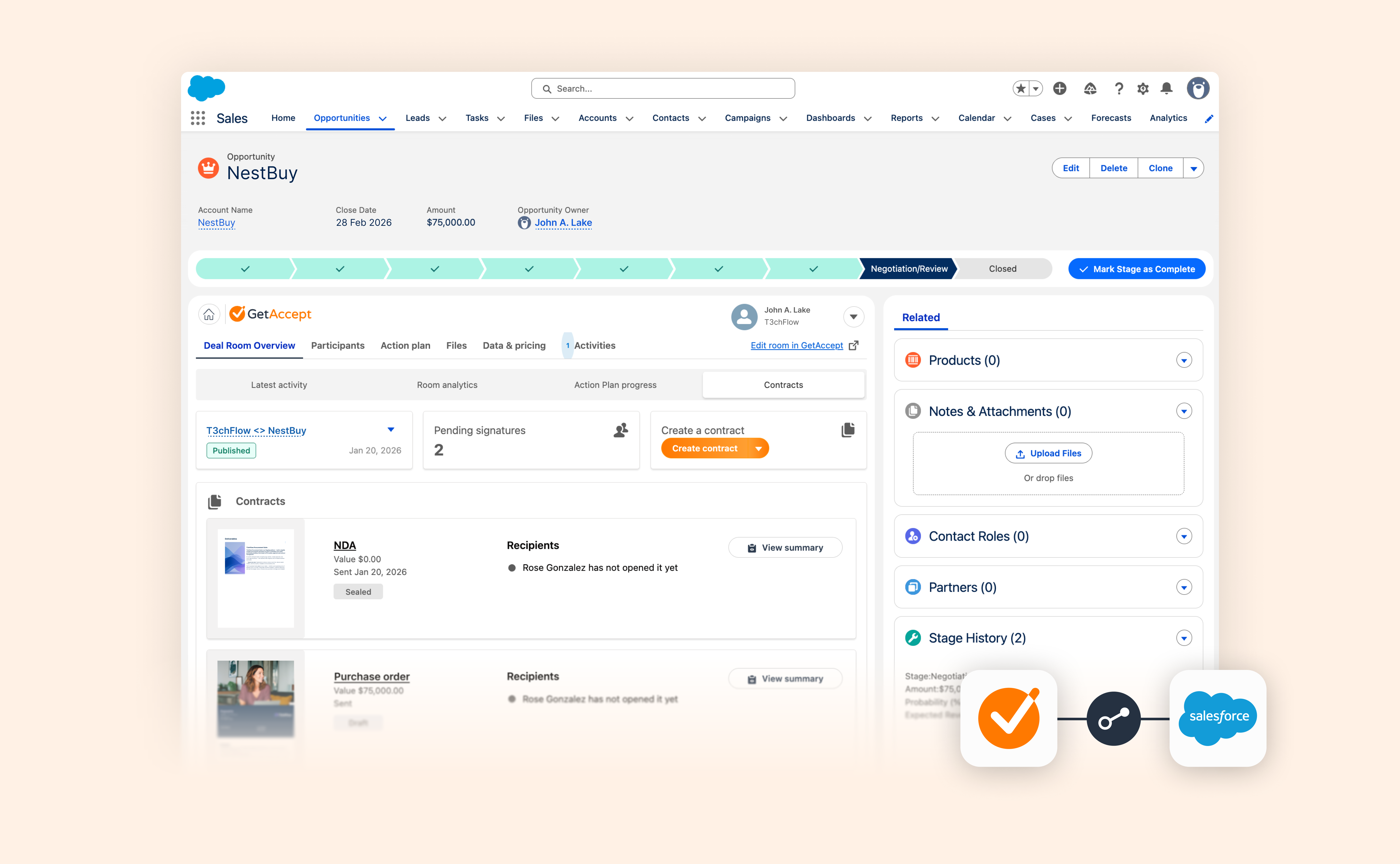
See that same Deal Room ↔ Contract connection reflected in your CRM (starting with Salesforce)
This shift turns the deal cycle into what it naturally is: one long, evolving conversation that leads toward an agreement.
Why this matters
A connected workflow doesn’t just make life easier. It changes the rhythm of a deal.
When everything lives together, buyers feel grounded, sellers stay focused, and deals move forward with fewer interruptions and fewer repeated questions.
Below are a few ways teams can take advantage of this connected workflow.
Two practical ways Deal Rooms + Contracts work better together
1. Moving from collaboration to contracting without breaking focus
You’ve shared resources, aligned on pricing, and agreed on next steps. The buyer is ready for the formal document.
Before: You’d simply switch over to the Contracts module to draft an agreement. Totally workable, just a different space.
Now: You can create the contract draft right from within the Deal Room. No shift in context, no toggling. Just a natural continuation of the conversation.
Why it matters: The flow feels cleaner. Reps stay focused. Buyers stay anchored in the same familiar environment.
2. Supporting late-stage stakeholders with clearer context
Deals often attract new stakeholders toward the end — legal, finance, compliance, or a VP who needs to review the agreement before signing. They’re joining late, but they still need the full picture.
With contracts now connected back to the room, context is always one click away.
Example: A finance stakeholder reviewing the contract can open the Connected Room and immediately see the business case, meeting summaries, or any clarifying files, without asking the rep to resend anything.
Why it matters: Everyone stays aligned, even if they join the deal late.
Bringing the same continuity into the CRM
For many sales teams, the CRM is where the deal is managed day to day. It’s where pipeline lives, where forecasts are updated, and where sellers expect to see the full picture of an opportunity.
That’s why extending this connected Deal Room + Contracts workflow into the CRM matters.
With Deal Rooms and Contracts now clearly linked, sellers can see which contracts belong to which Deal Rooms directly from the CRM. Contracts linked to a Deal Room from the CRM appear in the Contracts tab inside the Deal Room. The relationship between collaboration and contracting is no longer implicit — it’s visible.
This means Deal Rooms can truly act as the single thread from qualified lead to signed deal, not just inside GetAccept, but across the tools sellers rely on every day. The CRM reflects how the deal has actually been worked, rather than forcing reps to piece that story together manually.
A more unified deal journey — and this is just the beginning
This update builds on a simple belief: great sales experiences feel continuous, not fragmented.
By bringing Deal Rooms and Contracts closer together, we’re making the deal cycle feel more natural, for buyers who want clarity, and for sellers who want momentum.
And this is only the first step toward a more unified workflow across the entire platform.
Over time, the boundaries between collaboration and contracting will become lighter, and the experience will feel even more cohesive from first interaction to signature.
For now, you get a smoother, more connected deal journey. One that reflects how modern sales teams already work.
-1.jpg)





.png)